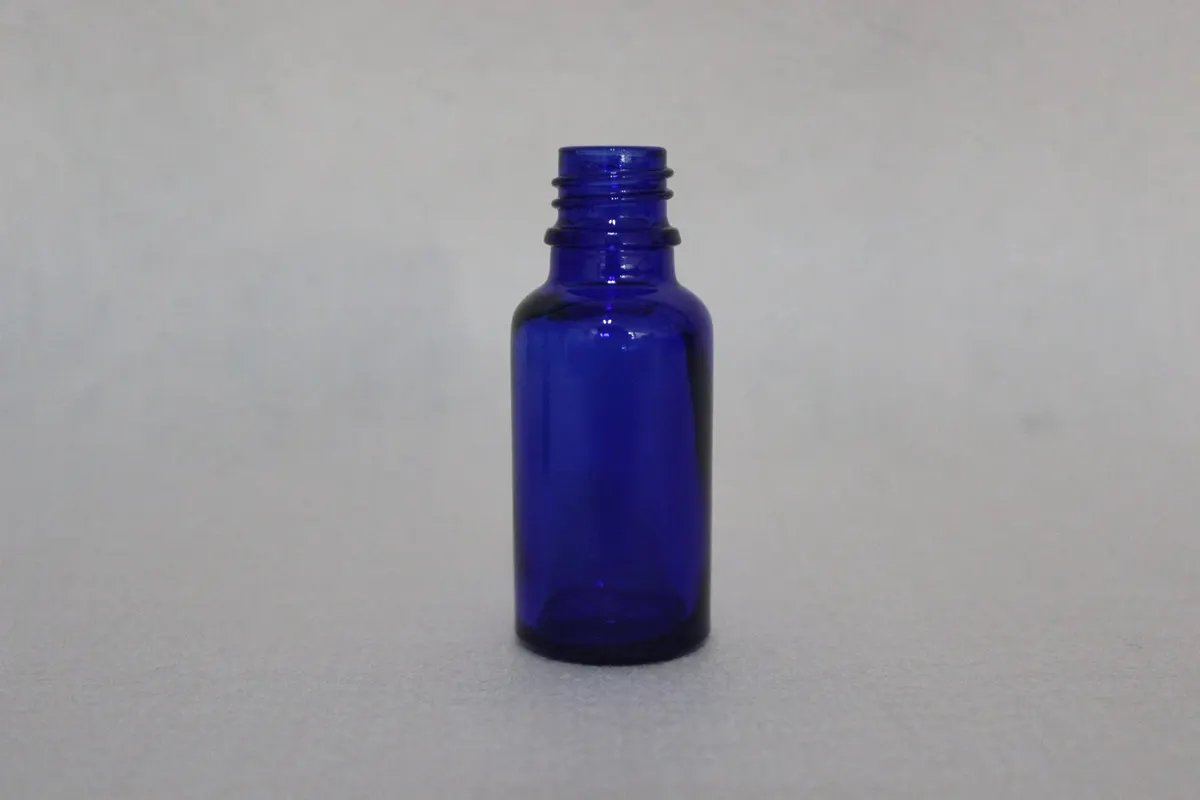
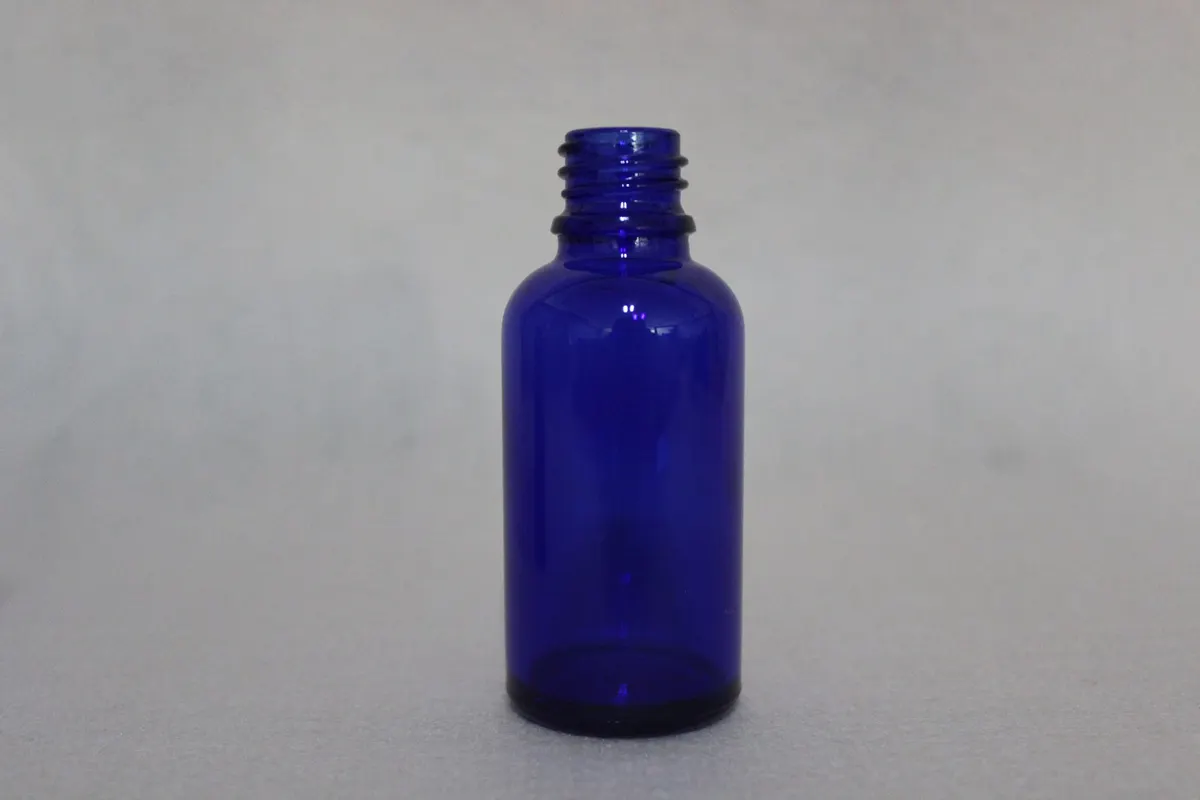
Part of our glass dropper bottles range; the stock moulds are pictured at the end of this guide.
Serum bottles run on a ladder of seven nominal capacities: 5 ml, 10 ml, 15 ml, 20 ml, 30 ml, 50 ml and 100 ml. Prestige retail in Europe and Asia centres on 15 ml, while North American retail centres on 30 ml, labelled there as 1 oz. At a planning figure of about 0.05 ml per drop, a 15 ml bottle holds roughly 300 drops and a 30 ml bottle roughly 600, and the 18 mm screw finish with a pipette graduated at 0.25 ml serves both.
Serum size chart with drop count, dose and finish
Treat the drop and application columns as planning magnitudes. They assume a 0.05 ml drop, a water-based or lightly oil-based serum and a conventional cosmetic pipette. Pipette bore, tip shape and formula viscosity all shift the real figure, so each row needs confirming by counting doses out of a filled sample.
| Nominal volume | Planning drop count | Applications at the planning dose | Typical channel | Neck finish and dropper | Weak point of the tier |
|---|---|---|---|---|---|
| 5 ml | About 100 | 25 to 33 at three or four drops (0.15 to 0.20 ml) | Beauty boxes, hotel amenities, gift inserts, starter packs for practitioners | Narrow 13 to 15 mm class neck, or an 18 mm screw finish; short pipette, frequently with a reducer insert | Fill tolerance is at its tightest and the label face at its smallest, so mandatory text goes on the carton |
| 10 ml | About 200 | 50 to 66 at three or four drops | Travel retail, subscription boxes, barcoded trial sizes | 18 mm screw finish class; pipette of standard length, sometimes with a shortened, reduced tip | Presents as a full product while pipette and carton dominate the unit cost |
| 15 ml | About 300 | 60 to 75 at four or five drops (0.20 to 0.25 ml) | European and Asian prestige and masstige retail; the anchor of a gift-with-purchase | 18 mm screw finish, now and then 20 mm; full-length pipette with 0.25 ml graduations | Often copied without re-measuring the fill; a bulb that over-doses is the usual fault |
| 20 ml | About 400 | 80 to 100 at four or five drops | Value retail, pharmacy lines, dermo-cosmetics | Screw finish of 18 to 20 mm; the tube length begins to affect how the final millilitre comes out | Sits so near 15 ml and 30 ml that a pair of tiers can pass for a picking error |
| 30 ml | About 600 | 100 to 120 at five or six drops (0.25 to 0.30 ml) | Standard retail size in North America, clinic retail, first private-label runs | 18 mm screw finish by default; 20 or 24 mm for a wider neck | Available on several finishes, so the collar has to be checked against the neck drawing |
| 50 ml | About 1000 | 125 to 165 at six to eight drops (0.30 to 0.40 ml) | Professional and backbar use, refills, value retail, family packs | Neck in the 24 to 28 mm class, or 20 mm fitted with a long pipette; buyers often weigh up a pump | Dose creep, since a big bottle invites a bigger dose and label life seldom scales with volume |
| 100 ml | About 2000 | 200 to 250 at eight to ten drops (0.40 to 0.50 ml) | Refill programmes, pro sizes, bulk value packs, supply for several months | Neck in the 24 to 28 mm class carrying a wide-bore pipette or a dispenser; most often replaced by a pump | Glass weight and freight per unit climb steeply; prestige planograms leave it out |
Millilitres, fluid ounces and why serum is sized differently
Settle the unit convention before the capacity. Bottles are specified by nominal volume in millilitres, yet in the United States a serum is usually marketed in fluid ounces. A nominal 30 ml bottle is therefore sold as 1 oz and a nominal 15 ml bottle as 0.5 oz. One US fluid ounce works out at about 29.6 ml, so the name in the catalogue and the volume in the mould are near neighbours, never the same number.
The numbers on a lotion chart do not carry over. A lotion is metered by a pump that delivers a roughly fixed volume per press and is spread over a large area. A serum is released drop by drop from a pipette, in fractions of a millilitre, and is sold on potency. It also tends to sit in glass that shields it from light.
The gap widens as the bottle shrinks. On a 200 ml lotion the label has room, the fill tolerance forgives small errors, and glass and decoration account for most of the cost per millilitre. On a 10 ml serum the label face is tens of millimetres high, the fill tolerance is tight in absolute terms and harsh as a percentage, and the pipette, bottle and carton drive the cost per millilitre.
An ampoule is sometimes filed under serum formats and does not belong there. It is a sealed single dose that is snapped open and thrown away, so it has neither closure nor pipette, and no ladder of retail capacities.
Converting volume into drops and applications
The working convention is that a standard pipette dispensing distilled water at room temperature gives roughly twenty drops per millilitre, or about 0.05 ml per drop. No real serum matches it exactly. A thin, watery formula through a narrow tip can reach nearer twenty-five drops per millilitre. With a wider tip and a formula rich in glycerin or based on oil, the count can fall to fifteen to eighteen, and lower again for a viscous concentrate. A band is the only honest figure, and it should be checked by counting doses with the actual tip and the actual formula.
The calculation has two steps. Multiply the dose in drops by the drop volume to get one application, and applications per bottle is the nominal volume divided by that. A four-drop dose at 0.05 ml comes to 0.20 ml, which puts a 15 ml bottle at something like seventy-five applications and a 30 ml bottle at something like one hundred and fifty.
Doubling the capacity does not double the value a consumer perceives. For someone who applies it twice a day, 15 ml lasts roughly five weeks and 30 ml ten weeks.
Pipette graduation is part of the same choice. With marks at 0.25, 0.5, 0.75 and 1.0 ml on the tip, the user can dose to a line and stop counting drops. A 5 ml bottle carrying a single 1 ml mark offers no fine control, and the dose drifts upward.
Matching a capacity tier to the use cycle and channel
The spacing of the ladder is uneven because each tier answers to a particular channel or use cycle.
- 5 ml is for discovery, sampling and travel. It is judged by what it costs to give away and how tidily it packs.
- 10 ml serves travel retail, subscriptions and trial retail. It is usually the smallest tier sold at full retail under its own barcode.
- 15 ml remains the most common single capacity in the category. The size warrants a glass bottle with a workable label face, yet stays small enough to suggest concentration.
- 20 ml falls between the retail hero and the value position.
- 30 ml is the professional workhorse as well as the standard North American retail size.
- 50 ml belongs to professional, backbar and value retail.
- 100 ml is a refill, pro-size or family format, normally fitted with a long pipette or a pump.
Two channels cut across the ladder and skew it. Travel retail leans toward 10 ml and 15 ml, and the clinical channel toward 30 ml and 50 ml.
Neck finish and pipette for each tier
Capacity narrows the closure choice through the pipette more than through the glass. A pipette has to satisfy three dimensions together: a collar diameter and thread that fit the neck, a length that reaches the bottom without resting on it, and a tip bore that determines drop size. The tier fixes the usable depth of the bottle and so the pipette length, and that length restricts which collar and tip combinations can actually be bought.
On the small tiers the neck is either a narrow 13 to 15 mm class or an 18 mm screw finish. The pipette is short, and a reducer insert is often added so the tip cannot bottom out. At 15 ml and 30 ml nearly everything uses the 18 mm class, paired with a full-length pipette carrying 0.25 ml graduations. At 50 ml and 100 ml the neck moves to a 24 or 28 mm class, or stays at 20 mm with an unusually long pipette, and a pump becomes a realistic alternative.
Confirm the pairing before artwork starts. Changing the finish once the mould is cut normally means a new pipette collar in addition to a new bottle.
Two mechanical details that get underestimated
The pipette must not rest on the base. Touching the glass puts load on the tip and cuts the bulb's compression travel, so the tube is normally cut to stop a few millimetres above the bottom. The consequence is that the last few millilitres are difficult to draw out.
Collar and neck also have to agree on the sealing land, and thread fit alone is not enough. With a serum that contains alcohol or oil, a mismatch appears as weeping at the shoulder and not as an obvious leak. Our guide to glass bottle dropper assembly covers the assembly sequence and tube-cut length.
How small and large tiers differ as packaging problems
The changeover comes at around 30 ml. Below it and above it the pack behaves differently, so a range running from 5 ml to 100 ml is really two sub-ranges under one brand. Expect two families of pipette, two cartons and, in many cases, two fill routes.
| Aspect | Small tiers (5 ml, 10 ml) | Large tiers (50 ml, 100 ml) |
|---|---|---|
| Where the cost sits | Hardware: pipette, collar, reducer and carton take a disproportionate share | Glass body, weight and volume of the packed case, and freight per unit; the pipette is a minor share |
| Fill accuracy | Measured on a tiny absolute quantity, so nozzle drip, neck residue and scale resolution eat much of the tolerance | Easier in percentage terms, though filling takes longer |
| Visible quality issue | Viscosity changes: a tip that works on a thin serum may bridge or string once the formula thickens | The fill line shows in a bottle with wide shoulders, so headspace and consistency from one bottle to the next are what the buyer sees |
| Decoration and label | Small silk-screen areas or a body wrap; full mandatory text often moves to a carton, leaflet or booklet label | Room for the statement on the primary pack |
| Closure life | Short use cycle | Used across many months, so the closure must survive hundreds of open and close cycles |
Light protection and the smallest tier
Light protection is normally treated as a question of glass colour, but capacity plays into it through surface area. A small bottle has a high ratio of surface area to volume. In a 5 ml bottle a formula has proportionally more glass wall around it than in a 50 ml bottle, and receives proportionally more light through that wall. For a formula with light-sensitive actives, the smallest tier of the range is where protection counts most.
The options are these:
- Amber glass blocks UV and short visible wavelengths and is the usual choice for the retail tiers from 15 to 30 ml.
- Violet glass is sold on a narrower argument about which light it filters. Treat the specific claim as a supplier statement to verify.
- Compromises on clear glass include a sleeve or a full-body label, and the alternative is a body that is opaque or heavily coated. Cost and shelf presence differ for each.
These choices feed back into capacity. Sleeves and coatings change both case weight and the label area you can use. Making the glass opaque also hides the product, and the smallest tier suffers most from that. Whether a particular formula is stable is a matter for the formulator and stability testing.
Fill tolerance, label space and case logistics
Net quantity and overfill
Cosmetic liquids are generally filled to a target weight on a checkweigher or by a volumetric filler. The tolerance with commercial weight is the one on net quantity, because a pack under its declared quantity is a compliance failure. A 5 ml target under a conventional filling tolerance leaves a very small absolute band. Small tiers therefore tend to run a higher percentage of overfill than large ones, which is a direct cost when the product is a high-value concentrate.
Label face
Mandatory information has a minimum type size relative to the label. A bottle between 5 ml and 10 ml cannot physically hold a full ingredient list at that size on the primary pack. The normal answer is a carton, leaflet, booklet or tag, and each adds a component, a print cost and an assembly step. The smallest tier in a range is often decided by the label and not by the product.
Net content printed on the bottle is a nominal quantity in millilitres or fluid ounces according to the market, under the cosmetic labelling rules that apply there. Confirm the framework for a given product and market with whoever is responsible for compliance, and do not infer it from a supplier summary.
Cases and freight
Glass weights vary widely between 5 ml and 100 ml. A case count picked for the retail tier is seldom right for the sample tier, and freight per unit peaks at the small end, which is the reverse of what most buyers assume.
Sizing mistakes that lead to a wrong order
- Confusing an ounce name with a millilitre volume. The bottle sold as 1 oz has a nominal volume of 30 ml and was never moulded to 29.6 ml. Mixing conventions yields declarations that disagree with the product name.
- Taking drop size as fixed. Twenty drops per millilitre is a convention for planning. A change of tip or formulation can shift the dose count by a third.
- Sizing only to a price point. The capacity that hits the price band is often too small for the mandatory label, and the carton it then needs forces a repriced unit.
- Choosing capacity ahead of the closure family. A dropper and a pump share neither finish nor collar, so deciding the closure after the bottle is drawn becomes a tooling decision.
- Overlooking pipette length on the biggest tier. A tube that reaches the base loads the tip and disturbs the seal. A short one leaves the final fraction of the bottle unusable.
- Counting overfill as free. Small tiers need proportionally more of it to stay above the declared net quantity.
- Copying a competitor's chart with no fill trial. A published capacity tells you what the mould holds. It says nothing about what the fill line delivers or how many doses reach the consumer.
Capacity in kits and refill programmes
A kit works when the steps between its units are obvious. A pair on 15 ml and 30 ml looks deliberate. Two units of the same 15 ml bottle, or a 15 ml with a 20 ml, look like a picking error. In a four-piece routine set, the treatment step is commonly 5 ml or 10 ml and the daily steps 15 ml or 30 ml.
Whether a set gets through production comes down to three mechanical rules:
- Keep every bottle in one neck finish class. A single pipette collar and a single capping head then cover the whole set.
- All bottles share a closure family, so the set does not contain two closures that open in different ways.
- The box cavity is sized on the widest point of the finished pack. On a serum bottle that is normally the pipette collar or the capped shoulder, not the body.
A refill programme is the same exercise in reverse with one more constraint. The refill unit needs a standard finish that can be filled, a removable pipette and a bottle that withstands cleaning, which limits the finishes and decorations on offer. Programmes normally settle on one or two capacities and print the capacity prominently, since the consumer already owns the outer pack. In both cases, settle secondary packaging together with the capacity.
What to send for a capacity recommendation
A sizing question turns into a procurement enquiry once any one of four things is fixed:
- A neck finish, which constrains the mould, the pipette collar and the fill route together.
- A decoration, since a coating, frost or sleeve changes the label face and may change which capacity can carry the mandatory text.
- A secondary pack, because the tray or box cavity limits cap diameter and fixes the spacing between bottles.
- A market and channel, which together bring labelling and net quantity obligations of their own.
From that point a drawing check and a filled sample are worth more than further discussion. A sample filled with the real formula and dispensed through the real pipette shows how many drops the dose actually is and how the fill line looks in that bottle shape. The Glass Packaging Institute and equivalent bodies publish standard finish dimensions, and ISTA and similar transit protocols are widely referenced for this category. Naming a standard is not the same as saying a given pack or supplier is certified to it.
For a capacity band and a pipette direction, send us three things:
- Category. The same tip gives different drop counts with a thin aqueous serum, a hydrating serum rich in glycerin, and a treatment based on oil.
- Dose per use. This converts nominal volume into applications and so into the length of the use cycle.
- Channel. The tier and pack hardware that suit a beauty box differ from those for travel retail, a pharmacy planogram or a professional backbar.
The destination market and the existing or planned closure narrow things fastest, since the unit convention, the labelling rules and the family of neck finish all follow from them. If the closure is already tooled, include the collar drawing, since an existing collar often decides the final capacity. Order quantity, tooling, mould ownership, decoration setup and timing are quoted per project against a specific drawing and run.
Once the volume is settled, the serum glass bottle wholesale range shows the formats and commercial options, and the serum and dropper bottle application page gathers bodies supplied with a pipette. The dropper bottle overview takes in pipette-closed formats outside the serum category. If the closure type itself is undecided, see the comparison of droppers and pumps for cosmetic bottles.
Frequently asked questions about serum bottle sizes
What is the most common serum bottle size?
Most of the category sits in the 15 ml and 30 ml tiers. The 30 ml size is also the most frequent choice for a first private-label run. The right one depends on how long the bottle should last at the intended dose.
How many drops are in a 30 ml serum bottle?
Of the order of six hundred at the planning convention, assuming a water-like liquid. A thin aqueous serum through a narrow tip can give about seven hundred and fifty. With an oil-based or glycerin-heavy formula and a wider tip the yield is about four hundred and fifty to five hundred and forty. Count doses from a filled sample before printing a figure.
Is a 1 oz serum bottle the same as 30 ml?
For catalogue purposes, yes: the mould is described by a round nominal figure. They are still two different quantities, which becomes important once a net quantity declaration goes on the pack. If one market sells the range in fluid ounces and another in millilitres, set a single conversion rule and prepare two sets of artwork.
Does a larger serum bottle cost less per millilitre?
On glass alone it usually does, since mould cost, decoration setup and handling are spread over more product. On the finished pack it may not. Pipette, collar, carton, filling and capping do not scale with volume, so a 100 ml pack often lands nearer a mid-size pack than the volume gap implies, particularly if it needs a pump, a heavier case and more freight per unit.
Does the pipette change with bottle capacity?
Yes, in tube length and in tip bore. Length follows the usable depth of the bottle, and bore follows the intended drop size and the formula's viscosity. A small tier takes a short tube, often steadied by a reducer. A large tier takes a long tube and a wider bore, which keeps the dose to a manageable number of drops.
Can a 100 ml bottle use the same dropper as a 30 ml bottle?
Rarely, unless a part is changed. The collar may fit if both share a neck finish, but a tube cut for 30 ml will not reach the product in a 100 ml bottle. A longer tube also changes how the bulb behaves, since lifting the product takes more force and dosing can turn inconsistent. Large tiers generally move to a long-bore pipette sized for the bottle, or to a pump.