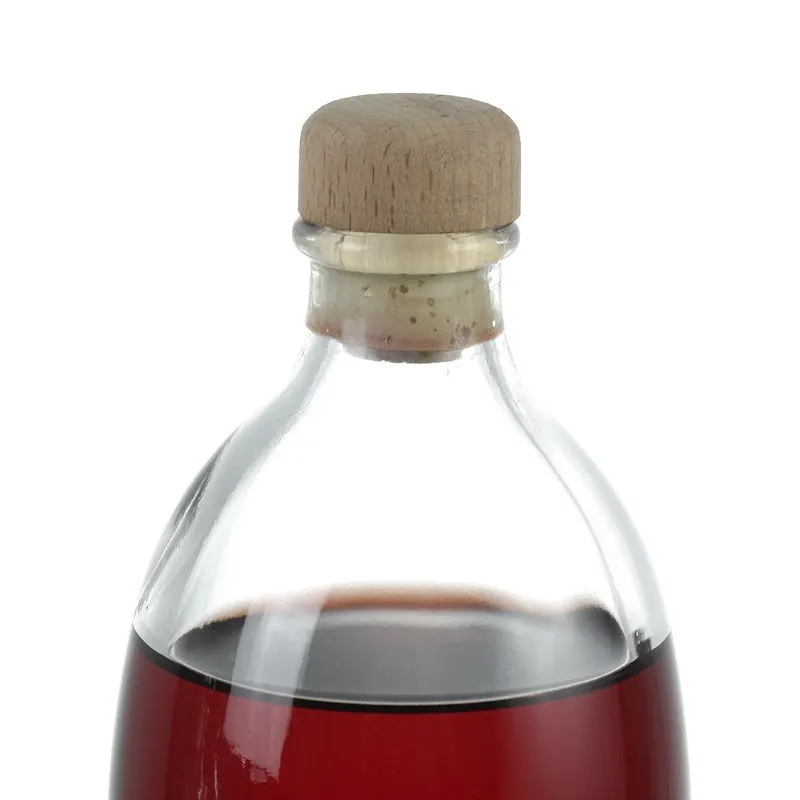
Part of our empty whiskey bottles range; the stock moulds are pictured at the end of this guide.
Quick answer
What size is a standard whiskey bottle?
In the United States the standard full-size whiskey bottle is 750 ml, about 25.4 US fluid ounces; it replaced the fifth of a gallon (about 757 ml), which is why it is still called a fifth. In the European Union and the United Kingdom the standard full size is 700 ml. US standards of fill are set in 27 CFR Part 5 and have been revised in recent years, so check the rule in force before the label is approved.
| Size | Main use |
|---|---|
| 50 ml | Miniature: airline, hotel, gift with purchase |
| 375 ml | Half bottle: trial, gift sets, single-serve releases |
| 700 ml | Full size in the EU and UK |
| 750 ml | Full size in the US |
| 1 L | Travel retail and duty free |
| 1.75 L | Large US value format |
This page is for the buyer who has a spirit to bottle and has to decide which volumes the range will be sold in, before any drawing is signed. It is written as a reference on the capacity family as a whole: what each volume band is used for, which markets habitually buy which one, which bottle shapes go with which volume, and what each band implies for the closure and for the weight in the hand. It is not a single-specification page. This site already carries a dedicated page for the 750 ml liquor bottle that works through finish geometry, punt depth, closure seating and tolerance in detail, and a separate page for small-format liquor bottles that covers container loading, cushioning, breakage rates, freight terms and landed cost per bottle. Neither of those is repeated here. What this page covers is the span: how 375 ml, 700 ml, 750 ml and 1 litre behave differently as commercial objects, why the same brand can need two of them for two markets, and which questions have to be answered before a capacity is fixed.
What a Whiskey Bottle Size Tells a Buyer, and What It Does Not
A capacity is a share of a market before it is a volume of liquid. When a supermarket in one country lists spirits by price per litre, the shelf is a rational place and the brands on it converge on the volume that gives the best price per litre at a price point the shopper will accept. When a specialist retailer lists spirits by brand story, the shelf is an emotional place and the volume is chosen to make the price feel appropriate to the story. Those two shelves want different bottles, and a brand that tries to serve both with one mould usually ends up with a bottle that is right for neither.
What a capacity figure does not tell you is the fill height, the label panel height, the carton size, the pallet pattern, the closure, the base weight, or whether the destination market permits that volume at all. Two bottles both described as 750 ml can differ by tens of millimetres in height and by a hundred grams in weight, and those differences decide everything downstream. A buyer who treats the capacity as the whole specification and leaves the rest to the supplier is choosing to discover the remaining variables after tooling, which is the most expensive place to discover them.
There is also a labelling consequence that sits inside the capacity decision. In most markets the net quantity has to be declared in metric units on the label, and in several markets the permitted nominal quantities for spirit drinks are defined rather than free. That means a capacity decision is partly a compliance decision, and it is made with the destination market in view rather than with the brand’s own preferences. Confirm the permitted volumes for each market you intend to sell into, and confirm whether the labelling rules require the figure in metric alone or permit a supplementary unit.
The Capacity Family in Numbers: 50 ml Through 1 Liter
50 ml and 100 ml. These are the sample and miniature bands. The 50 ml miniature is the airline and hotel format and the gift-with-purchase format, and it is usually specified with the same silhouette as the full-size bottle so that the miniature reads as a small version of the brand rather than as a generic jar. At this scale the closure dominates the object: a miniature cork with a wooden or plastic head is often taller than the liquid column, and the label has very little usable panel. Because the volume is small, the fill accuracy relative to the declared quantity is a tighter problem in percentage terms than on a large bottle, and a small dimensional error in the mould shows up as a visible fill variation. The 100 ml band adds the travel retail and gift-set role, and it is large enough to carry a legible front label, which is why 100 ml is often preferred over 50 ml for anything sold at a counter rather than handed out.
200 ml. The 200 ml band sits between the miniature and the half bottle and does most of its work in gift packaging and in markets where a two-person serve is the typical purchase. In the United States this volume was historically nicknamed the half pint, a pre-metric trade term that is inaccurate as a measurement and should not be used in specifications. The useful property of 200 ml is that it fits a small carton with a booklet or a pair of glasses without the carton becoming the dominant cost.
375 ml. The 375 ml half bottle is the most useful small retail format in spirits, because it is large enough to be a real product and small enough to be an impulse purchase. It is used for trial, for single-serve premium releases, for gift sets, and for bars that want a small allocation of a rare expression. In the US trade this size is loosely called a pint, which is a legacy term rather than a measurement; the metric figure is the number that belongs on the label and on the drawing. The shape convention at 375 ml leans toward a flask or a flask-like flat oval, because the bottle is short relative to its width and a tall shoulder would make it look stumpy. Note that a 375 ml glass body is not simply a 750 ml body scaled in half; the neck, closure and label panel are different proportions.
500 ml. The 500 ml band appears where the market expects a mid-value size. It is used in some export markets and by brands that want a price point between the half bottle and the full bottle. It is less standardised than the neighbouring bands, so the closure and carton often have to be developed for it rather than inherited from an existing format, which makes it a more expensive band to add than its volume suggests.
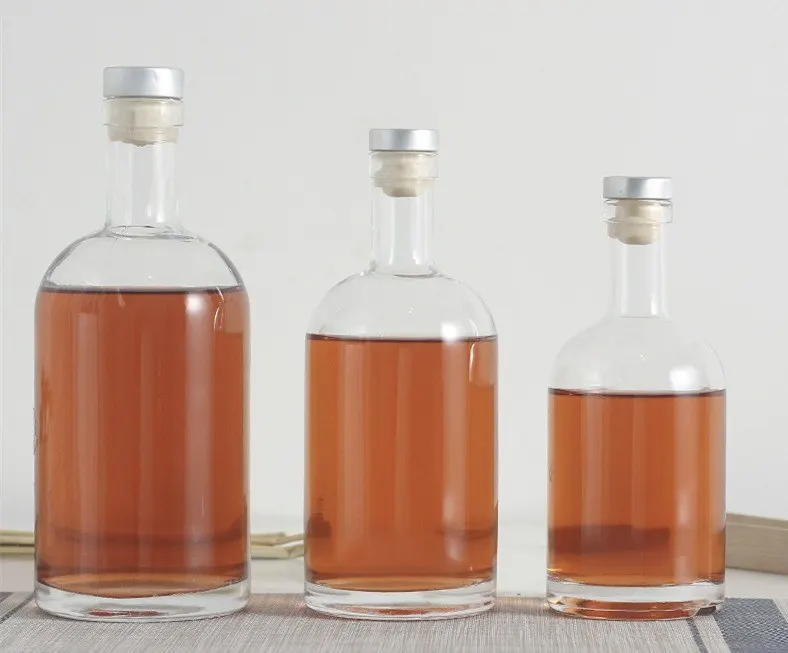
700 ml. The 700 ml bottle is the standard full-size spirits format across the European Union and the United Kingdom and in most markets that have followed European practice. It is the volume that the on-trade and off-trade both know, and it is the volume that the majority of export enquiries from those markets will specify. Because 700 ml is slightly shorter than 750 ml, a brand selling the same expression in Europe and in the United States cannot always use one mould for both unless the design deliberately holds the height and absorbs the difference in fill height, which in turn changes the appearance of the fill level through the glass.
750 ml. The 750 ml bottle is the standard United States full-size format and is widely used across the Americas and in export markets that have aligned to US practice. The number has a pre-metric ancestor: the fifth of a gallon, which was one fifth of a US gallon at approximately 757 ml. The metric 750 ml replaced it, and the old nickname survived the change, which is why the term fifth still appears in trade conversation while the label carries 750 ml. In fluid ounce terms, 750 ml is about 25.4 US fluid ounces, and the difference between a US fluid ounce at about 29.6 ml and an imperial fluid ounce at about 28.4 ml is one of the most common sources of confusion when a brand is adapting artwork from another market.
1000 ml. The one litre bottle is the travel retail and duty free format, and it also appears in domestic markets where a generous size is expected. In travel retail the litre does commercial work that no other volume does, because the channel exists to remove duty and the shopper is comparing value per litre against a home-market price. A litre bottle is not a 750 ml bottle with more glass; the taller body changes the label proportions, the carton, the case count and the pallet build, and the hand feel is different because the centre of gravity rises. Above the litre, the large-format band exists mainly in the United States, where the half gallon at 1.75 litres remains a value format in a few categories.
Market Rules: Why 750 ml and 700 ml Both Survive
The reason two full-size formats coexist is that two regulatory traditions defined their own permitted quantities and both are large enough to support tooling. In the United States, the standards of fill for distilled spirits at 27 CFR Part 5 have historically been the reference point that buyers design to, and the sizes that appear in US enquiries still cluster around that heritage list. Those rules have been revised in recent years, so the current position on permitted volumes should be confirmed against the regulation in force at the time of your label approval rather than taken from any list published on a supplier site, including this one.
In the European Union, the presentation and labelling of spirit drinks is governed by Regulation (EU) 2019/787, which sits alongside general food information rules and the measuring rules for pre-packed products. The practical effect is that popular volumes for spirits in those markets are well established and 700 ml is the dominant full-size format, with 500 ml, 1000 ml and larger sizes present as secondary formats. Not every volume that can be filled can also be presented as a spirit drink in every market, and not every label claim travels, so the capacity shortlist should be built market by market rather than once for the whole range.
Two further market effects are worth naming. First, labelling in a market that requires both a metric net quantity and a supplementary unit changes the front label area, which interacts with the smallest band far more than with the full-size band. Second, excise and duty structures can make an intermediate volume attractive in one country and irrelevant in another, which is how a 500 ml or a 1 litre format becomes a domestic standard in one market and a specialty in the next. Neither effect can be resolved by the glass supplier; both change what the glass has to be.
Shape and Closure Follow Volume: Shoulder, Body, Punt and Stopper
Shoulder. The shoulder is where the bottle meets the neck and it is the first thing a shopper reads as a shape. A sloping round shoulder belongs to the traditional Scotch and Irish silhouette and reads as heritage. A square or squared-off shoulder on a rectangular body reads as American whiskey and shelves efficiently because the front face is flat and the label area is generous. A flat flask at 375 ml reads as a hip flask and is carried rather than poured from a bar trolley. The shoulder choice is also a glass-distribution choice: a squared shoulder is harder to fill with even wall thickness than a sloping round one, and the resulting distribution shows up later as breakage or as weight variation.
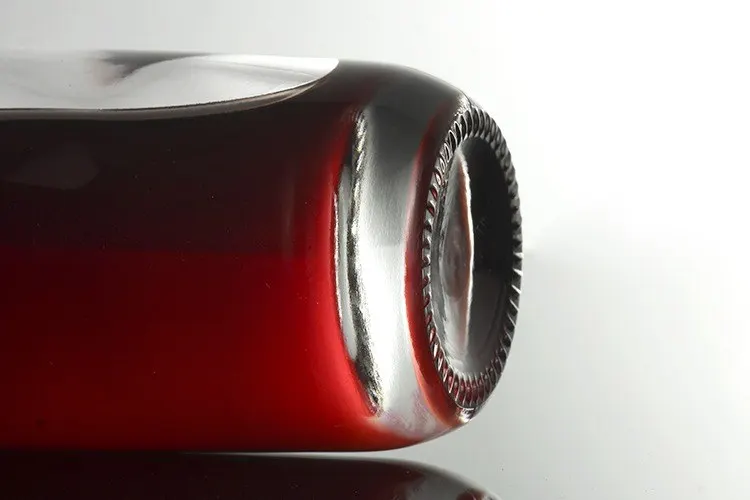
Punt. The punt is the concave push-up in the base, and its depth is a hand feel decision before it is a structural one. A shallow punt with a wide standing ring is stable on a conveyor, cheaper in glass and easy to inspect. A deep punt raises the apparent quality of the bottle in the hand, adds glass weight and lowers the centre of gravity, which helps a tall 1 litre body on a fast line. Depth also consumes internal volume, which means the brimful capacity has to be designed with the punt in place rather than added afterwards. On any premium brief the punt depth belongs in the drawing conversation, not in a reorder note.
Closure family. Three families cover most whiskey work. A natural or technical cork with a capsule seals by compression against the bore, so it requires a genuine cork finish with the right internal profile and the right bore, and the insertion depth has to be defined. An aluminium or plastic screw cap seals consistently, reseals repeatedly, and is the default on value and travel formats and in markets where the consumer expects to close the bottle and put it back on the shelf. A bar-top closure, in which a cork or synthetic shank carries a decorative head, is the common premium solution and combines cork performance with a resalable head. Separately, a pourer insert or a measured pourer changes the flow at the bar and occupies part of the neck, which affects the fill height and can interfere with a cork if it is not designed as part of the assembly. Closure choice is a function of the band as much as of the brand: a 50 ml miniature cannot carry the same closure as a 700 ml bottle, because the cork head would dominate the object, and a 1 litre duty-free bottle usually benefits from a closure that survives repeated opening in a hotel room.
The Capacity, Market, Shape and Closure Reference Table
The table is a shortlist for the first commercial conversation, not a specification. Volumes cluster rather than being fixed by the table, shapes are conventions rather than rules, and the weight column is a positioning band rather than a number. The signed drawing governs every dimension in the order.
| Volume and market convention | Main markets and buying habits | Common bottle shapes (shoulder and base) | Suggested closure | Reference body weight and hand-feel positioning | What to confirm with the factory |
|---|---|---|---|---|---|
| 50 ml | Airline, hotel and gift-with-purchase sampling; counter giveaways; collector miniatures | Miniature version of the full-size silhouette, sloping shoulder, shallow flat base | Screw cap or a short bar-top cork with a compact head | Light by necessity; the object must feel like a small version of the brand, not a generic vial | Fill accuracy at this volume, closure height relative to the body, label panel available after the mandatory text |
| 100 ml | Travel retail sampling, gift sets, gift-with-purchase at a higher value tier | Sloping shoulder or a squat round body, flat base with a shallow punt | Screw cap, or a bar-top cork with a modest head | Light to medium, chosen so the closure does not look oversized next to the body | Whether the closure family is shared with the 50 ml band or is a separate part, and the carton height it produces |
| 200 ml | Gift packaging, two-person serve purchases, markets that favour a small premium unit | Round or oval with a medium shoulder, gently dished base | Cork with a capsule, or a screw cap where resealability is the priority | Medium; weight is added at the base to keep the bottle from feeling hollow | Bore and insertion depth if cork is used, carton cavity for a booklet or accessory, case count |
| 375 ml | US half-bottle trade, trial and impulse, single-serve premium releases, bar allocations | Flask or flat oval as the convention; round with a sloping shoulder for value lines | Screw cap or bar-top cork; a pourer only on the on-trade version | Medium; the short body needs proportionally more glass in the base to stand convincingly | Shoulder height against label panel, whether the design reads as a scaled full-size or as its own format, pallet pattern |
| 500 ml | Selected export markets, mid-value shelf position between half bottle and full bottle | Often inherited from a neighbouring format, round with a medium shoulder | Screw cap is the practical default | Medium to heavy; this band is often where a brand first adds visible weight | Whether an existing mould can be used, because a purpose-built 500 ml format carries its own tooling route |
| 700 ml | European Union, United Kingdom and most markets that follow European practice; on-trade and off-trade | Sloping round shoulder for the heritage silhouette, square shoulder for a flat label face, base with a moderate to deep punt | Cork with a capsule, or bar-top; screw cap on value tiers | Medium to heavy; punt depth and shoulder weight do the premium work at this band | Punt depth against brimful capacity, cork bore and finish profile, and whether the height can be shared with a 750 ml drawing |
| 750 ml | United States standard, Americas, export markets aligned to US practice | Round sloping shoulder, square or rectangular body, base with a punt ranging from shallow to deep | Cork with a capsule or bar-top cork; screw cap on value and travel formats | Medium to heavy, with base weight as the main lever on perceived quality | Height shared with a 700 ml variant or a separate drawing, closure seating and torque, label panel and case dimensions |
| 1000 ml | Travel retail and duty free as the primary channel, plus domestic markets that expect a generous size | Tall version of the full-size silhouette, round or square, deep punt for stability | Screw cap for repeated opening, or a bar-top cork on a premium expression | Heavy; the taller body needs a lower centre of gravity to handle well on a fast line | Carton and pallet build, taller-body stability on the line, and whether the closure is rated for the repeated opening the channel implies |
Where These Numbers Are Misused
Treating ounces and millilitres as interchangeable. A 750 ml bottle is about 25.4 US fluid ounces, not 25, and an imperial fluid ounce is materially smaller than a US one. Artwork adapted from another market frequently carries the wrong supplementary figure, and the error survives review because both numbers look plausible. Convert once, from the metric figure that appears on the drawing, and check the conversion against the labelling rules of the destination market.
Using trade nicknames as specifications. Pint, half pint, fifth and half gallon are pre-metric American trade terms. They remain in conversation and they are not measurements. A specification, a purchase order or a drawing that uses them invites a mismatch, and the metric net quantity is what the label has to carry in most markets. Write the millilitre figure, and write it on every document.
Assuming 700 ml and 750 ml are the same bottle. They are close enough to confuse a spreadsheet and different enough to change a line. If the height is held and the fill height is lowered to create a 700 ml version, the ullage becomes visible through the glass and can read as an under-filled bottle on a shelf where the consumer has learned what a full fill looks like. If the height is shortened, the label panel, the carton and the pallet build all move with it. Either way the decision is a drawing decision and it should be made once, with both markets in view.
Assuming larger means more premium. Perceived quality in spirits comes from base weight, punt depth, shoulder mass and the way the glass catches light, not from volume. A heavy 375 ml bottle reads as more serious than a thin 1 litre bottle, and a band added purely to look generous usually delivers the opposite impression while raising freight. Choose the band for the channel and use the drawing to set the weight.
Assuming one case count covers the range. Case count, inner partition and pallet build derive from the bottle footprint and the carton dimensions, and those change with every band. A range with four capacities can end up with four different cartons and three different pallet patterns, which is a real cost that is invisible in a per-bottle quotation. Ask for the case and pallet arithmetic at the same time as the bottle price, because that is the number that reaches the warehouse.
When a Sizing Question Becomes a Sourcing Question
A capacity question turns into a sourcing question at four points. The first is when no existing mould matches the volume, the shape and the market in combination, at which case the answer is a drawing rather than a catalogue. The second is when the closure is not a standard screw or cork but a designed stopper, a bar-top head or a decorated capsule, because a bespoke closure changes the finish and therefore the mould. The third is when decoration is part of the brief, since embossing, frosting and coating all interact with the shoulder profile and with the label area. The fourth is when the destination market’s permitted volumes have to be verified before the answer is final, because a capacity that cannot be labelled cannot be sold, whatever the drawing says.
This page stops at the point where the band is chosen. The single-size detail for the full-size format, including finish geometry, punt depth, closure seating, wall distribution and inspection method, belongs to the page on the 750 ml liquor bottle specification, and it should be read before a full-size drawing is frozen. The commercial side of small formats, including cushioning, breakage rates, container loading and landed cost per bottle, belongs to the page on small-format liquor bottle sourcing, because those bands are freight-sensitive in a way the full-size band is not. The wider picture of glass types, neck finishes and pack routes across the category sits on the liquor bottle range page, which is the hub this article belongs to. And when the range is ready to be ordered rather than designed, the whiskey bottle wholesale supply page is the route into a quotation.
Frequently Asked Questions About Whiskey Bottle Sizes
What is the standard whiskey bottle size in the United States?
The 750 ml bottle is the standard full-size format, alongside 375 ml for the half bottle and 1.75 litres for the large value format. The size descends from the pre-metric fifth of a gallon, which was about 757 ml, and the old nickname survived the move to metric. The permitted volumes for distilled spirits are set by the standards of fill, and those rules have been revised in recent years, so confirm the current position for your product and market before the artwork is signed.
Why are European whiskey bottles 700 ml instead of 750 ml?
Because the permitted nominal quantities and the market conventions in the European Union settled on 700 ml as the dominant full-size spirits format. It is the volume that both the on-trade and the off-trade in those markets buy habitually, and a brand selling into the European Union will normally be asked for it. It is not a smaller version of an American standard; it is its own format with its own proportions, and where the same brand sells in both markets the drawing decision has to be taken deliberately rather than by scaling one mould.
Is a 375 ml bottle of whiskey a pint?
No. A US pint is about 473 ml, and an imperial pint is about 568 ml, so the nickname is a legacy trade term rather than a measurement. The 375 ml size is a half bottle, and the metric figure is what belongs on the specification, the purchase order and the label. Using the nickname in a drawing or a quotation is a reliable way to receive the wrong bottle, because the term is used inconsistently across suppliers and across markets.
Does a deeper punt make a bottle feel more premium?
It contributes to that impression, along with base weight, shoulder mass and the distribution of glass through the body. A deep punt lowers the centre of gravity, which helps a tall bottle on a fast line, and it consumes internal volume, so the brimful capacity has to be designed with the punt in place. Depth is also a cost, because it is glass that adds weight without adding liquid. Treat punt depth as part of the drawing brief rather than as a reorder option.
Can one bottle mould serve both a 700 ml and a 750 ml market?
Sometimes, if the height is held and the difference is absorbed in the fill height, but the visible fill level and the declared net quantity both change, and the ullage can read as an under-filled bottle on a shelf. The alternative is two heights and therefore two drawings, two cartons and a second pallet pattern. Neither route is wrong. What fails is deciding by default, which is why the two markets should be named in the same brief before the drawing is frozen.
Which closure should a whiskey bottle use?
It depends on the band and the channel. A natural or technical cork with a capsule is the traditional premium choice and requires a genuine cork finish with a defined bore and insertion depth. A screw cap reseals reliably and is the default on value, miniatures and travel formats. A bar-top closure combines a cork or synthetic shank with a decorative head and covers most premium requirements. A pourer or measured pourer belongs to the on-trade and takes up part of the neck, so it has to be designed into the fill height rather than fitted afterwards.
What should a buyer confirm before commissioning a whiskey bottle drawing?
The destination markets and the volumes permitted in each, the capacity band and the fill height, the bottle shape including shoulder type and punt depth, the closure family with its finish and bore, the label panel and mandatory panel dimensions, the base weight and glass distribution target, the case count and pallet build, and the container loading for the band. Where a requirement is not yet settled, name it, because the open items are usually the ones that decide the drawing and they are cheapest to resolve before tooling.
Send the Destination Market, the Capacity Band and the Closure Preference
Three items produce a specific answer rather than a catalogue response: the destination market or markets, the capacity bands being considered, and the closure preference or the reason for it. Adding the spirit type and the intended price tier allows the shape, the punt depth and the weight positioning to be discussed in the same pass, and adding the annual volume and the target channel allows the case and pallet arithmetic to be included. Where the volume is still undecided, send the shortlist instead, because comparing two bands against one drawing is a normal part of the conversation and it is far cheaper than comparing two moulds. Quantities, tooling and commercial terms are confirmed against your enquiry, since the glass, the closure and any decoration each carry their own minimum.