Filed under vodka bottles wholesale; the moulds we quote for this are pictured at the foot of the page.
A label sits flat on a gin bottle only where the glass is a true cylinder or a known cone, so begin with the label panel on the bottle drawing and build the artwork inside it. On a round 750 ml bottle that panel is typically 90–120 mm high, and a diameter drift of ±0.8 mm on an 85 mm body shifts the wrap length by ±2.5 mm. Wrinkling at the shoulder, skew on a taper and lifting in an ice bucket are rarely printing faults. They come from artwork, adhesive and glass geometry that were never matched.
Three figures to take from the bottle drawing
The label panel is the zone where the surface is cylindrical or conical enough to take a label without creasing. Its form depends on the silhouette:
- Round Oslo-style 750 ml: a cylindrical band, usually 90–120 mm tall.
- Square bottles: flat faces bounded by corner radii of 8–15 mm.
- Tapered apothecary shapes: a cone, which calls for a fan-shaped die.
From the drawing you need the panel height and width, the taper angle and the diameter tolerance across a production batch. The taper angle fixes the die shape. A rectangular label on a tapered body will wrinkle at its edges however carefully it is applied.
Diameter tolerance is the figure most often overlooked. The ±2.5 mm change in wrap length mentioned above is enough to turn a butt join into an overlap or an open gap. If the design wraps the full circumference, ask for measured tolerances and not only nominal ones. For each gin mould we provide a label-panel drawing that marks the usable zone, the recommended die shape and the measured tolerances. The capacities and silhouettes that determine these panels are listed in the gin bottle size guide.
Wet-glue paper or pressure-sensitive labels
Wet-glue paper is the standard on high-volume spirits lines. The material is inexpensive, rotary labelers run at 20,000+ bottles per hour, and uncoated paper gives the matte, tactile surface that heritage brands like. It is also demanding: the panel geometry has to be exact, condensation during a cold application stops the glue bonding, and paper lacking wet-strength treatment falls apart in an ice bucket.
Pressure-sensitive (self-adhesive) labels cost more per label and give more freedom. They take textured and coated papers, metallic films and clear films for a no-label look, and they run on simpler equipment. The technical decision is the adhesive: a permanent acrylic for ambient shelf conditions, a water-resistant system for refrigeration and ice service, and a high-tack grade where the label crosses heavy embossing.
| Factor | Wet-glue paper | Pressure-sensitive |
|---|---|---|
| Economic volume | 30,000+ per run | 5,000–50,000 per run |
| Facestock | Paper only | Paper, film, metallized, clear |
| Ice bucket | Requires wet-strength paper | Survives with a water-resistant adhesive |
| Labeling equipment | Rotary wet-glue labeler | Standard PS labeler, lower capex |
| Appearance | Matte, heritage | Any finish, including no-label look |
Plenty of gin brands use both, with pressure-sensitive labels on premium SKUs and wet glue on the high-volume pouring gin.
Decorating the glass directly
Decoration applied to the glass avoids the label panel problem altogether, though each process has a geometric limit of its own.
| Decoration | What the geometry must allow |
|---|---|
| Wet-glue paper label | A true cylindrical or conical panel |
| Pressure-sensitive label | A panel, with adhesive matched to service conditions |
| Spray coating | No limit; it follows any curve |
| Screen print (ACL), 1–3 colors | Wrap or spot zones as shown on the drawing |
| Hot foil stamping | A contact zone that is locally flat |
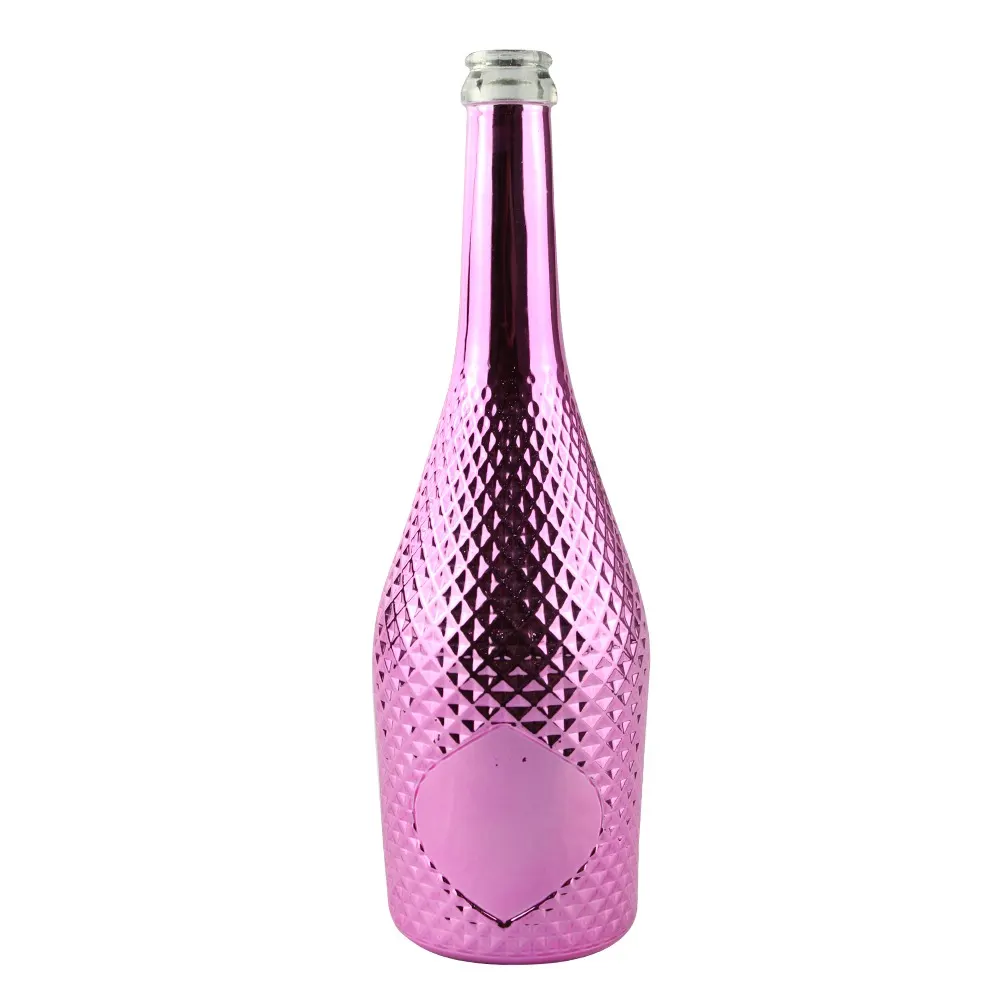
| Electroplating | Whole body, with the closure zone masked |
Spray coating gives matte, gloss, gradient or metallic colour on any shape. Screen printing, also called applied ceramic labeling or ACL, fires ceramic ink onto the bottle at 560–620 °C. The print cannot scuff, peel or wrinkle, which is why it is common on spirits for travel retail. It works best for bold designs, and brands often pair a printed brand mark with a small paper label that carries batch numbers.
Hot foil adds mirror-bright metallic accents but needs a zone that can be pressed flat, so foil position should be discussed when the mould is designed. Embossing is cut into the mould and gives relief that no label can copy. Electroplating turns the whole body into a mirror-metal surface. Frosting or acid-etch effects and full-body shrink sleeves complete the list.
Cold, wet and humid service
Labels that bubble or lift usually point to an adhesive or surface mismatch. Standard acrylic adhesives lose tack when applied below about 10 °C. On a cold-fill line, condensation prevents any bond, so bottles have to be dry and warmer than the adhesive's minimum application temperature at the labeler.
For ice-bucket service, specify a water-resistant adhesive on film or wet-strength paper. Film also conforms better than paper on compound curves. The treatment on the glass has an effect too: cold-end coatings help labels stick, while silicone-based treatments work against adhesion. Tell the bottle supplier at the start that the label will go through refrigeration and ice buckets, so the surface treatment can be chosen to suit.
Stock mould, modified stock or custom mould
| Route | Stage it suits |
|---|---|
| Stock mould with your own labels | Launch; branding carried by the label |
| Modified stock: spray, print, foil or emboss plate | Differentiation through decoration |
| Full custom mould with integral embossing | Icon bottle; branding carried by the glass |
Every decoration layer adds cost, so the real question is how many layers the brand needs. That trade-off is worked through on the wholesale gin bottle page, and decorated stoppers and caps are covered under gin bottle closures.
Information to send for a label or decoration brief
- The bottle mould or silhouette you are considering
- Label type (wet glue or pressure-sensitive) and facestock
- An artwork draft, or the decoration you have in mind: spray, print, foil or plate
- Service conditions: ambient, refrigerated or ice bucket
- Volume per SKU and launch timeline
With these details, submitted through the request form, we can prepare the label-panel drawing and coordinate decoration samples.
Frequently asked questions
Can a gin bottle carry no paper label at all?
Yes. Screen printing, spray coating, electroplating and embossing can carry the whole brand identity. Variable data such as batch codes and bottling dates is best printed by inkjet on the filling line, so it does not need a label either.
Which decoration choices must be settled before the mould is made?
Embossing, because it is part of the mould, and hot foil, because the flat contact zone it needs has to be designed into the shape. Spray, screen print and labels can be decided later, as long as the panel and print zones on the drawing suit them.
What must a gin label show for export?
It varies by market. The items that recur are brand and product name, ABV, net contents, country of origin, allergen statements where they apply, and importer details. The US TTB requires specific mandatory statements and health warnings. The EU requires allergen and energy declarations under FIC rules. Many markets also ask for recycling or deposit marks. Have your importer's compliance adviser review the final artwork before it goes to print.