Sourcing glass shampoo bottles at wholesale comes down to five decisions: the capacity your channel expects, a surface that can be held with wet hands, a pump matched to the formula's viscosity, glass weight, and decoration that survives water. Retail lines mostly use 250ml and 300ml bottles on a 28/410 pump neck, salons use 500ml and 1L, and hotel refill programs use bracket-mounted bottles of 300ml to 450ml. Quantities and pricing are quoted per project.
Capacities by sales channel
Each channel has settled on its own sizes, and departing from them adds trouble on the filling line and in freight without any gain.
| Channel | Usual capacity | Neck and closure | What to specify |
|---|---|---|---|
| Retail and DTC | 250ml and 300ml | 28/410 pump finish | Brimful 5% to 7% over nominal |
| Salon backbar | 500ml and 1L | Wide-mouth 33/400 or 38/400 with a high-output pump at 4cc per stroke | Heavier walls, typically 380g to 620g for a 1L |
| Hotel refill dispensers | 300ml to 450ml, usually 300ml to 350ml | Lockable, bracket-mounted | Tamper evidence and bracket fit |
| Travel and gift sets | 50ml to 100ml | Varies | Lighter walls, divider packing, custom decoration |
The 300ml round with a 28/410 pump neck is the shampoo bottle we are asked about most. Its brimful matters: a bottle sold as 300ml that only holds 285ml to the brim will not pass a fill-weight audit in the EU.
Backbar bottles get picked up hundreds of times a week, which is why their walls are heavier, and stylists want the larger pump dose for speed. Hotel bottles are topped up by housekeeping from 5L bulk containers, so the bracket and its lock belong in the bottle specification. Travel sizes are handled much like our 50ml flacon projects.
Grip for wet hands
The complaint buyers hear most about glass shampoo bottles is breakage after a drop in the shower, not damage in transit. Smooth flint glass is slippery when wet, and a 300ml cylinder carrying 280g of product is hard to hold with soapy hands. There are three established fixes.
Acid-etched frosting
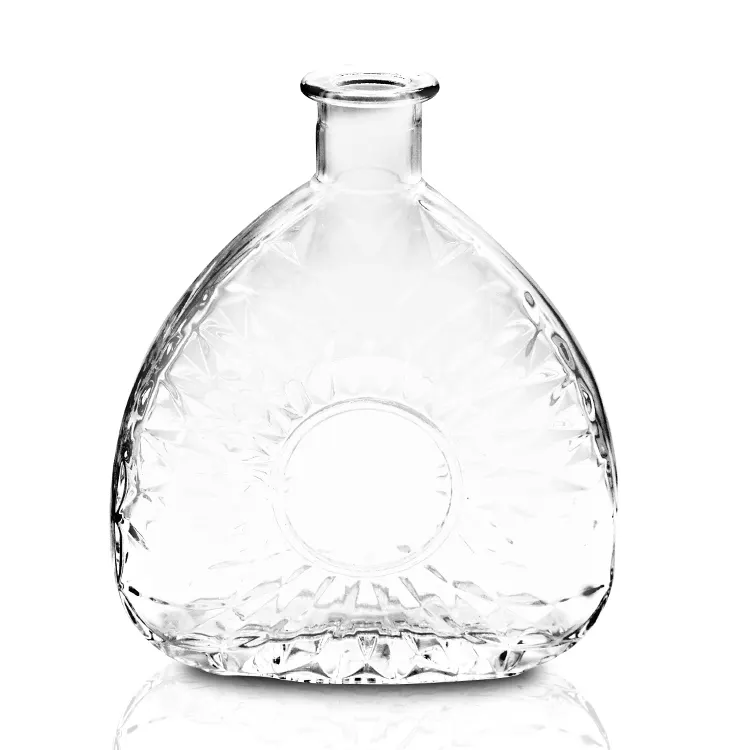
Frosting all or part of the body improves grip and reads as a finish in its own right. An etch 80 to 120 microns deep balances grip and appearance best. Go deeper and the surface turns chalky and holds soap residue. The frosted glass bottle page shows the finish options.
Texture in the mould
Vertical ribs, diamond knurling or a wave pattern are cut into the mould itself, so they add nothing to the unit cost once the mould is paid for and they last as long as the bottle. The drawback is print area, because silk screen needs a flat surface. A design that leads with its label should put the textured band low and leave a smooth panel above it.
Square and faceted shapes
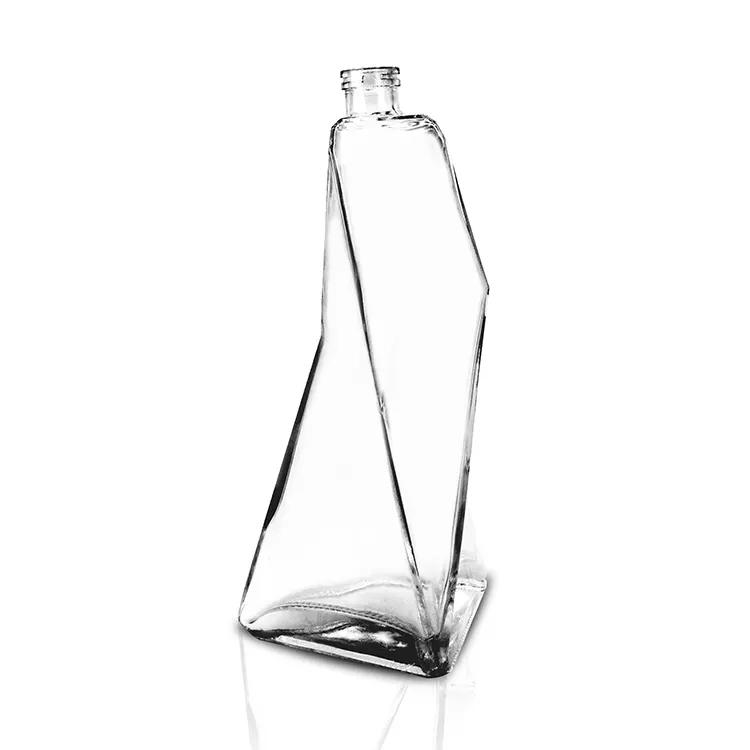
A square bottle rolls less than a round one and is easier to grip. Its weak point is the corner, where stress concentrates. Specify a corner radius of at least 8mm and a corner wall at least 15% thicker than the panel wall, so the bottle withstands line handling and bathroom drops. We ask for square shapes to be validated by dropping them 0.8m onto wet tile, three drops per axis, on a 30-bottle sample.
Pumps and caps for thick formulas
Shampoo is harder on a closure than lotion. Standard formulas measure 3,000 to 9,000 cP, sulfate-free and conditioning types run higher, and surfactants attack some pump internals. A poor choice here tends to surface about six months after launch.
- Lotion pumps, 28/410 and 33/410. The usual choice, with a 2cc dose for retail and 4cc for backbar. Above 6,000 cP, ask for a dip tube with an inner diameter of at least 6mm and an engine rated for high viscosity, because an ordinary 2cc pump stalls and air-locks on thick sulfate-free shampoo. Take 304 stainless as the minimum spring material. Salt-heavy or chelating formulas need an external-spring pump, in which the spring stays out of the product. Our guide to glass pump bottles goes further into engine choice.
- Flip-top and disc-top caps. These cost less and have fewer ways to fail. Travel retail and some salons prefer them.
- Locking and tamper-evident closures. Hotel dispensers generally combine a 28/410 pump with a locking collar or a proprietary bracket key. Choose the bracket system first, then source a bottle that fits it.
For any closure, require a torque retention test on filled bottles: hold them for 24 hours at 40°C, then re-check application torque. Surfactant creeps under the liner, so a pump that seals at filling may weep after a hot summer in a warehouse. Liner and torque values are set out in the closure selection guide.
Glass weight and refill programs
A glass shampoo bottle weighs six to eight times as much as its plastic equivalent, so freight should be worked out early. Lightweighting narrows the gap. A 300ml salon round can be made at 215g against a typical 260g by using narrow-neck press-and-blow forming in place of blow-and-blow, and top-load strength stays above 280N.
Refill is what makes the weight pay commercially, since one bottle serves many fills. If you are planning a refill line, look at the lotion bottle specifications as well, because conditioner and lotion share most of their closures.
Decoration, compliance and mould planning
Haircare decoration is usually spare: one or two silk-screen colours and perhaps a hot-stamped logo. Silk screen printed on the glass and fired at 560°C to 620°C is in effect permanent and lasts for years in a shower. Paper labels fail. If the design needs a label, specify PP or PE film with wet-strength adhesive and ask for a 72-hour water-immersion test.
In the EU a shampoo bottle is cosmetic packaging under EU 1223/2009 and has to be migration-tested as a packaging-contact material. Programs bound for the US normally add California Prop 65 screening of the decoration inks. All of this concerns cosmetic and personal-care packs only, not pharmaceutical ones.
Shampoo bottles are formed on the same IS machines as other cosmetic glass, so it pays to plan shampoo, conditioner and body wash as one mould family with different neck finishes, which lowers the total spend on moulds. The cosmetic glass bottle collection shows which finishes the family shares. For a new shape, begin with the custom bottle development process, which works the same way for haircare.
FAQ
What is the minimum order for glass shampoo bottles?
It is set per project. The mould and the production line it is scheduled on decide the figure.
Will a glass shampoo bottle survive a drop in the shower?
No glass is drop-proof on tile. The risk is reduced through a heavier base, grip surfaces, generous corner radii on square shapes and wall thickness proven in the wet-surface drop test described above.
Can shampoo bottles be hot-filled?
Haircare is normally filled at ambient temperature. If your process pasteurizes or hot-fills above 60°C, say so when you ask for a quote, because the annealing and temper specifications change. A sudden thermal differential over 42°C risks checking, meaning fine cracks in the glass.
How does a refill program change the bottle specification?
Plan for five or more refill cycles. That means hardened 28/410 threads, a pump rated for 10,000+ actuations, fired decoration in place of labels, and a base stable enough to stand in a shower for a year.
Which pump should I test for a thick, sulfate-free shampoo?
The high-viscosity lotion pump described above, in 28/410 or 33/410. Try it with your actual formula at both the 2cc and 4cc doses before fixing the specification.