Part of our bulk olive oil bottles range; the stock moulds are pictured at the end of this guide.
This page is written for the buyer who is specifying a vinegar pack and has to settle the capacity class before anything else can be decided, because the fill volume determines the bottle, the closure, the label area and the channel the pack can serve. It is aimed at food and beverage brands, private-label sourcing teams, importers and packers who need to know which fill volumes the trade actually stocks, why the acidity of the contents pushes the specification towards particular closure and seal materials, and how light protection changes what the customer sees through the glass. It covers the capacity classes in metric and in US fluid ounces, the acid compatibility question that runs through the whole specification, the choice between dark and clear glass, the practical difference between a brewed vinegar and a condiment vinegar, the closure and pour-control options that fit each neck, and the label area a regulated vinegar pack requires. It deliberately stops short of two neighbouring subjects. The container families themselves, with their dimensions and their typical uses, are listed on the page covering vinegar bottles, and the commercial side of volume buying, including packing formats and shipping quantities, belongs to the page covering vinegar bottles wholesale. Buyers who are also looking at adjacent categories should note where the boundaries sit: honey in wide-mouth jars is handled on the honey jar sizes page, thick sauces and hot-fill condiments on the sauce bottle sizes page, and high-viscosity syrups on the syrup bottle sizes page, and none of those pages deals with the acidity and light-protection problem that defines a vinegar pack. Nothing below quotes a minimum order quantity, a unit price or a lead time, because each of those follows from the container, the closure and the destination market and is confirmed on enquiry rather than published.
What Actually Decides the Size of a Vinegar Bottle: Capacity, Fill Point and Headspace
Three different quantities are called the size of a bottle, and confusing them is the first source of a mis-specified order. Nominal capacity is the interior volume of the container measured to the brim. Trade capacity is the volume of product the pack is sold as holding, which is the declared net content on the label. Fill volume is where the filling line actually stops, and it is a decision made by the filling machine, the product and the process rather than by the glass. A bottle described as a 500 ml bottle will not necessarily be filled to 500 ml, and it will not necessarily carry a declared net content of 500 ml, because the fill point sits below the brim and leaves headspace above the product.
Headspace matters more in vinegar than in many categories because the fill temperature varies so widely across the range. A brewed vinegar that is filled cold and unpasteurised needs enough headspace to accept thermal expansion in a warm warehouse and to avoid hydraulic pressure on the closure, while a vinegar that is hot-filled needs headspace that will draw down into a vacuum as the contents cool. The headspace is therefore a process value that has to be agreed with the filling line, and it belongs in the specification next to the fill volume rather than being left to the operator.
The capacity classes themselves are well established and differ by market. The metric trade works in 250 ml, 375 ml, 500 ml and 750 ml, which correspond closely to 8.5, 12.7, 16.9 and 25.4 US fluid ounces. The US retail trade works in its own round numbers, and 5 oz, 8.5 oz, 12 oz and 16.9 oz are the sizes a buyer will see on a shelf, where 16.9 oz is the same physical volume as 500 ml and 12 oz is close to 355 ml rather than to the metric 375 ml. Small formats of roughly 150 to 250 ml serve foodservice, tasting sets and gift packs, where the constraint is not volume per serving but the number of units in a case and the impression the pack makes. Above 750 ml the category thins out, because vinegar is used in small quantities and a large format mostly suits catering, refill and bulk retail rather than household purchase.
Two sizing consequences follow from the product rather than from the shelf. First, a bottle intended for refilling from a bulk container usually needs a wider neck, because a narrow orifice makes refilling slow and messy. Second, a bottle intended to be used directly at the table needs an orifice small enough that the pour can be controlled by hand, which pushes the design towards a restricted neck and a pour insert rather than towards a wide mouth. Those two intentions are difficult to serve with one container, and buyers who try to combine them usually end up with a bottle that is adequate for both and satisfying for neither.
How the Size and Its Fit Are Measured and Inspected
Because the declared net content is a legal statement about the pack rather than a property of the glass, the inspection question has to be separated into what is measured on the container and what is measured on the filled pack. The container is inspected against a drawing with tolerance bands: overall height, body diameter, brimful capacity, weight, verticality, neck finish dimensions and the wall distribution that follows from the forming process. The filled pack is inspected against a declared net content rule, which is a statistical statement about a production lot rather than a measurement of one bottle.
In practice a vinegar line measures fill by weight rather than by volume, because vinegar density varies with acid strength and with temperature, and because weighing is faster and more repeatable on a moving line than any volumetric method. That means the acceptance criterion at goods-in should be expressed in a way the line can actually use, usually a target net weight with a permitted band derived from the declared volume and the density of the specific product. A brand that writes only a volume into the purchase order and then measures the filled pack by weight has created a dispute that neither party can win.
Verticality and the neck finish are the two container dimensions that most often decide whether a line runs smoothly. A container that leans slightly is still acceptable as glass, but it will be rejected by a capping head, and verticality therefore belongs in the acceptance criteria with a stated method and a stated limit. The neck finish is inspected with a gauge rather than with a calliper, because it is a functional interface: the diameter, the thread form and the height all have to be within band together for a closure to seat and seal. Buyers who want the full geometry of finish designations, including how a code is read and which closures interchange, will find that on the page covering the bottle neck finish chart rather than here.
The Acid Question: Where Vinegar Actually Attacks the Pack
Vinegar is a dilute solution of acetic acid, typically between four and seven per cent by volume for culinary products, and it is the acidity rather than the product that drives the compatibility work. The first and most useful fact is that the glass itself is not the problem. Soda-lime and borosilicate container glass are highly resistant to dilute acetic acid at ambient and at pasteurising temperatures, so the interior wall does not corrode, does not leach and does not change the product. This is why vinegar has been stored in glass for centuries and why a metal or plastic alternative usually has a shorter compatibility story rather than a longer one.
The risk migrates to everything attached to the bottle. Inside the closure, the sealing liner is in continuous contact with the product, and a liner that is not resistant to acetic acid can swell, soften, take up odour or allow the product to wick past the seal. Plain metal discs without a protective coating are the classic failure, because the acid attacks the exposed metal, and the visible signs are discolouration, pitting and a smell that should never be present in a sealed pack. Foam liners, pulp liners with a barrier face, and foil laminates built with an acid-resistant sealing layer are the usual families considered for this category, and the selection has to be made against the acid strength and the fill temperature rather than against the category name alone.
An induction seal changes the geometry of the same question. The wad is a laminate whose sealing layer bonds to the lip of the finish, so the acid resistance of the seal depends on both the sealing layer and the integrity of the bond, and the critical properties become continuity of the seal and the force required to peel it. A seal that is continuous but very hard to open is a consumer complaint; a seal that opens easily but has a channel at the lip is a leak. Both are decided by the sealing parameters and the finish condition rather than by the material alone, and both should be verified on filled packs rather than on empty bottles.
Cork needs its own treatment because it is not a threaded closure at all. Natural cork suits premium vinegars, but it requires a cork-finish neck rather than a screw thread, it imposes different filling and corking equipment, and it exposes the product to a material whose surface can interact with an acidic liquid. Where cork is chosen for appearance, the usual resolution is a coated or agglomerated cork with a barrier facing, and the container is specified around the cork rather than the cork being adapted to a screw-finish bottle. Buyers who intend to offer both a screw cap and a cork version of the same pack should decide which finish governs the mould, because the two are not interchangeable on one neck.
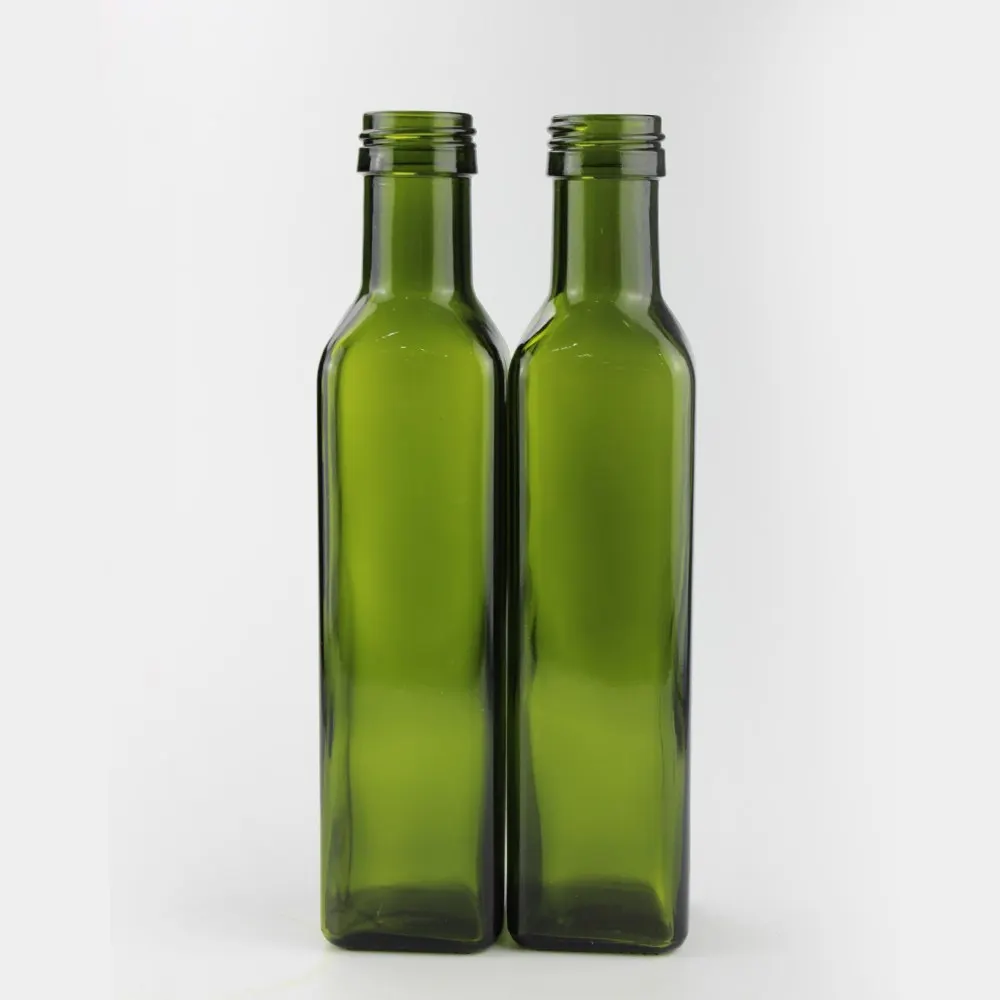
Vinegar Type and Acidity Against Capacity, Colour, Closure and Fill Route
The table below places the main vinegar types against the specification decisions that follow from them. Acidity is stated as a range rather than a single value, because it varies by producer and by grade, and the column entries describe how each type is normally packed rather than what any one bottler must do. Where a decision depends on the filling line, the destination market or the brand position, it is described as a range of practice and the final specification is confirmed on enquiry against a specific product and a specific container drawing.
| Vinegar type and acidity | Typical capacity classes | Channel the format serves | Bottle colour and light protection | Closure and seal | Fill route | Pour control and neck | Label and statement area |
|---|---|---|---|---|---|---|---|
| Wine vinegar, red, about 5 to 7 per cent | 250, 375, 500 and 750 ml, with 500 ml the retail workhorse | Retail grocery and delicatessen, plus foodservice in the larger formats | Dark glass is usual for red wine vinegar, both to reduce light exposure and because the colour reads as the product type | Continuous-thread closure with an acid-resistant liner, often with an induction seal for retail | Usually cold filled and unpasteurised; some producers pasteurise for shelf stability | Restricted neck with a pour insert for the table; wider neck for catering decanting | Moderate. Region, grape or source, acidity and net content, plus any ageing statement |
| Balsamic vinegar, about 4.5 to 6 per cent, with long-aged grades lower | 250 and 375 ml dominate, with 500 ml for volume retail and 100 ml or less for gift sets | Premium retail, gift and foodservice; the format itself signals position | Dark glass for the standard range; clear glass is used where the dense colour is the selling point | Screw cap for standard grades; cork or a cork-look closure for aged and gift grades | Normally cold filled; the higher solids content makes the fill behaviour closer to a thin syrup | Restricted neck with a controlled pour; a narrow insert is essential because the product is used sparingly | High. Ageing, origin, producer, acidity and often a certification statement, in more than one language |
| Apple cider vinegar, about 4 to 5 per cent, often unfiltered | 250, 375, 500 and 750 ml, with 16.9 oz the main US retail size | Retail grocery and health food, plus a strong direct-to-consumer channel | Dark glass protects the colour and is common; clear glass is used when the cloudiness or the culture is a selling feature | Continuous-thread closure with an acid-resistant liner; induction seal is normal for retail distribution | Usually unpasteurised to retain the culture, which raises the requirement for clean filling | Wider neck than a wine vinegar, because a live culture or sediment can block a fine insert | Moderate to high. The unfiltered claim, acidity and any culture statement all compete for space |
| Rice vinegar, about 4 to 5 per cent | 150, 250 and 500 ml | Asian grocery, mainstream retail and foodservice | Clear glass is usual, because the product is light in colour and the clarity is part of the presentation | Continuous-thread closure with an acid-resistant liner, plus a shrink band or induction seal for export | Typically pasteurised or hot filled where long ambient shelf life and export distribution are required | Restricted neck with a small pour insert; the product is used in small measures | Moderate, but export packs typically need bilingual or multilingual panels |
| Distilled white vinegar, about 5 per cent for food use, higher for household grades | 500 ml, 750 ml and larger household formats | Retail grocery and household, with a large private-label presence | Clear glass, because the product is colourless and the container is chosen for economy and visibility | Simple continuous-thread closure with an acid-resistant liner; induction seal where retail integrity matters | Usually cold filled and unpasteurised for the food grade; the household grade is not a food pack and follows its own rules | Wide or unrestricted neck for economy filling; a measuring insert where the format is designed for kitchen use | Low. Net content and a short ingredient statement are usually enough |
| Malt vinegar, about 4 to 5 per cent | 250, 375 and 500 ml | Retail grocery and fish and chip foodservice | Dark glass or clear glass with a dark label, depending on brand tradition | Continuous-thread closure with an acid-resistant liner; a non-drip insert is common | Usually cold filled; pasteurisation where the distribution chain is long | Restricted neck with a non-drip pour insert, since the product is used directly on food | Low to moderate. Net content, acidity and origin |
| Sherry vinegar, about 6 to 7 per cent | 250 and 375 ml, with smaller gift formats | Premium retail, delicatessen and foodservice | Dark glass is usual; clear glass appears in gift presentation | Screw cap for standard, cork for premium, with an acid-resistant liner in the screw version | Usually cold filled and unpasteurised, with ageing time as part of the value proposition | Restricted neck with a controlled pour insert | High. Ageing designation, origin and certification statements take significant panel space |
| Condiment or glazed vinegar, higher solids, acidity varies by recipe | 150, 250 and 375 ml, with squeeze-format alternatives outside glass | Retail grocery, gift sets and foodservice | Clear glass is common so that the glaze is visible | Continuous-thread closure with an acid-resistant liner, plus an induction seal for retail | Hot filled or pasteurised in most cases because of the added sugars and the thicker body | Wider neck and a larger insert or a wide-mouth dispensing fitment | Moderate to high. Ingredient declaration is longer, and the panel carries more marketing content |
Running a High-Acid Product on the Filling Line
The filling decision that most changes the bottle specification is whether the product is pasteurised. A pasteurised or hot-filled vinegar imposes a thermal load on the container, which means the thermal shock resistance that comes from correct annealing becomes a real production requirement rather than a theoretical one, and the headspace, the closure and the seal all have to be specified for a pack that is filled hot and cools in the case. The payback is shelf stability and a longer ambient distribution life, which is usually what an export programme needs.
An unpasteurised product runs the other way. The line is simpler and the thermal demand on the glass is much lower, but the microbial burden has to be controlled by other means: clean filling conditions, a hygienic filling head, an effective seal and, in most cases, a faster route from filling to a cool and dark storage position. Unpasteurised packs that also contain a live culture require particular care, because the culture is a suspended solid and every element of the line that the product touches, including a fine pour insert or a small-orifice fitment, becomes a place where it can accumulate and block.
Two commercial points about the line are worth deciding before the container is ordered. The first is neck rationalisation: a brand that offers several vinegar types in several capacities will save considerable changeover time if the whole range shares one or two neck finishes, even at the cost of a slightly less ideal orifice on one product. The second is filling accuracy, which should be agreed in the units the line measures. Because vinegar strength and temperature both affect density, a specification that states a fill volume without stating the temperature and the acid strength has left the filling operator to interpret the instruction, and interpretations differ between shifts.
Where Vinegar Packs Fail, and Which Failure Each Size Invites
The failures in this category are repetitive and most of them are decided long before filling. Container corrosion is not among them, but everything attached to the container is.
The most common failure is closure corrosion and product wicking, where an unprotected metal component or a non-resistant liner reacts with the acid. Its early signs are a smell inside the cap, staining on the disc and product found under the seal. It is prevented by specifying the liner against the actual acid strength and fill temperature rather than against the category, and by checking the closure on filled packs after a period of storage rather than on the day of capping.
The second is the leak in transit, which appears when a pack that sealed correctly at the plant loses its seal during handling or temperature cycling. It is more common in the larger formats, because the headspace behaves differently when a large pack is warm, and it is prevented by matching headspace to the process and by verifying the seal after the case has been through a realistic handling sequence.
The third is capacity mis-declaration, which happens when a nominal container volume is written into a label as a declared net content without allowing for the fill point, the headspace or the density of the product. Its consequence is a labelling problem in the destination market rather than a quality problem, and it is prevented by declaring net content against the filled pack and the actual product rather than against the bottle.
The fourth is appearance drift in light, which affects clear packs most because a clear bottle is chosen precisely so that the product can be seen. A pale vinegar in clear glass on a bright shelf fades and can discolour over a normal shelf life, and the answer is either a darker container, a smaller exposed window, a carton, or a shorter stated shelf life, decided at the sizing stage rather than after the first complaint.
The fifth is an impractical pour, which is a design failure rather than a manufacturing one and is the most common cause of a pack that sells once. A bottle whose neck is too wide delivers a rush of liquid, and one whose opening is too small clogs when the product carries sediment or a culture. The size class and the orifice have to be chosen together, and the choice should be tested by pouring the real product from the intended container before the order is placed.
How This Page Relates to the Neighbouring Pages on This Site
The container families that carry these capacities, with their dimensions, finishes and typical uses, are listed on the page covering vinegar bottles, and a buyer who has not yet chosen a shape should start there and return here once the format is fixed. The commercial side of the category, meaning packing formats, case quantities and the terms that apply when the product is bought by the container load, is handled on the page covering vinegar bottles wholesale rather than on this page, which stays with the specification of the pack itself. Buyers buying across several product categories at once, where the container count rather than the individual pack decides the order, will find that logic on the page covering glass containers in bulk. The general container families, including the standard jar and bottle shapes that many vinegar packs are built from, are set out on the glass bottle range overview.
The boundaries with the other category pages in this group are worth stating plainly, because the sizing questions look similar from a distance. Honey is packed in wide-mouth jars and the constraint there is viscosity and crystallisation, so the capacity logic and the closure logic both differ; that subject belongs to the honey jar sizes page. Thick sauces and hot-fill condiments share the fill-temperature question with pasteurised vinegar but not the acidity profile, and they belong to the sauce bottle sizes page. High-viscosity syrups share neither the chemistry nor the pour behaviour, and they are handled on the syrup bottle sizes page. This page owns one thing: the capacity class and its fit for vinegar, where the acid strength, the light protection and the small-measure pour are the constraints that decide the specification. Presentation sets where vinegar is paired with oil in a single carrier are a different subject again and are covered by the oil and vinegar cruet pages rather than here.
Frequently Asked Questions About Vinegar Bottle Sizes
What are the standard sizes for vinegar bottles?
The metric trade works in 250 ml, 375 ml, 500 ml and 750 ml, which correspond closely to 8.5, 12.7, 16.9 and 25.4 US fluid ounces. The US retail trade works in its own round numbers, where 5 oz, 8.5 oz, 12 oz and 16.9 oz are the sizes seen on a shelf, with 16.9 oz being the same physical volume as 500 ml and 12 oz sitting near 355 ml rather than at 375 ml. Small formats of roughly 150 to 250 ml serve foodservice, tasting sets and gift packs, and formats above 750 ml are mainly catering, refill or bulk retail rather than household purchase. Capacity class is decided first because it determines the container, the closure, the label area and the channel the pack can serve.
Does the acidity of vinegar attack the glass bottle or the closure?
The glass is not the risk. Soda-lime and borosilicate container glass are highly resistant to dilute acetic acid at ambient and pasteurising temperatures, so the interior wall does not corrode or leach. The risk sits in everything attached to the bottle: the sealing liner in continuous contact with the product, the metal disc behind it, an induction seal whose bond must be continuous, and any exposed metal component in the closure. A liner that is not acid resistant can swell, soften or allow the product to wick past the seal, and an unprotected metal disc will discolour and pit. Specify the liner and the seal against the actual acid strength and fill temperature rather than against the category name.
Should vinegar be bottled in dark glass or clear glass?
It depends on what the pack has to protect and what the brand wants the customer to see. Dark glass reduces light exposure, which protects colour and slows the fading of pale vinegars, and for red wine vinegar and aged balsamic it also reads as the expected product type. Clear glass is chosen when the colour, the clarity or an unfiltered culture is the selling point, and it is standard for distilled white vinegar and many rice vinegars. A clear pack on a bright shelf will fade over a normal shelf life, so the decision is really a choice between a darker container, a smaller exposed window, a carton, or a shorter stated shelf life. The acidity is unaffected either way; the difference is appearance and shelf life.
What is the difference between a brewed vinegar and a condiment vinegar in packaging terms?
A brewed vinegar is a fermented product whose value comes from its origin, its ageing and its acidity, so the pack has to carry those statements and often presents them on a generous panel. It is usually filled cold, frequently unpasteurised, and where it contains a live culture it needs a neck wide enough that sediment does not block the orifice. A condiment or glazed vinegar is a formulated product with added sugars or thickeners, so its ingredient declaration is longer, its body is thicker and it is normally hot filled or pasteurised for stability. That single difference changes the thermal demand on the glass, the headspace, the closure and the size of the pour fitment.
How do I control the pour from a vinegar bottle?
Pour control is a function of the orifice, not of the bottle volume. A restricted neck fitted with a small insert gives a controlled drop or a thin stream, which is what a table vinegar used over salad needs, while a non-drip insert suits malt vinegar used directly on food and a wider neck with a larger fitment suits a thick glaze. Where the product carries a culture or sediment, the orifice has to be large enough that it does not clog, which is the main reason a cider vinegar pack is not specified with the same insert as a wine vinegar pack. Test the pour with the real product from the intended container before the order, and rationalise the neck finish across the range where the changeover cost matters more than the ideal orifice on one product.
Does vinegar have to be pasteurised, and what does that change in the bottle?
Not always. Pasteurising or hot filling gives shelf stability and a longer ambient distribution life, which is usually what an export programme needs, but it imposes a thermal load on the container, so the thermal shock resistance that comes from correct annealing becomes a production requirement and the headspace, closure and seal all have to be specified for a pack filled hot and cooled in the case. Filling cold is simpler and much gentler on the glass, but the microbial burden has to be controlled by clean filling, an effective seal and a faster route to cool, dark storage. An unpasteurised pack that contains a live culture needs particular care at every point the product touches, including fine pour inserts.
How much label area does a vinegar pack need?
More than the size of the bottle suggests, because vinegar is a statement-heavy category. A typical pack carries the net content, the acidity, the ingredient or source declaration, the country of origin, warnings and recycling marks, and in many cases a region or ageing designation; premium and export packs add certification statements and a second language, and that requirement multiplies on small formats where the same mandatory content has to fit a much smaller panel. The practical response is to fix the label area when the capacity class is chosen rather than after the artwork exists, and to keep the pour insert and the neck free of any statement that a drinker needs to read. Where a 250 ml gift pack and a 750 ml retail pack share one artwork, expect the small format to be the one that constrains the design.
Send the Vinegar Type, the Channel and the Fill Method
Three facts settle most of the specification. The first is the vinegar type and its acidity, because acid strength and the presence of a culture decide the liner, the seal and the size of the orifice. The second is the channel, since a foodservice or refill pack and a premium retail or gift pack imply different capacity classes, different closure expectations and different label areas even when the product is identical. The third is the fill method, whether the pack will be cold filled and unpasteurised, pasteurised or hot filled, because that single answer decides the thermal demand on the glass, the headspace, the seal verification and the storage requirement.
With those three inputs, a reply can be specific rather than generic: the capacity classes that fit the channel, the container colour that matches the shelf-life position, the closure and liner family that suits the acid strength and the fill route, the pour fitment that matches how the product is actually used, the label area that the mandatory statements require, and the points to verify on the filled pack before the order is placed. Where a brand is running several vinegar types in one range, send the whole range together, because the neck finish decision is far cheaper to make once across the range than to revisit product by product.