Glass suits mouthwash because the formula is hard on plastic: rinses commonly carry 10% to 27% alcohol by volume together with menthol, eucalyptol and thymol, and soda-lime glass is inert to all of them. For a refillable counter bottle, the usual specification is a 250 ml or 500 ml body with walls of 3.5 mm or more and a 28/410 neck, which accepts pumps, measuring caps and screw caps alike. Hotel and spa programs use 30 ml to 100 ml bottles with thinner walls and smaller finishes.
Standard sizes, neck finishes and closures
These are the configurations we source most often for oral care. Every one of them can be supplied in flint or furnace amber.
| Capacity | Typical channel | Neck finish | Closure options | Wall thickness |
|---|---|---|---|---|
| 30 ml | Spa and hotel amenity | 20/400, or 18 mm bore for cork | Aluminum cap or T-top cork | 2.5 mm |
| 50 ml | Travel size, hotel amenity | 20/400 or 24/410 | Mini pump or aluminum cap | 2.8 mm |
| 100 ml | Trial size, amenity, online sales | 24/410 or 28/400 | Flip-top, pump or aluminum cap | 3.0 mm |
| 250 ml | Counter bottle for retail | 28/400 or 28/410 | Measuring cap, pump or aluminum cap | 3.5 mm |
| 300 ml | Refill station, retail | 28/410 or 38 mm | Wide cap, pump or flip-top | 3.5 mm |
| 500 ml | Family counter bottle, refill programs | 28/410 or 38 mm | Aluminum cap, pump or measuring cap | 4.0 mm |
| 750 ml | Professional and back-bar use | 38 mm or 43 mm | Pour fitment or wide cap | 4.5 mm |
Two points help when reading the table. Wall thickness governs both drop survival and how substantial the bottle feels, so we advise against going thinner than the listed values to trim freight weight. And among the finishes, 28/410 is the most flexible single choice: a brand can launch on a screw cap and move to a pump later with no change to the bottle or to the chuck heads on the filling line.
Stock shapes that fit the current apothecary style include a 250 ml square flint bottle with a 28/400 finish, a 500 ml amber Boston round and a 100 ml faceted cylinder first developed for hotels. A capacity between the listed sizes requires a dedicated mold.
How alcohol and essential oils behave in plastic and in glass
Ethanol is in the rinse to dissolve the essential oils, and it is an aggressive solvent against polymers. The practical differences between the three common materials are these.
| Material | What happens with an alcohol and essential-oil rinse |
|---|---|
| PET | Terpene oils and alcohol can pull plasticizers out of the wall. Panels may form when internal pressure shifts, and the shoulder can show stress whitening within 6 to 9 months. Industry permeation data puts ethanol loss through the sidewall at 1% to 3% per year at room temperature, faster in warehouses above 35 degrees Celsius. |
| HDPE | Holds its shape better, but menthol and eucalyptol migrate into the wall. This flavor scalping makes the last 50 ml taste flatter than the first. |
| Glass | Inert to ethanol, menthol, eucalyptol and thymol, with zero permeation through the wall. |
Permeation matters for more than the label claim. As alcohol escapes, the oils it kept in solution can precipitate and leave a cloudy ring at the liquid line, which customers take for spoilage. Across the 12 to 18 months of a typical shelf life, many plastics also swell, craze or stress-crack. In glass, the balance set in the lab is still there 14 months later.
For a new formula we ask the plant to sample every batch for thermal shock, internal pressure strength and hydrolytic resistance. Thermal shock is relevant because many fillers hot-fill mouthwash at 40 to 50 degrees Celsius to speed up the line and cap application. If an internal surface treatment is specified, it should be checked against the high alcohol content too. A migration test summary accompanies the pre-production samples, and third-party verification at an accredited laboratory can be arranged before mass production.
Amber or flint glass
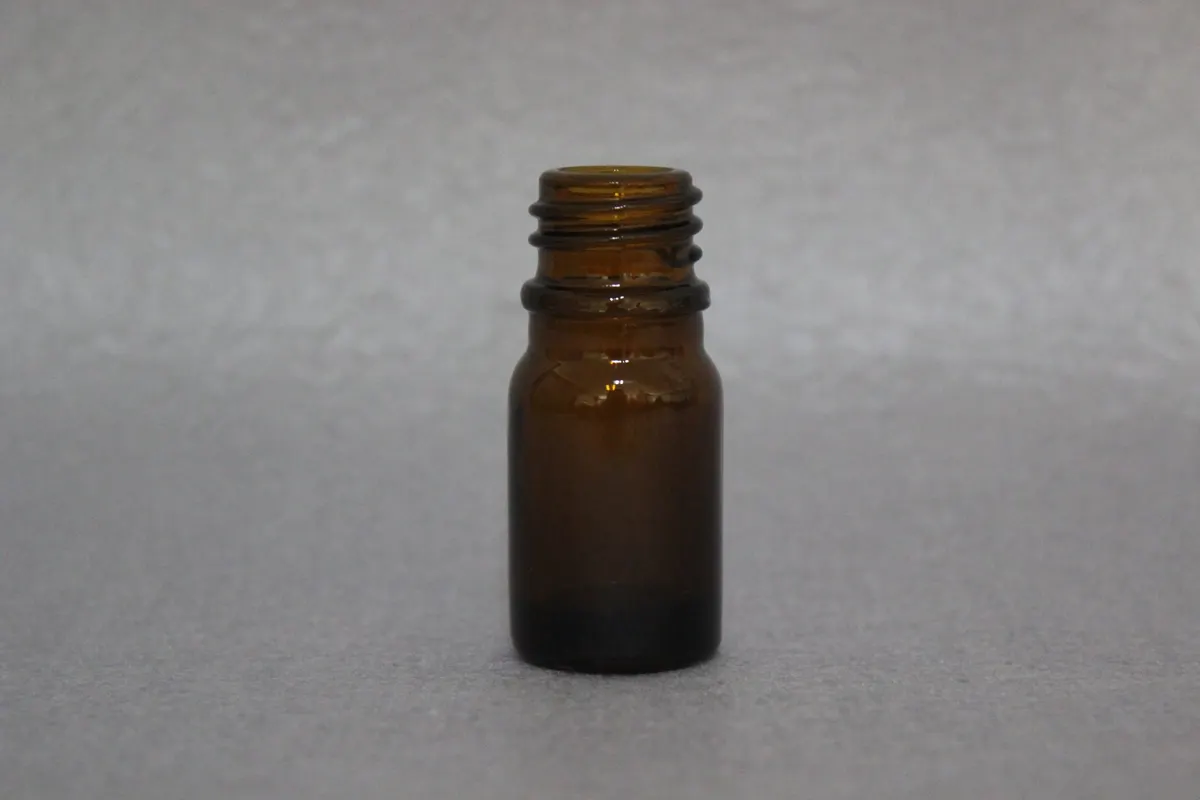
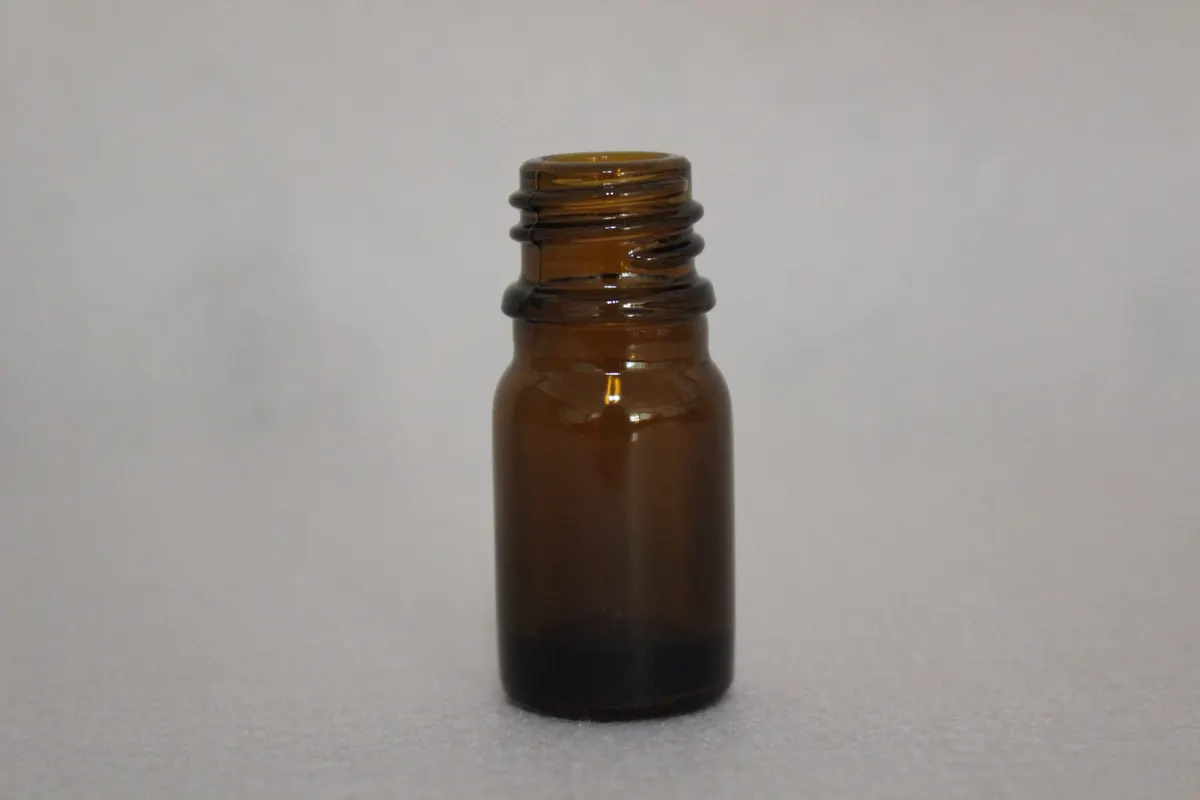
Ultraviolet light breaks down thymol, menthol and eucalyptol, and a clear bottle on a sunny shelf speeds the oxidation of botanical extracts. Amber glass filters roughly 90% of UV radiation below 450 nanometers. We recommend it by default once essential oil content passes 5%, or when the formula includes light-sensitive botanicals. Flint is the better choice when the color and clarity of the liquid are part of the brand and the formula is light-stable.
For brands building a wider light-sensitive range, the amber cosmetic bottle family has matching jars and droppers.
Designing a refillable counter bottle
In the concentrate model, the brand sells one heavy glass bottle that stays on the bathroom counter and small refills that the user dilutes with tap water. A single 30 ml concentrate vial can stand in for a 500 ml ready-to-use bottle, which cuts shipping weight per use by more than 80% and reduces plastic per liter of product by a factor of 5 to 10.
The permanent bottle then has to last through years of wet handling and dozens of refills. We specify it as follows:
- Body wall of 3.5 mm or more.
- Base 6 mm to 8 mm thick, or a punt with a heavy base, for stability and weight in the hand.
- Closure rated for the duty. A refill bottle is opened 30 to 60 times, against 10 to 15 cycles for a single-use pack.
- Decoration that withstands water, toothpaste and daily wiping for two years or more. That means fired ceramic screen printing, acid etching or a high-build UV ink, not a paper label.
The refill itself is a consumable. A plain pressure-sensitive label is enough for it, and a tamper-evident dropper or orifice reducer on the concentrate vial prevents spills during dilution.
Frosted finishes photograph well for e-commerce but show water spots on the counter. For refill programs we usually suggest a gloss body with a matte-printed logo band. On a custom mold, a 2 mm embossed brand mark in the base is a small addition that the user feels every time the bottle is picked up.
Amenity sizes compared with family and refill-station sizes
Hotels and spas
This channel uses 30 ml, 50 ml, 80 ml or 100 ml bottles that look right on a marble vanity and survive housekeeping. Breakage in guest rooms is the main objection hotels raise against moving away from plastic, so wall thickness is tuned for the bottle to survive a 1-meter drop onto tile in a majority of cases. Closures are usually aluminum screw caps with PE liners, or natural cork for resort properties that want a boutique look.
Family and retail
Retail formats are 250 ml, 300 ml, 500 ml and sometimes 750 ml, sized for 4 to 8 weeks of twice-daily use. Filled, a 500 ml glass bottle comes to nearly 900 grams. Neck diameter and shoulder angle therefore have to let any user, young or old, pour with one hand. A wide mouth invites over-dosing, which is why we tend to recommend a 28 mm neck with a pump or a flip-top measuring cap. The base should be wide and stable.
Plan secondary packaging at the same time. Divider cartons rated for sea freight can go directly to a co-packer or 3PL warehouse, and a 40-foot container holds roughly 25,000 to 30,000 bottles depending on format.
Refill stations
Zero-waste stores and some grocers sell mouthwash in bulk. The customer buys a branded 250 ml or 500 ml glass bottle once and refills it in store. Here the mouth has to be wide enough for a filling nozzle to enter without splashing, which usually means a 43 mm or 38 mm neck. The closure should make tamper evidence obvious when the bottle is first bought.
Choosing the closure
| Closure | Where it fits | What to watch |
|---|---|---|
| Pump dispenser, 28 mm | Counter and refill bottles where a metered dose is wanted | Torque retention after heat conditioning |
| Flip-top measuring cap | The drugstore format in glass, with a 15 ml or 20 ml dosing chamber built into the cap | Torque retention after heat conditioning |
| Aluminum continuous-thread cap | Cleanest outline and the best alcohol barrier, with a foam, induction or food-grade liner | The user needs a separate cup or pump |
| Natural or micro-agglomerated cork | Spa, hotel and gift-box programs | Flavor pickup with high-alcohol formulas |
Cork needs a frank conversation. T-top bar-top corks with 18.5 mm and 21.5 mm shanks fit standard 18 mm and 21 mm bore necks, but natural cork can add trace flavor during long contact with strong alcohol. Above 15% alcohol content we recommend micro-agglomerated cork with a food-grade coating. For any closure, run a 90-day filled compatibility test with the exact formula before committing to production.
Neck finish tolerance decides whether the pack leaks in transit. The specification we work to is neck bore and thread dimensions within plus or minus 0.2 mm, checked with go/no-go gauges every 30 minutes during the run, and camera inspection of every finish ahead of annealing. For pumps and measuring caps we add a torque retention test after 30 days of conditioning at 45 degrees Celsius. This simulates a summer container voyage, because liner relaxation in heat is the leading cause of slow leaks found at the destination warehouse.
During sampling we share a compatibility matrix covering liner materials, torque specifications and application speed, so the filling line can be set up in advance. The guide to glass bottle closures goes further into liners, torque windows and compatibility testing. If you would like bottles and matched closures to arrive in one shipment, see glass bottles supplied with caps.
Forming, annealing and decoration
Bottles from 100 ml to 500 ml are typically made by press-and-blow, which distributes the wall more evenly. That improves drop strength and the clarity expected of a counter bottle. After forming, the ware passes through an annealing lehr that relieves internal stress over a 90-minute temperature curve, and automatic inspection then rejects stones, checks, birdswings and defects in the finish.
Decoration options are:
- screen printing in up to 4 colors, with UV or thermoplastic inks;
- hot stamping in gold and silver foil;
- spray coating in matte, gloss or soft-touch;
- full or partial frosting by acid etch or sandblast.
For refill bottles our first recommendation is ceramic-fired printing. The ink is fused into the glass surface at about 600 degrees Celsius and stands up to dishwashing and years of wet handling.
Brands running one bathroom line across several categories can compare neck and closure choices on the pages for glass lotion bottles and glass shampoo bottles. Bespoke shapes follow the mold-development route described for custom lotion bottles.
Frequently asked questions
Is glass safe for high-alcohol mouthwash?
Yes. Soda-lime glass does not react with ethanol, menthol, eucalyptol or thymol at any concentration used in oral care, so a formula at 10% to 27% alcohol shows no interaction with the container over an 18-month to 24-month shelf life. We still recommend the 90-day filled test, because the closure and liner are part of the pack.
What is the minimum order quantity?
It is quoted per project. The figure depends on whether a stock or custom mold is used, on the decoration and on the line the bottle runs on.
Which closure is best for a refillable bottle?
Most refill programs use either a 28/410 pump or an aluminum continuous-thread cap with a food-grade liner, the latter when the user measures with a separate cup. Both cope with 30 to 60 open-close cycles. Cork suits gift and spa positioning, with a food-grade coating for formulas above 15% alcohol.
How long do production and shipping take?
Timing is quoted per project once the mold, decoration and line schedule are confirmed. Freight terms and destination set the shipping leg.
Can a bottle be made to our own shape?
Yes, with a dedicated mold. Embossed base marks and logo details are normally drawn into the same tool. Send the container, closure, decoration, quantity and destination, as far as you know them, and we will match the project to a suitable plant.