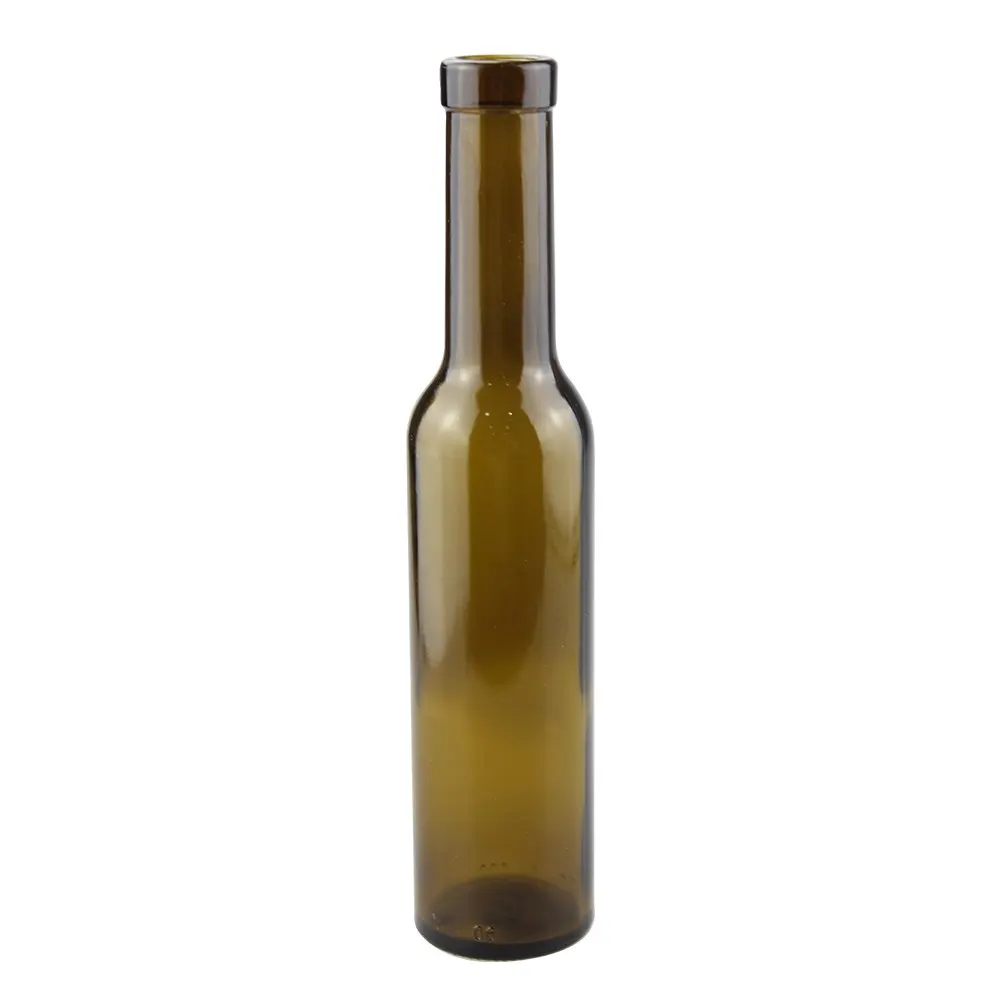
Filed under bulk olive oil bottles; the moulds we quote for this are pictured at the foot of the page.
This page is for the buyer who has already chosen an olive oil bottle and now has to make the top of the pack work. The bottle may be a Dorica, a Marasca or a plain round flask, the colour may already be fixed and the volume may already be confirmed, but the pourer, the insert, the liner and the cap still have to be selected, and they only work as a matched set. This is a matching page, not a catalogue page. The bottle body itself, meaning shape, capacity, glass colour and UV protection, belongs to the olive oil bottles guide and to the colour-specific discussion on brown and amber glass bottles, because those pages own the reservoir and this page owns everything above the neck. If the question is commercial rather than technical, meaning case quantities, pallet configuration or how a mixed container is built, that belongs to the olive oil bottles wholesale page, and the same accessory logic applied to acidic products is handled on vinegar bottles wholesale. Nothing below quotes a unit price, a minimum order quantity, a tooling charge or a lead time, because a closure cannot be priced honestly before its neck finish, its insert and its seal material are all fixed.
Why an Olive Oil Closure Is Really a Two-Part System
Buyers tend to describe the top of an olive oil bottle in one phrase. They ask for a cork top, a pourer cap, a non-drip spout or a black screw cap with a pourer inside. Every one of those phrases describes at least two separate parts, and the parts have different materials, different suppliers and different failure modes. Treating them as one item is the origin of most of the complaints that follow an oil pack to market.
The first part is the closure body, which is the visible cap. It may be an aluminium screw cap, a plastic screw cap, a flip-top, a bar-top stopper, a t-cork with a plastic head, or a cork stopper. Its job is to be removed and replaced by the consumer, to carry the branding, and in many markets to show tamper evidence.
The second part is the wetted sealing element, which is everything that touches the oil and forms the barrier. That includes the insert, meaning the pourer or the stopper stem, and the gasket or liner that seals the closure against the neck. Its job is to keep oxygen out, keep the oil in, and pour cleanly without dripping. It is the part that determines whether the pack is still sound at month twelve, and it is the part buyers specify least precisely.
The two parts are joined by a third feature that neither of them owns: the neck finish. The closure has to engage the thread or the bore, the insert has to sit on its seat, and the liner has to press on the sealing land. All three of those are cut into the glass mould and cannot be altered afterwards. For that reason the finish, not the cap, is the first line of the accessory specification, and everything else is reverse-engineered from it.
There is one more reason to treat the top as a system on an oil bottle specifically. Olive oil has a low surface tension relative to water, and it creeps. It wicks along surfaces, climbs the inside of a spout, and finds a path through any gap a fraction of a millimetre wide. An accessory set that would be perfectly adequate on a bottle of water can still leave an oil film on the outside of the bottle within a week, and the cause is usually geometric rather than a material defect.
The Neck Finish, the Bead and the Bore: What the Insert Actually Grips
A finish specification for an oil bottle has four measurable features, and a purchase order that omits any of them will eventually produce a closure that does not fit.
- Neck diameter and thread family. This is the code usually quoted, and it identifies the thread, the number of turns and the sealing land together. A diameter on its own is not a finish; several thread configurations share a nominal diameter, and a closure built for one of them will not seal reliably on the others.
- The bead, or the tamper-evident ring groove. Many oil closures carry a tamper-evident band that has to engage a bead on the neck at a specific height. The height matters: a band that sits too low will not fold away cleanly, and one that sits too high will not lock at all.
- The bore. On a cork-style finish and on some press-fit designs, the relevant dimension is the internal diameter of the neck at the point where the stopper or pourer shank seats. Bore diameter and taper decide whether the insert seals by compression or by friction alone.
- The sealing land. The flat, unthreaded annulus at the top of the neck where the liner presses. Its width, its flatness and its freedom from chips determine whether a liner can form a barrier at all, and it is one of the most common hidden causes of a leak on an otherwise correct assembly.
Two necks can carry the same capacity and look identical from the outside while differing in all four features, so the finish has to be read from the neck drawing rather than inferred from a stock bottle in the warehouse. When a buyer sends a photograph instead of a drawing, the matching process simply starts with a measurement, and that is a normal step rather than an obstacle. A caliper reading across the threads at the correct point, together with the thread pitch, the neck height and the bore, is usually enough to identify the family.
For oil bottles the practical landscape is narrower than the general bottle market, which helps. Wide screw necks that take a large pourer are common on the taller shoulder shapes, standard small screw necks appear on cruets and smaller formats, and cork-style straight bores appear on formats where the look of a cork is part of the product story. Each of those families has an established set of insert solutions. The recurring mistake is to specify by appearance, meaning “a cork top like the one in this photograph”, rather than by the seam where the glass meets the insert.
Pourer Families: Open Pour, Self-Closing and Restricted Flow
An olive oil insert is normally one of three functional types, and the choice follows from how the pack is used rather than from how it looks. A bottle that stands on a restaurant pass, where oil is poured dozens of times per service, has different requirements from a retail bottle that is opened twice a week in a domestic kitchen.
The open pourer is the simplest construction: a spout with a free passage, sometimes with a small air vent tube alongside the main channel so that the oil flows smoothly instead of glugging. It has no moving parts, so nothing can stick or fatigue. Its weakness is that it cannot stop the last drop. When the pour ends, oil remains on the lip and inside the spout, and gravity plus capillary action move it down the outside of the neck. The remedy is geometric, which is why a well-designed open pourer has a lip profile that cuts the stream and a spout angle that lets residue run back inside rather than out.
The self-closing pourer adds a valve. The common constructions are a gravity ball that drops onto a seat when the bottle is upright, a spring-loaded ball for a more positive close, and a slit membrane in silicone or a similar elastomer that opens under pressure and closes when the pressure stops. Self-closing inserts are the standard answer to the drip complaint and work well when the oil is thin and the pack is used often. They behave less predictably with unfiltered or cold-pressed oil that carries fine particles, with herb or chilli infusions, and with oil that thickens or deposits wax in a cold store, because the valve can be held open by debris or by waxy solids. When a self-closing insert sticks, the symptom is not a leak but a pour that will not start, which is a different complaint with a different remedy.
The restricted-flow or measured pourer narrows the passage so the pour is slower and more controlled, and in some designs the geometry delivers a roughly constant amount per tilt. These are used where oil is dispensed in a controlled way, including finishing and light frying, and where a brand wants a consistent visual pour in demonstration. The trade-off is time: the same restriction that gives control also makes a large bottle slow to empty, which is a real consideration in a professional kitchen where an operator pours throughout a service.
Two further constructions sit slightly outside those three families and deserve naming because they are frequently confused with them. A tapered cork pourer is a spout whose shank is a compressed cork or synthetic plug that seals by interference in a straight bore; it belongs to cork-style finishes and cannot be used on a threaded neck. A t-cork or bar-top stopper is a closure in its own right, with a head that stays above the neck and a stem that seals below it, and it may or may not carry a pourer channel. Both of these are specified from the bore and the neck height, not from a thread code.
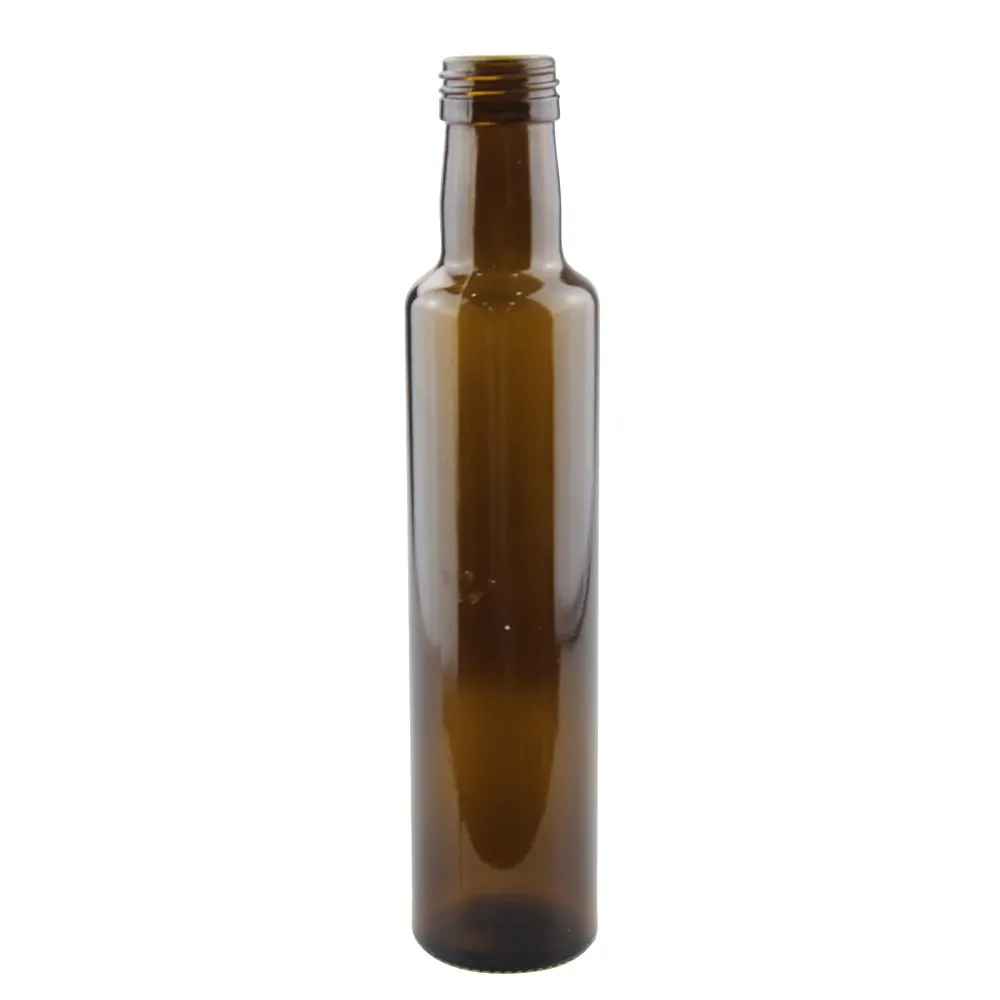
Neck Finish and Insert Matching Matrix
The matrix below maps the neck families that appear on glass olive oil bottles against the insert types that suit them, the seal materials that are normally used, the way the insert and the closure body combine, the failure each combination is prone to, and the items that should be confirmed before a batch is agreed. Treat the neck descriptions as families rather than as fixed codes, because the exact code, the thread pitch and the bore have to come from the bottle drawing.
| Neck finish | Suitable insert type (open pour / self-closing / restricted flow) | Seal material | How it combines with the closure body | Common problems | What to confirm with the factory |
|---|---|---|---|---|---|
| Standard small screw neck, approximately 24 mm to 28 mm, tamper-evident bead | Open pour as the default; self-closing where the drip complaint has already been raised by the market | LDPE or a TPE gasket disc; avoid plasticised flexible PVC in the wetted path | Insert presses into the cap and seats on the neck mouth; the cap carries the tamper-evident band | Drip after pouring; band that does not fold cleanly on a bead set too high | Full finish code with thread pitch and bead height; whether the closure is supplied pre-assembled with the insert seated |
| Wide screw neck, approximately 31.5 mm, typical of taller shoulder oil bottles | Self-closing as the usual choice; restricted flow where a controlled pour is wanted | LDPE insert body with a silicone or TPE valve element; liner or plug gasket against the land | Insert drops into the neck and is retained by the screw cap; cap may be aluminium or plastic | Hard to pull out for refilling or cleaning; valve held open by particles in unfiltered oil | Seat depth and seat diameter inside the neck; whether the insert is designed for removal and reuse or for one-time seating |
| Cork-style straight bore finish | Tapered cork pourer; alternatively a t-cork or bar-top stopper with an integrated channel | Natural or agglomerated cork, or a synthetic TPE stopper stem; no liner is used | The stopper is the closure; there is no separate cap, and tamper evidence is normally a shrink band or a seal strip | Plug that swells and becomes hard to remove; cork dust or taint concerns; inconsistent bore giving loose or tight fits | Bore diameter and taper with tolerance; cork grade and its food-contact documentation; whether the stopper is fitted before or after filling |
| Threaded neck with an internal insert seat under the cap | Press-fit pourer that sits below the cap and is exposed only when the cap is removed | LDPE pourer body; the cap liner seals against the neck land independently | Two seals in one pack: the liner seals the cap, the pourer seals the neck seat | A pack that looks dry but seeps at the lower seat; a pourer that lifts out with the cap | Whether the seat is moulded or relies on the pourer skirt; retention force measured on the assembled pack |
| Small threaded neck on cruet and miniature formats | Restricted flow for controlled dispensing; open pour for the smallest formats where drip risk is low | LDPE or a food-grade TPE plug; acid-resistant selection if the same format is used for vinegar | Pourer pressed into the cap, often with a removable dust cap over the spout | Slow pour that buyers read as a manufacturing fault; dust cap that does not stay attached | Orifice diameter and expected pour time for the intended oil viscosity; dust cap retention |
| Wide screw neck with a shoulder that narrows sharply below the thread | Self-closing with a short shank; long-shank pourers risk contact with the oil surface when tilted | As above; the material choice follows the oil rather than the neck | Insert and cap as a single supplied unit; the shank length is the variable that changes with the bottle | Oil reaching the thread during pouring, which then attracts dust and makes the cap tacky | Shank length against the neck height and the fill level; the pour angle at which the spout clears the shoulder |
Sealing Materials Against Oil, Acid and Time
The material that touches the oil has to satisfy three requirements that are usually tested separately and very rarely tested together: food-contact compliance, chemical compatibility with the product, and mechanical behaviour over the shelf life. A closure can pass the first and fail the third, and that is the pattern behind most slow leaks.
Food-contact compliance is the baseline. In the United States, food-contact materials are governed under FDA 21 CFR, and in the European Union the framework sits in EU 1935/2004 with material-specific measures such as EU 10/2011 for plastics. Those rules define what may be used and what migration limits apply, and the evidence is normally a declaration of compliance and the supporting migration data from the material supplier. A supplier who cannot name the regulation the material is documented against is not providing the evidence a buyer needs, and a general statement that a part is food grade is not a substitute for it. Note also that compliance is a property of the material and its intended use, not something a glass or closure plant can grant to a customer by assertion.
Chemical compatibility with oil is the second requirement, and it is where material choice becomes non-obvious. Oil is non-polar, and most elastomers absorb some of it. A material that swells appreciably will grow into a space it does not fit, deform, and lose the compression that was providing the seal. Natural rubber and many general-purpose elastomers swell noticeably in oil and are poor candidates. Low-density polyethylene is the common insert and liner material for oil because it is essentially inert towards it, dimensionally stable and cheap to mould. Thermoplastic elastomers and silicones are used where a flexible valve is needed, and their grade has to be selected for oil service rather than for general flexibility. For aggressive or high-aroma products, fluorocarbon elastomers are the more resistant family, at a higher cost.
Metals matter more than buyers expect. Olive oil oxidises, and the reaction is catalysed by trace metal ions, particularly iron and copper. A decorative collar, an uncoated metal spring in a pourer, or a metal-lined cap of unknown provenance that sits inside the neck can shorten the flavour life of the product even when nothing visibly goes wrong. The practical rule is that exposed metal should not sit in the wetted path unless it has been specified for food contact and its alloy and coating are documented.
Time is the third and quietest requirement. Oil packs are usually given a shelf life of eighteen months or longer, and a closure has to hold that long. The mechanisms that fail slowly are plasticiser migration, where flexible PVC components lose their flexibility and the liner shrinks or hardens; compression set, where an elastomer takes a permanent deformation under the cap and stops pressing back; and adhesive or coating failure on foil-faced liners. None of those shows up in a test that lasts a week, and all of them are visible in a retained-sample programme held for the stated shelf life. That programme costs almost nothing and is the single most useful piece of evidence a buyer can build.
One further point applies to cork and to any plant-derived material. Cork is a natural product with batch variation, it can carry compounds that are perceived as taint, and its performance depends on density and on how it was washed and graded. If the aesthetic calls for cork, the sensible approach is to specify grade, density range and documentation, and to agree a sensory check on the retained sample, rather than to treat cork as a commodity with no variables.
Combinations That Work and Combinations That Fail
Matching is easier to understand through concrete pairs than through rules, because the failure cases repeat in recognisable ways.
- A wide screw neck with a tapered cork pourer. Fails. A taper seals by interference in a straight bore and has nothing to grip on a threaded neck. The insert will sit loose, wobble, and let oil past the shank into the thread.
- A cork-style bore with a 31.5 mm screw cap. Fails for the same reason in the other direction. There is no thread to engage, so the cap cannot be applied, and the only valid closures are stoppers sized to the bore.
- A self-closing insert in a bottle of unfiltered cold-pressed oil. Works at first, then becomes unreliable. Fine sediment collects on the ball seat or on the membrane, the valve does not close fully, and the pack drips at the joint rather than at the tip. Either specify a filter step or move to an open pourer with a drip-control lip profile.
- An open pourer with a short spout on a short-neck bottle. Works until the bottle is tilted far, at which point oil reaches the thread. The correct fix is a longer spout or a different neck, not a tighter cap, because the cap is not what is being wetted.
- A self-closing insert combined with a cap that also carries a liner. Works only if the two seals are designed for each other. A thick liner can hold the cap higher than the insert expects, so the pourer never seats fully, which produces a pack that appears correctly capped but is sealed only by the liner.
- A silicone valve element in a vinegar-filled format from the same family. Works only after the acid resistance of the specific grade is confirmed. A material selected for oil service is not automatically the correct choice for a low-pH product, which is why the acid-resistant accessory discussion belongs with the vinegar pages rather than being assumed from the oil side.
- An aluminium cap with an internal coating of unstated composition. Usually works, and occasionally ruins a batch of oil. Ask for the coating or the lacquer to be named and documented for food contact, because this is precisely the kind of detail that is invisible on a sample and decisive after twelve months.
The pattern behind all of these is the same: the neck is fixed, so the insert has to be chosen to fit it, and the closure then has to be chosen to hold the insert. Buyers who start from the cap colour reverse the order of decisions and pay for it in fit problems.
Foodservice Packs Against Retail Packs
The same bottle frequently goes to two different buyers with two different accessory requirements, and it is worth separating them before the specification is written rather than after a complaint arrives.
A foodservice or catering pack is opened and used many times a day. Its priorities are pour speed, a valve that does not stick, an insert that survives rough handling and the ability to be removed for refilling or cleaning. Tamper evidence is usually a secondary concern compared with throughput, and a slightly larger orifice is normally acceptable because the operator pours onto food rather than into a measure. Inserts are frequently supplied in bulk as loose items so that they can be replaced when one is dropped or damaged, and a durable design that can be re-seated many times is worth more than a very fine seal.
A retail pack is opened occasionally, sits on a shelf and is judged on the first impression. Its priorities are a clean first pour, no oil film on the neck after the first week, and a closure that still looks good at the end of the shelf life. Tamper evidence usually matters, whether as a band, a shrink sleeve or a seal strip over the cap. The insert is often supplied pre-assembled into the cap, so the consumer never sees the individual parts, and the whole unit is discarded with the bottle. Because the pack is seen before it is used, the cap surface matters too: a matte or anodised aluminium finish, a moulded plastic shell or a cork head are brand decisions, but they carry consequences for how the closure grips, how it is torqued and how it is printed.
Two practical consequences follow. First, a brand that sells both channels should not assume one accessory specification covers both; the orifice, the valve type and the tolerance on the cap fit can differ, even on the same bottle. Second, a retailer’s demand for a very tight, clean-looking closure can push towards a design that is unnecessarily difficult to remove, which is a genuine consumer annoyance. Removal torque is worth specifying rather than leaving to the moulding process, and it is measured, not estimated.
Drip, Wall Creep and Hard-to-Pull Pourers: Reading the Failure
Three complaints account for most of the accessory issues on oil packs, and each has a distinct cause.
Drip after pouring is the most common. It is the residue left in the spout or on the lip finding its way to the outside of the bottle. Contributing factors are a lip that does not cut the stream cleanly, a spout with a shallow internal angle that lets oil pool, a bottle that is stored upright with oil resting on the lip, and, in the case of a self-closing insert, a valve that does not close completely. The diagnosis is to look at where the oil first appears: if it appears at the tip, the lip geometry is the suspect; if it appears at the joint between the spout and the neck, the insert to neck seal is the suspect; if it appears at the thread, the pour is reaching the thread during use and the pack is being handled at too steep an angle for the neck design.
Wall creep, sometimes described as the bottle looking greasy, is oil migrating down the outside of the glass and leaving a film that collects dust. It usually starts from a single drop left on the neck, and it is made worse by a neck shape that has a recess or a groove where oil can sit. It is also aggravated by labels applied over the area, because oil under a label edge loosens it. The remedies are the same as for drip, plus a cleaning step or a protective neck band in the packing process for the retail channel.
Hard-to-pull pourers come from the opposite direction. A press-fit insert that holds too well, a cork that has swelled in a humid store, or a membrane valve that has bonded to its seat will resist removal, and a consumer who cannot pull the insert out to clean the bottle is a consumer who will complain. The variables are the interference between the insert skirt and the neck bore, the material of the insert, and the bore tolerance. A pull-force check on the assembled pack, made at the temperature the pack will actually see, is the test that catches this class of problem.
Alongside those three, the pack-level checks worth naming are a leak test on the assembled and filled pack, an oxygen or headspace check where oxidation is a concern, and a transit simulation before the first bulk shipment, because a closure that holds on a bench can still back off in a container journey. ISTA procedures are the standard reference for the transit part, and an agreed sampling plan for incoming closures gives a basis for a claim if a batch of inserts or liners is out of specification.
Reordering, Replacing and Standardising Inserts
The accessory conversation does not end with the first order. Oil brands change cap colours, add a channel, move a product from a cruet format to a retail bottle, or simply reorder after eighteen months and find that the pourer no longer fits as it did. A small amount of standardisation at the beginning prevents most of that.
The most useful habit is to define one matching set per bottle: the finish code, the insert part and its material, the liner or gasket part and its material, and the closure body, all recorded together on one line of a specification sheet. When any item in that set changes, the set is re-verified rather than assumed. Replacing an insert with a visually identical one from another mould is exactly the change that produces a leak, because the seat and the skirt interference are the parts that matter and neither is visible.
The second habit is to separate the two motives for replacement. If a new insert is needed because the product changed, meaning a different viscosity, a new flavour infusion or a move from oil to vinegar, the seal material may have to change with it and the set should be re-tested against the product. If it is needed because the supply changed, the material and dimensions should be held constant and the fit re-verified on the assembled pack before the balance of the order ships.
The third habit is to keep samples. A retained sample of the assembled pack from the first approved batch, held under normal store conditions with the date written on it, settles arguments about whether the current pourer is different from the approved one, and it doubles as the physical reference for a visual acceptance rule on cap colour, surface finish and sprue marks. Cap colour is a frequent source of dispute, because two batches of the same nominal colour can differ under different lighting; agreeing the lighting condition and the maximum acceptable visual difference in advance is far cheaper than arguing after delivery.
Related Pages and Where This Page Stops
This page owns the accessory system at the top of an olive oil bottle: how the neck finish is read, which insert family suits which finish and use case, which seal materials tolerate oil and time, how the cap and the insert combine, and how the assembled pack should be verified. It does not own the bottle.
The reservoir, meaning shape, capacity, glass colour and UV protection, is covered on the amber and dark glass colour page and in the shape guide on the olive oil category page. Decisions about how the pack is bought, meaning case quantities, pallet patterns, mixed containers and the commercial terms around an order, sit with the wholesale page. Handled accessories for acidic contents, where the material selection follows a low pH rather than an oil, belong with the vinegar bottle pages, because the two products pull material choice in different directions and should not share a default specification by accident.
Keep the accessory question separate from the body question and both move faster. The accessory conversation needs the neck finish, the contents and the use case. The body conversation needs the volume, the colour and the market.

Frequently Asked Questions About Olive Oil Bottle Caps
Will a pourer that fits one olive oil bottle fit another?
Only if the neck finish matches in full. A pourer is retained by the thread family and the seal seat inside the neck, so two bottles with the same nominal neck diameter can take different inserts if the thread profile, the neck height or the internal seat differs. The reliable method is to specify the finish from the neck drawing and to confirm the insert against a bottle taken from the production mould, not against a stock sample that may come from an older tool.
What is the difference between a pourer and a self-closing pourer?
A pourer is an open spout, sometimes with an air vent, and nothing closes when pouring stops, so a drop is normally left at the lip. A self-closing pourer contains a valve, most often a gravity ball, a spring-loaded ball or a slit membrane, that closes the passage when the bottle is upright. The self-closing type removes most of the drip, but it can stick when the oil carries fine particles or thickens in the cold, and the pour is slightly slower.
How do I stop oil running down the outside of the bottle?
Start by identifying where the oil first appears. Oil at the tip points to the lip geometry, oil at the joint between insert and neck points to the insert seal, and oil at the thread means the pour is reaching the thread because the bottle is being tilted too far for the spout length. A spout with a stream-cutting lip, an internal angle that drains back, and a neck without a recess where oil can collect removes most of the problem. A self-closing insert is the next step when the geometry alone is not enough.
Which material should the insert and gasket be made from for olive oil?
Low-density polyethylene is the common baseline for the insert body and the gasket, because it is close to inert towards oil and dimensionally stable. Thermoplastic elastomers and silicones are used where a flexible valve element is required, and their specific grade has to be selected for oil service rather than for general flexibility, since many elastomers swell in oil and lose the compression that provides the seal. For every wetted material, ask for the food-contact documentation, referring to FDA 21 CFR in the United States or EU 1935/2004 and EU 10/2011 in Europe.
Should the closure be aluminium, plastic or cork?
That is a brand and channel decision as much as a technical one. Aluminium gives a premium appearance and a firm, precise thread engagement, and its internal coating or lacquer has to be documented for food contact because oil can be affected by trace metals. Plastic is lighter, cheaper to mould and available in a wide colour range. Cork suits a straight bore finish, is judged on grade and density rather than on a thread code, and carries batch variation that should be handled through a sensory check on a retained sample.
Do catering bottles and retail bottles need different caps?
Usually yes, even when the bottle is identical. A catering pack is opened many times a day, so pour speed, valve durability and easy removal for cleaning matter most, and replacement inserts are often supplied loose. A retail pack is opened occasionally and judged on appearance, so a clean first pour, tamper evidence and a closure that still looks correct at the end of the shelf life matter more. Changing the channel is a reason to re-verify the accessory set rather than to reuse the previous one.
Why does a pourer that was fine at first become hard to pull out?
Because the interference between the insert and the neck bore changes with time and conditions. A cork or a cork-based shank swells in humid storage, some elastomers swell in contact with oil, and a membrane valve can bond lightly to its seat. The pull force should be checked on the assembled pack at a temperature close to the one the pack will actually experience, and the acceptable range should be written down, since a specification that only states a maximum leak rate says nothing about whether a consumer can remove the insert.
How should a closure specification be written for an oil bottle?
As a single matched set. Record the finish code with thread pitch and bead height, the insert type and its material, the valve element where one is used, the liner or gasket part and material, the closure body with its material and surface finish, the application and removal torque bands, the required tamper-evident feature, and the tests the assembled pack has to pass, covering leak, pull force, transit simulation and a retained sample held for the stated shelf life. Anything not stated in that set will be decided by whoever supplies the part.
Send the Neck Finish, the Contents and the Order Quantity
Accessory matching goes quickly when the enquiry arrives with three items. First, the neck finish as written on the bottle drawing or measured on the neck, including the thread pitch, the neck height and the bore. Second, the contents and how the pack will be used, meaning oil or vinegar, filtered or unfiltered, retail or catering, and roughly how often the pack is opened. Third, the order quantity and the destination market, so that the packing format and the applicable food-contact framework can be checked at the same time.
Send those three and the accessory recommendation can be put together in one pass, covering the insert family, the seal material, the combination with the closure body, the tamper-evident option and the checks that should be run on the assembled pack before a batch ships. If the neck finish is still open, say so and describe the bottle and the contents instead; the finish recommendation follows from the insert requirement, and it is much cheaper to settle before a mould exists than afterwards. Minimum order quantities, unit prices and lead times are quoted against a finished specification, once the finish, the insert and the closure body are agreed.