Part of our glass olive oil bottles range; the stock moulds are pictured at the end of this guide.
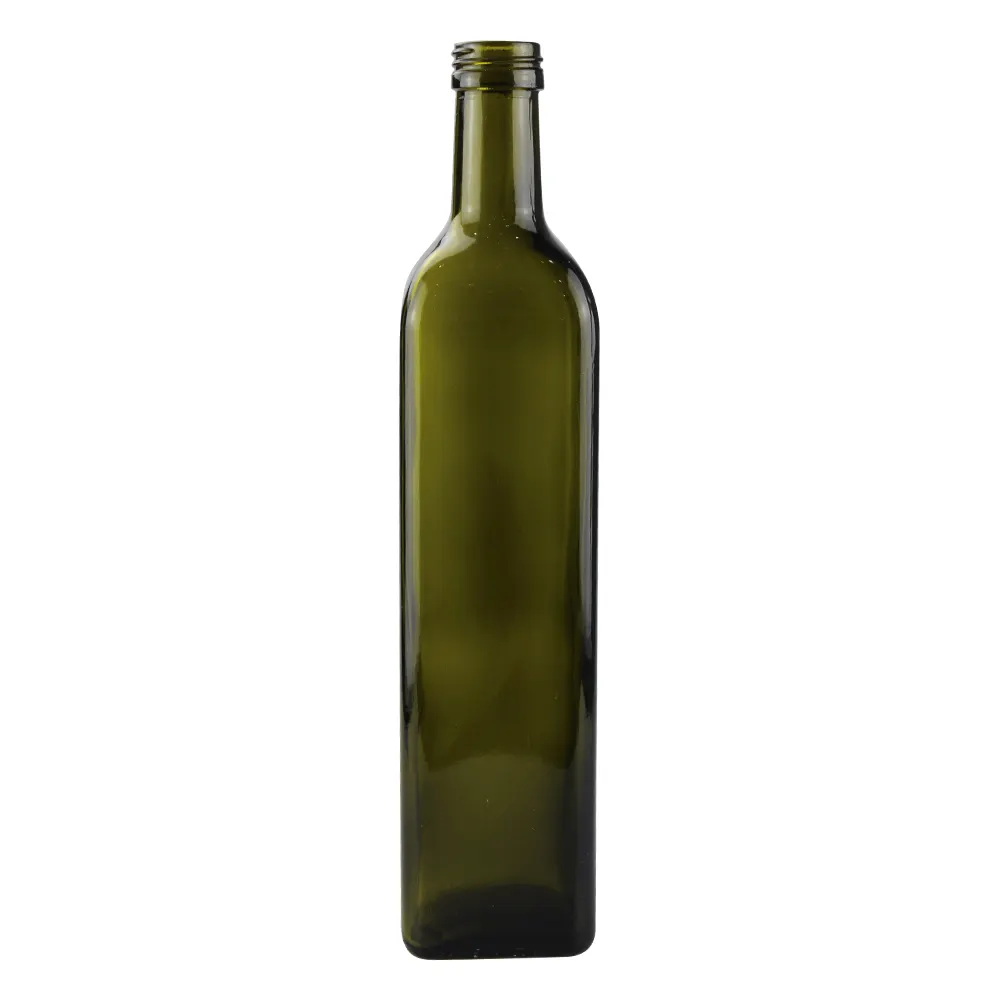
For extra virgin olive oil, the safe default is a square marasca bottle in antique green glass with a 31.5×24 mm tamper-evident pourer finish. Antique green cuts light in the damaging 350–450 nm band by roughly 70–80%, where clear flint lets about 90% through, and the marasca shape loads about 12% more liters on a pallet than a round bottle. Move away from that default only for a stated reason: a wrap label, a gift shape, a refined oil that turns over quickly, or a long export route that needs a darker glass and a tighter liner.
Bottle profile and what it does to freight
Three profile families cover almost every olive oil bottle. They differ less in how they pour than in how many of them fit in a case, on a pallet and in a container.
| Profile | Usual capacities | Packing efficiency | Where it fits |
|---|---|---|---|
| Marasca (tall, square) | 250 / 500 / 750 / 1000 ml | Highest; ~12% more liters per pallet than a round bottle | The silhouette shoppers read as olive oil; sits neatly in retail trays |
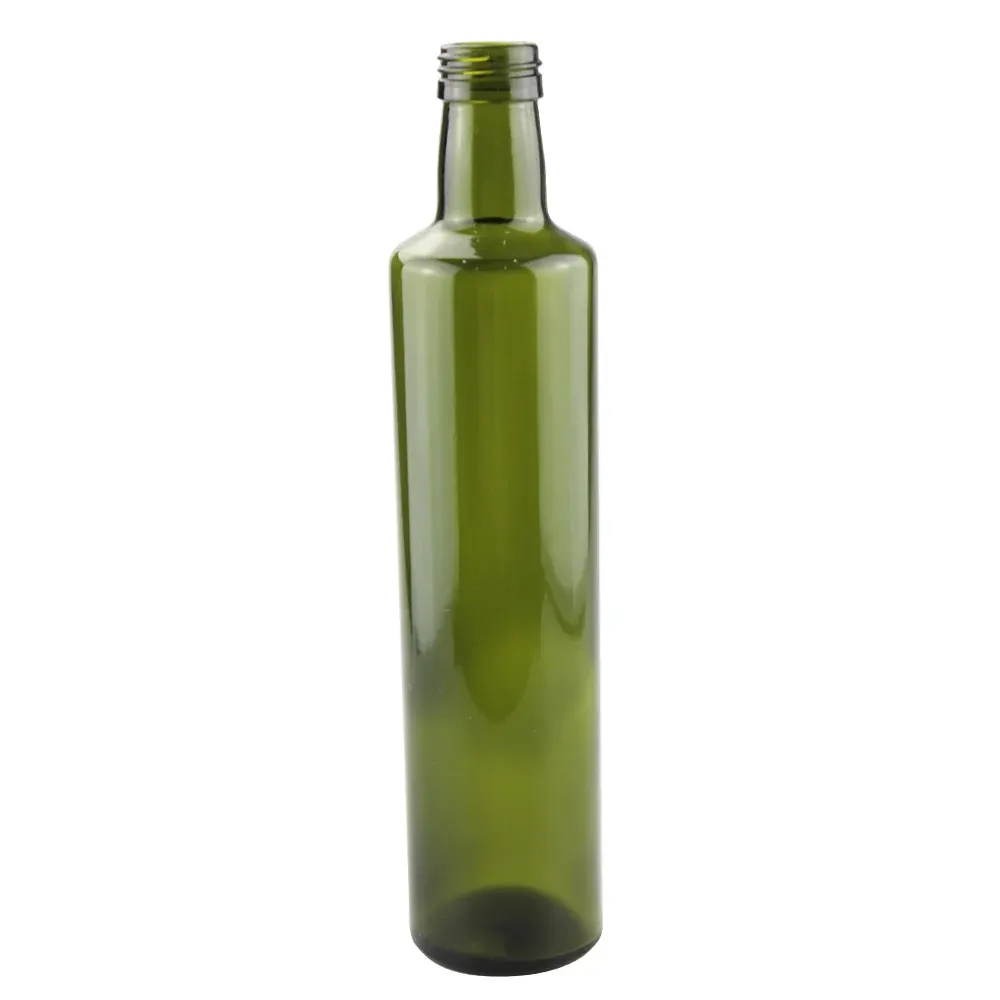
| Dorica (tall, round) | 250 / 500 / 750 ml | Somewhat below marasca | Traditional Mediterranean table bottle; the easier body for a wrap label |
| Amphora and other specialty shapes | 250–500 ml | −15 to −25% | Gift and top-tier positioning |
In practice the freight sum settles the choice more often than the brand book. On bulk pallets a 500 ml marasca loads at roughly 36,000 pcs per 40HQ, against about 32,000 for a round bottle of the same capacity, and that gap repeats on every shipment.
Dorica earns its place when labels are applied by hand or the design calls for a full wrap or sleeve, since a cylinder takes a label without wrinkling. A specialty shape makes sense only when the bottle is itself the marketing and annual volume stays under about 200,000 units. For a first private-label range, marasca is usually the right call for its pallet efficiency and its instant recognition; switch to dorica if the label wraps the whole body or the brand leans on a traditional Mediterranean look.
Glass colour as a preservation choice
Olive oil photo-oxidizes. Chlorophyll and riboflavin in the oil absorb light and hand the energy on as singlet oxygen, which consumes polyphenols and leaves rancid off-notes. This route is usually much faster than the slow oxygen-driven ageing of a sealed bottle kept in a cupboard, and it means a deep green, early-harvest, high-chlorophyll oil tends to be the most light-sensitive item in a range.
| Glass colour | Behaviour at 350–450 nm | Suited to |
|---|---|---|
| Flint (clear) | Lets roughly 90% through | Refined oil, fast-moving foodservice, bottles kept cartoned until use |
| Antique or dead-leaf green | Reduces transmission by roughly 70–80% | Mainstream EVOO; flavour-stable shelf life of 12–18 months |
| Dark green / UVAG | Blocking of about 85–90% | Higher-end EVOO moving through long distribution chains |
| Amber | Strongest blocking of the four | Infused oils; on an oil shelf it tends to look medicinal |
Roughly 70% of extra virgin oil is shipped in green for this reason. Flint is defensible only where the route is both quick and dark. Under ordinary retail lighting, EVOO in flint shows measurable polyphenol loss within 8–12 weeks, so anything destined for a lit shelf should be in antique green at the least.
Colour slows the damage; it does not stop it. Filled bottles still need to stay under 25°C and away from direct light. The background on how each tint behaves is in our reference on how glass packaging blocks UV and visible light, and the companion piece on dark glass for olive oil goes further into specifying amber, green or black. If you are weighing the darkest tints against full clarity, see amber compared with clear glass for oils and drinks.
Sizing the light barrier for your route
Protection from light is a stack of layers: the glass, any coating or sleeve, the shipper, and the lighting where the bottle is sold. The weakest layer in a lit stage decides the result, so size the barrier for the stage where the bottle spends longest exposed, not for total journey time.
- The glass itself is the permanent layer and should carry the base requirement, because its blocking never wears off.
- A UV-blocking lacquer or printed full-body shrink sleeve is the usual way to keep a clear bottle for shelf appeal, and a sleeve or carton over antique green adds useful margin under canopy lighting. A sleeve only protects the area it covers, so a bare neck or base is an open path to the oil, and any coating has to survive filling, capping and condensation.
- A closed carton or shipper removes nearly all light while the bottle is inside. Dark case liners and opaque bags work the same way. None of them counts toward a shelf-life claim once the bottle stands on an open shelf.
Two inputs fix the target: the shelf life you plan to print, and how long the product stands unpacked under light. The second depends on the channel. A distributor who displays bottles for months on a bright shelf needs more blocking than one who keeps stock cartoned until the day it is used.
Write the target as a condition, such as no detectable sensory drift over the stated months at a stated illuminance and temperature. Then walk the route, give each lit stage a barrier and check that the weakest one still meets the condition. If colour alone falls short, choose a darker glass, add a coating or sleeve, or take the product out of the lit channel. As an order of magnitude only, drift can be detected within weeks in clear glass under continuous retail light and after several months in well-blocked dark glass; a shelf-life test on your own oil is the only way to confirm the rate.
Closure and neck finish
The closure carries legal weight as well as doing the sealing, so decide it together with the neck finish. The finishes named most often in olive oil enquiries are the 31.5×24 mm tamper-evident pourer and 28 mm ROPP (roll-on pilfer-proof), with a bar-top cork for gift lines.
- 31.5×24 mm tamper-evident pourer. The standard EU format: an aluminium shell with a breakaway band over a non-drip pourer insert. Non-refillable versions meet the anti-refilling rules that several EU states apply to olive oil in hotels, restaurants and catering.
- Cork or T-cork. A good look for gift and infused oils, but it lets more oxygen through, so keep it for products meant to be used up within 6–12 months.
"Non-refillable" describes a pourer insert built so the cap cannot come off and the bottle be topped up again without leaving visible damage. Where a market requires it for oil served at the table, name it in the enquiry; it is not implied by "tamper-evident".
Fill level interacts with every closure type. On a 500–750 ml marasca, leave 20–25 mm of headspace beneath the pourer seat so the insert seats properly and oil does not spurt on first opening. Our guide to choosing ROPP caps and their liners covers the aluminium family, and the one on matching lug caps and twist-off lids covers the alternative. Whichever you use, confirm finish and closure together in writing, because a mismatch tends to appear only after filling.
What to write in the enquiry
Six fields let a plant quote without guessing: profile (marasca or dorica), capacity, glass colour, finish (28 mm ROPP or 31.5×24 TE), annual volume with its seasonal split, and destination port. The RFQ checklist for bottles and jars adds tolerances to each field, and existing moulds can be browsed in the product center, including the stock olive oil bottle range.
A colour name on its own cannot be enforced. Three lines turn it into a requirement:
- Spectral transmittance through the wall over an agreed band, as a maximum average instead of a single-point reading, with the test method and sample size named.
- Lot-to-lot colour consistency as a colour-difference limit against a signed master sample. Two greens with the same name can differ visibly when shipments land months apart.
- Wall thickness with its tolerance, because a thinner wall means less coloured glass in the light path and weaker blocking.
Request the measured transmittance curve and the master-sample reference along with the pre-production samples, and file both with the purchase order. A supplier with no measured curve is offering a colour, not a barrier. If a coating or sleeve does part of the job, test it on samples that have already been through your own filling and capping.
| Item | Line in the enquiry | Proof to request with the order |
|---|---|---|
| Glass and light barrier | Antique or dark green body; maximum average transmittance over the agreed band with method and sample size; colour matched to an approved master | Transmittance curve per lot, sealed and dated master sample, wall-thickness report |
| Closure system | Finish to drawing; ROPP or twist-off lug as specified; liner type and torque ranges | Closures fitted to the bottle, torque and leak results, liner specification sheet |
| Carton and divider | Full-height die-cut divider with one bottle per cell; board grade and internal dimensions | Carton drawing, gross weight of a filled carton, an assembled sample |
| Pallet build | Treated or engineered wood pallet; pattern, layers, stretch wrap and top cap | Pattern diagram, photo of the treatment mark, photo of a loaded pallet |
| Container load | Written load plan with pieces and gross weight for the agreed container type and weight limit | Load plan, container and seal numbers, photos taken during stuffing |
| Traceability | Lot number on every carton and on each line of the packing list | Packing list tying lot numbers to carton ranges, an inspection report per lot |
If caps, cartons and labels are to be consolidated under a single QC plan, that is what our sourcing and export support is for.
Sample approval and incoming inspection
A pre-production sample is informative only if it tests every interface, and the order of approval matters.
- The bottle against the drawing: profile, capacity, weight, height and neck finish, with a master sample signed and retained.
- The closure on the actual bottle, not on a fixture: application and removal torque, how the breakaway band behaves, and seal integrity.
- A fill trial: fill to the planned level, measure headspace, open one to see that the insert stays seated, then invert, hold and examine the liner.
- A packing trial: carton, divider, closure orientation and pallet pattern as one system. Bottles that run cleanly on the filling line can still fail on the pallet.
Production lots are judged on sampled criteria, not bottle by bottle. Measure capacity at the fill line instead of nominal volume, then verticality (lean), the neck finish on a gauge, and closure fit and seal on filled samples. Look for stones, cords, blisters and chipped rims, and compare appearance with the sealed master. Log results by lot and keep the master sealed and dated; in a colour dispute, a faded or unsealed reference proves nothing.
Export packing, claims and comparing quotes
Glass is both heavy and fragile, so two limits shape the freight: the weight a container may legally carry and the movement the packing can absorb. A 20GP often reaches its payload before it is full, while a 40HQ may fill before it reaches payload, depending on bottle weight and pattern. Tare, loading ceilings and realistic payloads are set out in our note on container loading limits for all-glass cargo.
The packing rules for oil bottles are short:
- dividers that are die-cut and run the full height of the bottle;
- a pallet or slip-sheet under everything, never cartons on the bare container floor;
- no inverted layer in which the closures take the load;
- an interlocked pattern so the top layer cannot shift.
Wooden pallets and crates fall under the wood-packaging rules enforced by most destinations, which means heat treatment or fumigation plus the correct mark. Engineered wood is generally exempt, though your forwarder should confirm the conditions at destination.
Who bears a breakage depends on where risk passed, and the Incoterm fixes that, so read the trade term before arguing the facts. Evidence matters just as much. Photograph the container seal, the doors as they open, every layer as it comes out and the damaged layer before it is touched, and keep the packing list with the pictures. For a loss of real value, ask for a joint survey or an independent inspection; without photos of the load at opening, claims usually go in the carrier's favour.
Quotes issued under different trade terms have to be normalised before they can be compared. Put them all on one footing, either delivered to your warehouse or free on board at the real loading port, and list each element: glass, closures, cartons and dividers, pallets and treatment, inland haulage, terminal handling and documentation, ocean freight where it applies, and insurance. Palletisation and port documentation charges are the two most often left out, and they come back later as extra invoice lines. Have each supplier state the container load, in pieces and gross weight, that the quote assumes. A figure built on a fuller container is a different offer, not a better one.
Olive oil bottle FAQ
Does glass colour change what the bottle costs?
Cost is quoted per project. It depends on the mould, the decoration, the quantity and the freight terms, so ask for colours to be quoted side by side on the same specification.
Is there an oxygen-barrier upgrade for long export routes?
Glass is already a complete oxygen barrier; oxygen gets in through the closure liner. For supply chains of 12+ month duration, specify Saranex-type or tin-saran liners in ROPP caps and ask for the closure's oxygen-transmission data when samples are sent.
What filling temperature is safe?
Olive oil is filled between ambient and 35°C, which puts no thermal stress on the glass. Moisture is the real limit. Store bottles dry before filling and air-knife them if they are rinsed, because water speeds up hydrolytic rancidity.