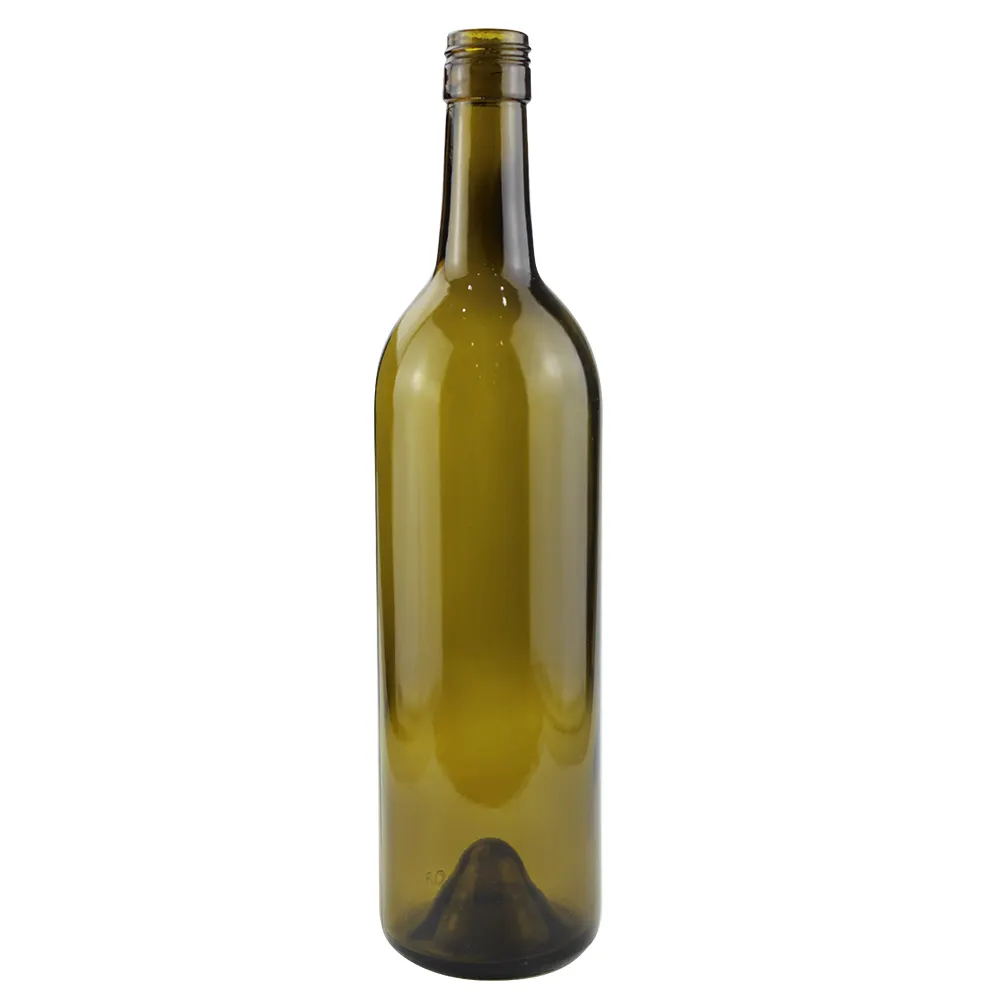
Part of our empty wine bottles range; the stock moulds are pictured at the end of this guide.
A winery fixes four things when it buys bottles: shape, size, closure and colour. The closure is the one to settle first, because a cork finish (18.5mm bore) or a BVS screw thread is cut into the mould and cannot be converted afterwards. After that, shape sets the carton and pallet dimensions, and colour sets how much light reaches the wine: dark green stops roughly 85–90% of damaging UV, while flint stops under 15%.
Cork finish or screw cap
Decide this before any other line of the specification.
- Cork finish, 18.5mm bore: accepts natural cork, technical cork or synthetics. The bores we specify are 18.5mm ±0.3mm, which matches the industry-standard 24mm cork compressed on insertion. Matching rules are set out in our guide to wine bottles and corks.
- Stelvin / BVS screw cap: an aluminium cap with a Saranex or tin liner, on a 30×60 finish for 750ml and 30×44 for 375ml.
Winemaking supply retailers should carry both. Kit and hobby winemakers increasingly choose screw caps for whites and early-drinking reds, while customers who age wine 5+ years still ask for cork. A 70/30 split of cork to screw finish is a workable opening mix for a new store.
Shape and size
Shape tells the shopper which varietal to expect, and it determines case dimensions and pallet efficiency. Three shapes cover roughly 90% of still-wine ranges.
- Bordeaux (claret): straight sides and high shoulders. It is the default for Cabernet Sauvignon, Merlot, Sauvignon Blanc and most private-label wine, because no other shape is as forgiving on a filling line. The Bordeaux bottle range comes in light, standard and heavy weights.
- Burgundy: sloped shoulders on a wider body, traditional for Pinot Noir and Chardonnay. The larger diameter uses more glass and puts fewer bottles on each pallet layer.
- Hock / Alsace flute: tall and slender with no shoulder, standard for Riesling, Gewürztraminer and dessert wines. A 750ml Hock stands 290–330mm tall against 289–302mm for Bordeaux, so check carton height and shelf clearance. Dimensions are in the Burgundy and specialty shape catalogue.
Sizes run from the 187ml split, used by airlines, tasting rooms and gift sets (see miniature wine bottles), through the 375ml half-bottle and the workhorse 750ml, up to the 1.5L magnum. The 187ml and 1.5L sizes run on dedicated moulds at slower line speeds.
Typical specifications for stock bottles
| Shape | Capacity | Neck finish | Weight | Height | Pieces per 40HQ |
|---|---|---|---|---|---|
| Split / piccolo | 187ml | BVS 28mm screw only | ~200g | ~190mm | ~120,000 |
| Bordeaux half | 375ml | Cork 18.5mm / BVS 30×44 | ~300g | ~238mm | ~78,000 |
| Hock / Alsace flute | 375ml | Cork 18.5mm / BVS 30×44 | ~290g | ~268mm | ~64,000 |
| Bordeaux, mid | 500ml | Cork 18.5mm / BVS 30×44 | ~360g | ~262mm | ~62,000 |
| Bordeaux, light | 750ml | Cork 18.5mm / BVS 30×60 | ~400g | ~289mm | ~52,000 |
| Bordeaux, standard | 750ml | Cork 18.5mm / BVS 30×60 | ~500g | ~295mm | ~44,000 |
| Bordeaux, heavy | 750ml | Cork 18.5mm | ~600g | ~302mm | ~38,000 |
| Burgundy, standard | 750ml | Cork 18.5mm / BVS 30×60 | ~530g | ~290mm | ~40,000 |
| Burgundy, heavy punt | 750ml | Cork 18.5mm | ~650g | ~297mm | ~34,000 |
| Hock / Alsace flute | 750ml | Cork 18.5mm / BVS 30×60 | ~480g | ~330mm | ~33,000 |
| Magnum | 1.5L | Cork 21mm | ~850g | ~355mm | ~22,000 |
The container counts assume bulk loading on pallets with dividers. Cartoned loading lowers them by roughly 10–15%. These are typical industry figures, so confirm the packing plan for your own order.
Glass colour and UV protection
Colour is a preservation choice as much as a branding one. UV light at 320–450nm drives the light-strike reactions that give wine a skunky smell, and the damage can appear within hours of exposure.
| Colour | Damaging UV blocked | Use it for |
|---|---|---|
| Antique / dark green | Roughly 85–90% | Reds and any wine expected to age |
| Standard green (Georgia green, emerald) | Roughly 60–70% | Wine drunk within 12–18 months |
| Flint (clear) | Under 15% | Whites and rosés for near-term drinking, or retail with controlled lighting |
For a supply store the working rule is dark green for anything a customer might cellar, and flint only for kit wines and fruit wines that are finished in months. Changing colour means a furnace transition at the plant, so not every colour is available in every mould at every time. Our article on green, brown and clear wine glass goes further into the trade-offs.
Printing, decoration and mould-level details
Wineries that want to stop applying paper labels can have the design screen printed directly on the glass. The process is ACL, applied ceramic labelling: the ink is fused into the surface at 600°C+ and withstands ice buckets and dishwashers. Frosting, etching and spray-colour coatings are other options. Examples are on the screen printing page.
If you stay with conventional labels, ask for the label panel dimensions of the specific mould so the designer works to real tolerances; see wine bottle label support.
On a bottle made to your own drawing, punt depth, base embossing such as the winery name and capacity marks, and neck-ring details all belong to the mould. They can be designed in freely, and they are permanent once the mould is cut.
Inspection and compliance documents
We ask for AQL 2.5 sampling per ISO 2859 on every lot. The checks that matter for wine glass are:
- finish bore tolerance, ±0.3mm on cork bores;
- vertical load, minimum 180kg for a standard 750ml;
- internal pressure resistance, tested at ≥1.2 bar for still wine. Still wine exerts almost no pressure; the test is there to find thin walls;
- thermal shock at a 42°C differential;
- visual defects: stones, blisters and birdswings.
Glass containers are food-contact articles. For the United States, request a food-contact compliance statement and heavy-metal migration test reports for lead and cadmium per FDA CPG 7117.06/7117.07. EU buyers can ask for LFGB/EU 10-2011 documentation.
Container loading and freight
A 40HQ holds ~44,000 standard 750ml bottles and a 20GP ~19,000–21,000. Weight changes the sum quickly: a 600g bottle cuts pieces per container by ~14%, so freight per bottle rises along with the glass. Stock moulds for the common shapes are listed in the wine glass bottle category.
Two container plans show how orders are usually built. A supply store opening its range might fill one mixed 20GP with 9,000 × 750ml Bordeaux in antique green with cork finish, 6,000 × 750ml Bordeaux in flint with screw finish, and 4,000 × 375ml flint. A private-label brand supplying a retail chain might take 100,000 × 750ml Bordeaux light in antique green plus 40,000 × 375ml, spread over three containers with staged warehouse releases, sending the label panel dimensions to the chain's packaging designer before the first run.
Breakage, LCL and FCL
On properly palletised wine bottles, ocean breakage typically runs 0.5–2%. Below ~12,000 bottles, LCL is possible, but plan for 3–5% breakage, since glass travels better in a full, tightly loaded container. Have the forwarder confirm that glass is booked as top freight and never placed under dense cargo. Above ~15,000 pieces, FCL is better on both freight per bottle and damage rate.
Pallets and insurance
Fumigation-free plywood pallets are the norm for US and EU destinations. Heat-treated pallets must be ISPM-15 compliant and free of bark, which avoids fumigation-certificate hold-ups at US, EU and Australian ports. Marine insurance on ICC-A all-risk terms is worth taking on every glass shipment.
Checking the goods at destuffing
A 20-minute routine on arrival makes any later breakage or tolerance claim far easier to settle:
- Photograph the condition of each pallet before unwrapping it.
- Pull two cartons per pallet row and check the finish bores with a go/no-go gauge.
- Fill one bottle per pallet to verify capacity and closure fit.
What to put in the brief
These bottles suit winemaking supply retailers restocking 750ml and 375ml lines, estate wineries bottling 1,000–50,000 cases per vintage, and private-label brands that want screen-printed glass. When you send us the brief, include what you already know:
- Shape and capacity: for example Bordeaux 750ml, Hock 750ml or a 375ml half, or a drawing for a custom mould.
- Closure: cork finish with your cork specification, or Stelvin BVS 30×60 / 30×44.
- Colour and target fill date: antique green, emerald or flint. The date affects which colours are available.
- Quantity and destination port: pieces per SKU.
- Decoration: plain, label panel dimensions required, or screen-print artwork in AI/PDF with the number of colours.
FAQ
Can colours and shapes be mixed in one container to reach a minimum quantity?
Containers can carry mixed bottles, as the supply-store example shows. Minimum quantities are quoted per project, because they depend on the mould and the line it runs on.
What should I do if bottles arrive broken?
Count the breakage and photograph it at destuffing. If the loss is above the normal range for ocean freight, the packing plan, meaning the divider specification and pallet pattern, should be reviewed before the next container ships.
Which documents travel with the container?
The commercial invoice, packing list and bill of lading are what your broker needs for customs. The certificate of origin, fumigation-free pallet declaration, food-contact compliance statement and lead/cadmium migration test summary go into your compliance file for TTB, state or EU food-contact audits.