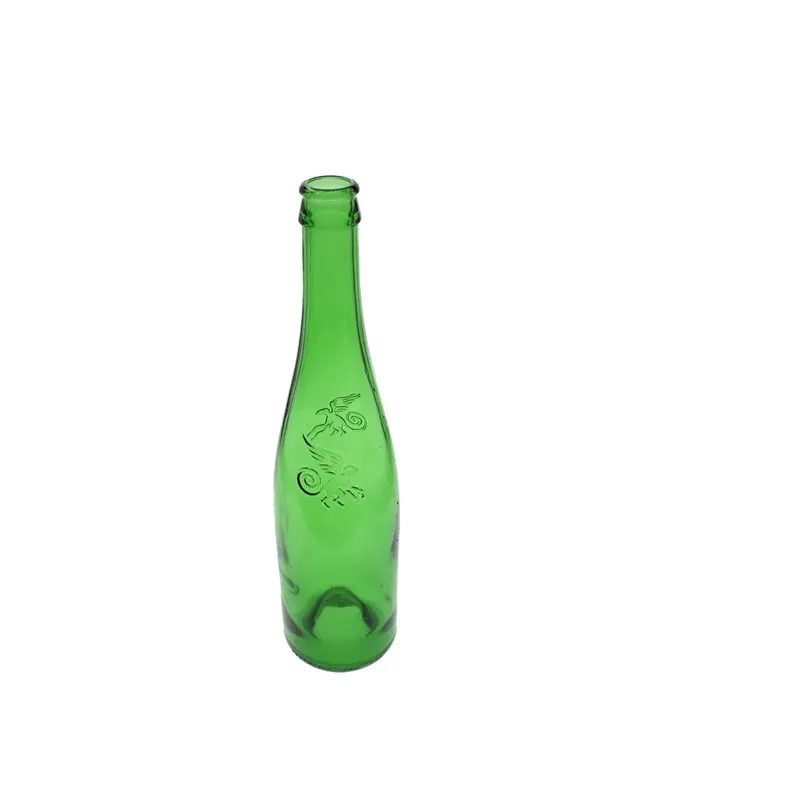
Filed under glass beer bottles; the moulds we quote for this are pictured at the foot of the page.
A wholesale order of 12 oz (roughly 355 ml) long neck crown bottles is won or lost in the loading plan, not on the unit price. A 20GP offers roughly 33 cubic metres and a 40HQ roughly 76, and with this bottle the box fills up by volume long before it reaches its weight limit, so the packing form, the pallet footprint and the stack height decide how many bottles share the freight bill. Two quotations for the same bottle only compare once those three inputs match, and the landed cost per bottle is a stack of about a dozen separate lines on top of the glass itself.
Receiver limits to collect before any pack is chosen
Containers are filled with pallets, so planning begins one level down. Before asking anyone how many bottles fit in a box, find out what the receiving site can physically take. Three ceilings apply, and each has to be checked against the other two.
Pallet footprint
Metric markets mostly work with 1200 by 800 mm or 1200 by 1000 mm pallets, while North America uses a 48 by 40 inch base. Ask the destination which one it expects, because some customers publish their own pallet specification and a pool pallet from one country cannot always be swapped for its counterpart elsewhere. Keep the load inside the pallet edge. Very little overhang is tolerable, since a bottom-layer case that sticks out takes the first knock of the journey.
Wood that crosses a border counts as regulated packaging material. Pallets and crates normally need ISPM 15 heat treatment or fumigation, and the mark has to be visible. Decide early whether the plant provides compliant pallets or the buyer supplies them, because that is a commercial point as much as a technical one.
Stack height
Height answers to three masters: the container door and roof, with room left to load; the racking or handling height at the receiving warehouse; and whatever load height the customer's storage accepts. The last of these is frequently lower than the container would permit. A pallet built right up to the container's limit can be entirely legal and still useless on arrival, so get the maximum receiving height in writing before a loading plan is drawn.
Pallet mass
Glass pallets are heavy, and the limit usually comes from the equipment that moves them. Check what the receiver's forklift, pallet truck and racking are rated for, and check that the pallet itself carries a rating for the load. A stronger pallet holds more but also weighs and costs more, which adds to freight. It is a small optimisation, yet repeated across a year of shipments it shows up.
Packing forms for 12 oz bottles compared
No packing form is right everywhere. The choice follows the destination: who unloads, whether a depalletiser is on site, whether the box carries one SKU or several, and how much the market charges for handling secondary packaging. A distributor feeding a bottling line through an automatic depalletiser wants bulk pallets and values every bit of cube. An importer splitting a container into van drops for several customers needs cases, because a case can be picked and a pallet of loose glass cannot.
The comparison below is a working reference, not a quotation. It cannot give a bottle count by itself, since the count depends on the exact bottle, pack and pallet. Pay most attention to the right-hand column, which lists what we ask a plant to put in a written loading plan instead of accepting a verbal assurance.
| Packing form | How the pallet quantity is counted | Effect on a 20GP or 40HQ | Where breakage starts | Ask the plant to confirm |
|---|---|---|---|---|
| Bulk on layer pads under a shrink hood | Bottles per layer times number of layers, a pad separating every layer | Best cube efficiency available, so pallets and bottles per container peak here | Glass touches glass throughout, and the lowest layer takes every accumulated road shock | Layer pattern drawing, pad material, hood specification, tallest stack the pattern has been validated at |
| Shallow corrugated tray with shrink film | Trays per layer and layers per pallet, at a declared twelve or twenty four bottles a tray | Trays add little height, so the loss against bulk is modest and pallet count normally holds | Rim contact where a tray edge passes compression down, and film that relaxes in transit so trays open | Board grade of the tray, film shrink and tension, whether trays sit on the bottles below or on a top pad |
| Sealed carton, bottles loose inside | Cartons per layer and layers per pallet, with a carton count that divides cleanly into the pallet build | Takes the most space per bottle among the usual forms, giving the fewest bottles per box and the dearest freight share | Bottles knocking together in the case, plus crushed corners when cases are stacked too high | Case compression strength, case size against the footprint, the pattern inside the case so the count can be reproduced |
| Sealed carton with corrugated partition | As the loose carton, the partition fixing the cell layout | A little less efficient than the same carton unpartitioned, because the dividers occupy room | With a correctly sized partition, what remains is risk to the case, not to the bottle | Cell size against the tolerance on bottle diameter, and whether partitions arrive assembled or flat |
| Retail ready pallet: corner boards, top cap, stretch wrap | Set by the retail presentation unit, since the pallet itself is what gets sold | Boards and cap cost some cube against bulk, and the retailer's height limit applies | Crushed corners at the base and film rubbing on the outside columns | Retailer's pallet specification, height ceiling, wrap pattern, exchange or one way pallet |
| Several formats in one container | Every SKU keeps a pallet or part-pallet basis of its own, and the container caps the total | Total pallets and total mass are what bind, and loading order must follow unloading order | Unstabilised part pallets, and neighbouring stacks of unequal height with no blocking between | Written plan giving the SKU sequence, each part pallet wrapped and labelled to come off separately |
In short, bulk and tray packs trade control for cube and cartons do the reverse. Bulk stacks bottles straight onto the pallet and protects least against contact. Trays stop bottles spreading and run well on a palletiser, which makes them the everyday pack for glass. Cartons protect best, cost most to pack and eat the most container space. Corner boards, a top cap and edge protection beneath the stretch film can be added to any of them, and they are what keep the outside columns from collapsing under a tensioned strap or a second pallet.
One point is missed in bottle loading plans more than any other. Stack height is set by the top of the closure, not by the case, and in a column-stacked pallet the compression travels through closure and case wall together. A case that tests strong when empty proves nothing about the stack, because the bottles carry part of the load. So the case specification, the closure and the number of layers have to be agreed in a single conversation.
Working out what a 20GP and a 40HQ hold
Every container has a volume limit and a mass limit, and the two must be calculated separately. Internal volume is roughly 33 cubic metres for a standard 20GP and roughly 76 for a 40HQ, a ratio near two point three. Payload allowances sit far closer together, and the exact figure shifts with the tare of the box, the carrier's limit on the road leg at either end and the law in the destination country. Size selection is therefore mostly a volume decision, and a 40HQ should never be treated as a pair of 20GP loads.
A 355 ml bottle is mainly air wrapped in glass, so volume runs out early. For a first estimate, take the bounding cylinder of one packed bottle, which for a long neck comes to something like half a litre before packing allowances. Multiply by the bottle count, apply an efficiency factor for the tray or carton pattern, and divide the result into the container's internal volume. A 20GP comes out in the tens of thousands of bottles with payload to spare.
Heavier specifications narrow that margin. Thicker glass, partitioned cartons, wooden pallets and full-height stacks all add weight, and a 40HQ filled near its volume limit can come close to its payload ceiling. Work out both limits, use the lower, then test the answer against the destination road leg. The container rate is not the whole freight cost.
Pallet counts by footprint
Small footprint changes move the pallet count, so confirm it. Typical figures are:
- 1200 by 800 mm: ten or eleven pallets in a 20GP, twenty three to twenty five in a 40HQ.
- 1200 by 1000 mm: about nine or ten in a 20GP, twenty to twenty one in a 40HQ.
Hand-stacked loads on non-standard bases, or loads on slip sheets with no pallets at all, change the sums again. When a quotation states that a container takes so many bottles, ask which footprint, which packing form and what stack height sit behind the figure. Those inputs recreate the number, and without them it cannot be checked.
The same discipline applies to comparing offers. A bulk quotation and a carton quotation that each promise a full 40HQ describe two different loads. Delivered cost per bottle is comparable only when both are built on an identical pack, footprint and height.
How glass loads get damaged in transit
A broken load seldom traces back to a single incident. More often a stack that left the plant stable has been shaken loose over several thousand kilometres, while the paper around it has been softening. Corrugated board loses compression strength as humidity climbs, so a carton that performs in a dry warehouse may give up a large share of its stacking strength during a humid sea passage. Tropical routes and unventilated boxes are harder on bottles than the rated capacity of the container implies. For such routes we ask for a higher safety factor on case compression, a shorter stack and, where the lost volume can be afforded, moisture-resistant packaging.
Five mechanisms account for nearly all of it:
- Top load. Everything above presses on the bottom layer without pause. In column stacks the force runs through cases, bottles and closures alike, so closure height and case height must be uniform across the load. Changing the pack count while keeping the old case leaves it over- or under-filled, a frequent reason for a leaning stack.
- Vibration and abrasion. Constant tiny movement between touching bottles scuffs the surface, and that fine damage becomes a weak point later. Interlocked layers shift more than columns do, so they gain road stability and pay in contact wear. A tray wall or partition breaks the contact path. Treat this as a design trade-off, not a fault.
- Shock. Potholes, rail coupling and port handling deliver sharp, high-acceleration jolts. If a pallet can slide, the jolt ends against the container wall. Bracing, blocking and, where suitable, dunnage bags between the final pallet and the doors are required, not extras. A tight load is protected by the box around it, and a load with gaps has no protection.
- Thermal shock and condensation. A fast temperature difference across the glass wall can start a crack. Moisture condensing inside a sealed box weakens cases and may mark labels. Shield cargo from sudden temperature swings at loading and unloading, and do not stack warm pallets against a cold surface.
- Handling at each end. Careless clamp-truck work destroys the outside layers, and a large portion of transit claims arise during unloading. Match the pack to equipment the receiver really has. Bulk pallets need a depalletiser or an order picker, and without one staff will break bottles while stripping the pallet by hand. In that case cartons cost less overall, despite costing more to ship.
Inspection, transit testing and damage records
Two checks are worth agreeing before the first shipment, and both need to be documented. Pre-loading sampling inspection on an attribute plan, for instance on the ISO 2859-1 basis with an acceptance quality limit chosen by the buyer, shows that the glass matches the drawing. Physical distribution testing to an ISTA series protocol that fits the real shipping mode shows that the pack and pallet build survive the trip. Without that evidence a claim tends to be settled on the carrier's terms.
Agree the counting method for damage as well. Record breakage at the moment of unloading: photographs before any pallet moves, a count with the carrier's representative present where possible, and a written note of how many pallets and layers are affected. Damage reported a week on, once pallets have been restacked, is very hard to attribute. For larger volumes, all risks cargo insurance usually responds more readily than a carrier's limited liability, and its premium should be in the landed cost from the first calculation.

Trade terms and the point where risk passes
A trade term settles more than the figure on the invoice. It fixes who owns the cargo at each stage, who books transport, who bears the risk and who absorbs a loss. Name the current edition of the Incoterms rules in the contract, since identical three-letter codes carried slightly different meanings in older editions.
| Term | What the seller does | Where risk passes | What it means for a glass order |
|---|---|---|---|
| EXW | Makes the goods available at the plant door and nothing further | At the plant, often before loading | The buyer pays for and organises loading, haulage, export clearance, port, ocean and destination leg. Loading risk falling on the buyer is awkward, since the seller knows the pallets and has the right equipment. A poor fit unless a forwarder is already appointed. |
| FCA | Clears for export and hands over to the buyer's nominated carrier | At that handover | Often cleaner than FOB for containers, because goods really are handed over at a terminal or depot and not lifted across a ship's rail. |
| FOB | Places the goods on board at the loading port | On board at the loading port | Still the market habit for containerised glass, although recent editions point container traffic to FCA. Write it with the named port and agree which origin terminal handling charges fall to which party. |
| CFR / CIF | Pays freight to the destination port, and under CIF also arranges cargo insurance | At the loading port, as with FOB | Paying freight is not the same as carrying risk. CIF insurance is a minimum standard, so broader cover has to be requested and paid for. |
| DAP / DPU / DDP | Delivers to a named place, with DDP extending to import duty clearance | At the named place | One delivered figure and no import mechanics for the buyer, with all delay and customs risk on the seller. A DDP offer made without detailed questions about the destination is usually an estimate. |
Buyers with a forwarder, a warehouse and a wish to control routing generally do best on FCA or FOB, which keep the shipment visible. Buyers with no import capability who want a single figure can use DDP and accept that convenience carries a cost. Under every term, two operational questions remain: who answers for delay, and who documents damage. Those are the two expensive ways a glass shipment fails, and the term alone resolves neither.
Cost lines that make up a landed cost per bottle
Landed cost is a build-up of items that each behave differently, and going through them in sequence is the only dependable way to compare quotations written on different terms. Figures for every line are quoted per project. What follows is the checklist we use so nothing is left out.
- Glass at the plant. Quoted per bottle or per thousand, stating packing form, pallet footprint and who owns the pallets. Lacking any of those, the figure cannot be compared with another.
- Origin haulage and export handling. Plant to loading port, with loading, origin terminal handling and export papers. The trade term decides whether this sits with the goods or with the freight.
- Ocean freight and surcharges. A base rate, fuel and currency adjustments, and any peak season or equipment surcharge. Surcharges move on their own schedule, which is why costs drift inside a fixed annual contract.
- Marine insurance. Based on cargo value and the level of cover. Minimum and all risks cover differ in premium and, more to the point, in what they will pay for.
- Import duty and taxes. Duty follows the bottle's tariff classification in the destination market and any preferential arrangement in force. Value added tax or an equivalent is generally recoverable but ties up cash. Verify against the real classification, not a similar past shipment.
- Destination port and clearance. Terminal handling, documents, customs brokerage, inspection if the box is selected, and demurrage or detention once free time expires.
- Destination inland delivery. Drayage from port to warehouse with chassis and lift fees, and a further leg when the customer is away from the port.
- Returnable equipment. Pallet deposits, exchanges, pool fees and one way pallet charges. On palletised glass these matter per bottle and are often left out of comparisons.
- Damage allowance. Expected breakage net of claim recovery, sized by pack and route.
- Compliance and packaging levies. Some markets charge importers an extended producer responsibility fee or packaging levy by mass and material, a direct reason to prefer packs with less secondary packaging.
- Working capital and storage. Financing goods on the water, and financing the safety stock that covers the line until the following shipment lands.
Two conclusions follow. Freight per bottle depends on volume at least as much as on mass, so a bulkier pack costs more than its own material. And glass has a long cash cycle, so the capital tied up in a container belongs in the landed cost and is not just a matter for the finance team. Both argue for ordering quantities that fill the box properly, not quantities that happen to be convenient.
Ordering by the pallet or on an annual programme
A craft brewery taking its first pallet and a contract packer covering a year of filling are buying the same bottle in two different ways, and the mechanics should differ.
Small batches
The workable routes are a part load or consolidated shipment, a pallet-level release, or a container shared among several formats or products. Flexibility is high and stock commitment low. Against that, freight per bottle rises, the goods are handled more often and mixed pallets are more exposed to damage. Three rules help:
- Stay on a standard pallet footprint, so a part load consolidates with no re-palletising.
- Specify the pallet build the receiver can handle, not the one that loads cheapest.
- Choose the pack for protection ahead of cube, because one part load cannot carry the cost of being remade.
Annual volume
Here the buyer issues a forecast and a release schedule in place of single orders. A useful structure is a rolling forecast split into a firm window and a longer planning window, called off in tranches on agreed dates, with timing defined for each release and commercial reviews linked to published glass and energy indices. The plant gains real planning certainty from this. In return the forecast has to be honest and not inflated to win allocation. Where a format is assigned to particular moulds, calling off materially less than the allocation becomes a commercial problem, not just a scheduling one.
Setting the reorder point
The 12 oz long neck is a standard item for which most plants already hold moulds, so tooling does not govern timing. Production scheduling and shipping do. The reorder point equals the total time from release to warehouse arrival plus safety stock, and that total includes production scheduling, any inspection, inland haulage, port handling, ocean transit, possible transhipment, destination clearance and final delivery. A line that runs dry on a Friday gains nothing from knowing customs caused the delay.
Because the sea leg is the long part on most routes, safety stock is the buyer's main lever. Size it to the variability of demand, not the average, and calculate it openly. On a continuously running line a stoppage normally costs more than extra inventory, which supports a buffer of at least one full transit cycle on a slow route. Seasonal demand calls for building the buffer ahead of the season, not spreading it evenly.
Whatever the rhythm, hold the packing form and pallet footprint steady from shipment to shipment where possible. Altering either changes the loading plan, the pallet count and often the case specification, and loading mistakes and damage claims cluster around exactly those changes.
What to send for a loading plan, and where related decisions sit
A loading plan cannot be drawn from a photograph of a bottle. To prepare one for a specific configuration, we need:
- annual volume and the quantity of the first release;
- destination port;
- preferred packing form, or the unloading equipment at the receiving site;
- pallet footprint and maximum stack height;
- the trade term you plan to buy on;
- whether pallets are to be supplied or exchanged;
- release dates, if the filling line runs to a fixed schedule.
If bulk versus cartons is still undecided, tell us the destination and how the load will be unloaded. The unloading method usually settles it, and the freight gap between the two forms is far smaller than the cost of a load nobody can handle on arrival.
Everything above assumes the format is already fixed. Capacity, finish, tolerances and compatibility with your filler, labeller and crowner should be closed first, because changing format after a pallet is designed means starting the loading plan again. Broader volume buying and the question of which plant can hold a specification for a year are covered with our beer glass bottle range. A bespoke neck, a non-standard body or embossing moves the project into tooling and sampling, described under custom beer bottle development. The shorter, wider 330 ml shape loads differently because of its lower height and broader body, and is treated on the stubby beer bottle page.
The stakes differ by decision. A wrong format wastes a mould and a line trial, a wrong supplier wastes a year, and a wrong loading plan wastes a container.
Frequently asked questions
How many 12 oz beer bottles fit in a 20GP or a 40HQ?
No fixed figure exists. The count comes from four inputs: the layer pattern, layers per pallet, pallets per container and the assumed stack height. Since the container fills by volume first, tighter packs and thinner secondary packaging raise the number. Ask for those four inputs in a written loading plan and the count can be verified.
Is bulk or carton packing the better buy?
Let the receiving site decide. Bulk and tray packs use space best and need less packaging, but the destination must be equipped for full pallets of loose glass. Cartons suit importers who pick part of a load for several customers, and they avoid hand repacking at destination, which is why they often work out cheaper overall there.
What usually breaks bottles inside a container?
Generally a mix of top load, prolonged vibration and an unrestrained load that was free to move, made worse when humidity weakens the cases. Block or brace the last pallet, keep stacks inside the case specification, and separate bottles with a tray or partition wherever they could touch.
How do FOB and CIF differ on a bottle order?
They differ in who pays ocean freight and insurance. They do not differ in risk, which passes at the loading port in both cases. CIF includes only minimum insurance, so all risks cover must be specified. Either way, write the named port and the split of terminal charges at each end into the contract.
Can several bottle formats travel in one container?
Yes, and small orders commonly reach a full container load this way. Watch total mass against the route limit, put the first item to come off nearest the doors, and keep each SKU on its own wrapped, labelled pallet or clearly separated part pallet. Sorting at destination adds a cost that should be set against the freight saving.
How much lead time should a repeat order allow?
Timing is confirmed per project and varies with route and season, so plan on the total from release to delivery and not on production time alone. Ocean transit and clearance are usually the longer portion. Express safety stock as cover over that total instead of a fixed quantity, and have the current timing and release schedule confirmed in writing instead of relying on a previous shipment.
What belongs in a request for a wholesale quotation?
Beyond the items listed for a loading plan, state the format and nominal capacity, the maximum pallet mass, and whether this is a repeat programme with a forecast, because a release schedule shapes the offer as much as quantity does. A reply that states the packing form, pallet build and trade term can be compared with another. A bare unit figure cannot.