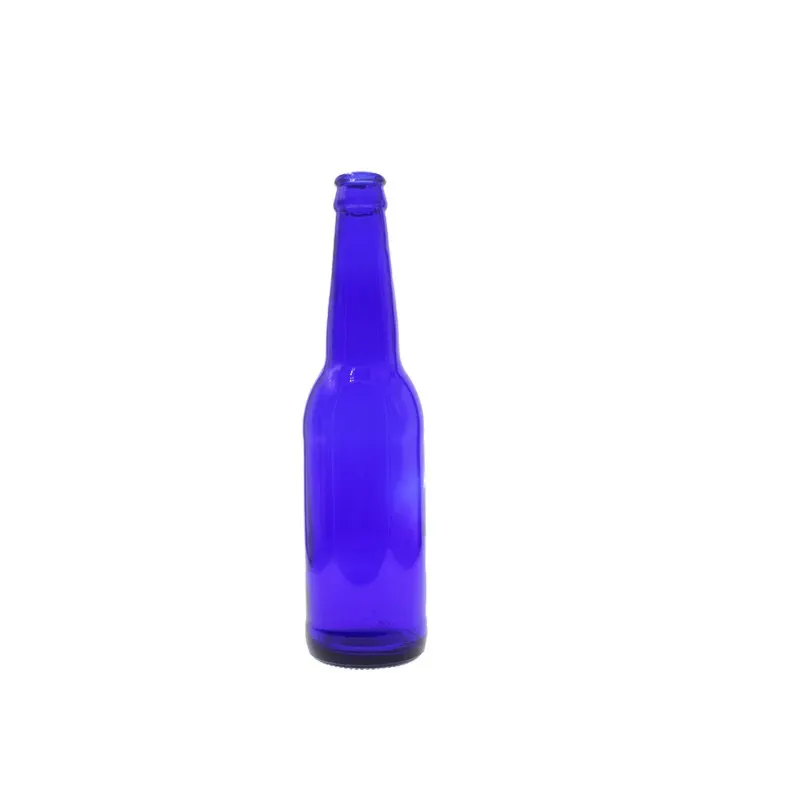
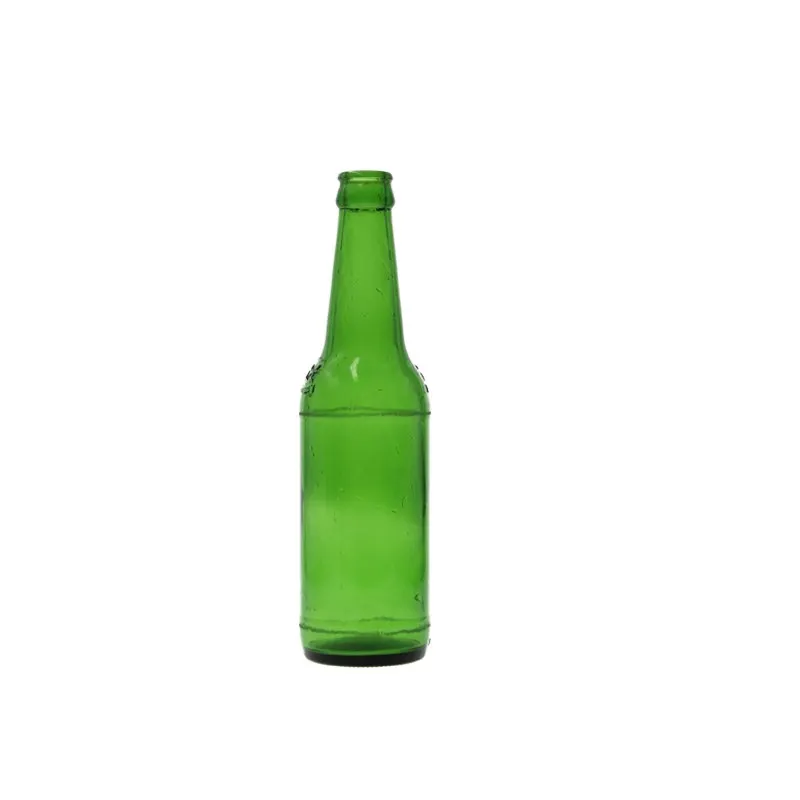
Part of our empty beer bottles range; the stock moulds are pictured at the end of this guide.
Quick answer
What is the standard beer bottle size?
There is no single standard, but four sizes cover most orders: 330 ml, 355 ml, 500 ml and 750 ml. The 355 ml bottle, sold as the 12 oz beer bottle, leads North American craft and contract work; 330 ml is the usual European size and 500 ml is common in continental Europe. Most beer bottles close with a 26 mm crown, but finishes coded 26-611 and 26-600 are not interchangeable.
| Format | Capacity | Finish |
|---|---|---|
| Stubby | 330 ml | 26-611 crown |
| Long neck | 355 ml | 26-611 crown |
| Steinie | 330 ml | 26-600 crown |
| Vichy | 500 ml | 26-611 crown or swing top |
| Belgian style | 750 ml | 26-611 crown or swing top |
This page is written for the buyer who has already decided that beer goes into glass and now has to answer a shop-floor question: which format, and will it actually run on the line I already have. That is a different question from the one most pages about beer bottle sizes answer. The first page of results for this term is almost entirely homebrew guidance, written for someone filling twenty bottles on a kitchen bench with a hand capper. That audience needs a bottle that fits a bench capper and a shelf. A production buyer needs a bottle that survives a depalletiser, a star wheel, a filler valve pitch, a crowner head, a labeller and a palletiser at a defined speed, and that arrives at the destination market legally labelled and undamaged. Those two conversations share vocabulary and almost nothing else. Everything below is the factory-side conversation: the format, the finish, the tolerances and the line interfaces. It deliberately does not cover container quantities, pallet build, ocean freight or free-on-board terms, which are the subject of the wholesale page, and it does not cover new mould development, decoration development or tooling approval, which are the subject of the custom beer bottles page. The stubby format has a page of its own because it behaves differently from a long neck on a modern line, and supplier-selection evidence belongs on the manufacturer page. Those four pages are linked again at the end of this article so the boundary is explicit rather than implied. Volume buying and tooling are separate decisions and they are made after the format is fixed, not before.
Why “Beer Bottle Sizes” Is a Line Decision Before It Is a Product Decision
Ask ten suppliers for beer bottle sizes and you will receive ten capacity lists. Ask a filling line the same question and you get a different answer, because a line does not see capacities. It sees a stack of mechanical interfaces stacked on top of each other: a body diameter that has to sit in an accumulation lane without shingling, a neck that has to be gripped or supported while the bottle crosses a transfer, a finish that has to accept a crown without cocking, a shoulder that has to clear the filler valve shroud, a height that has to sit inside a sensor window, and a centre of gravity that has to survive a change of direction at speed. Capacity is the number the brand owner puts on the label. It is the last variable the line cares about and the first one the buyer asks about.
This mismatch is why format selection so often goes wrong in a way that costs money twice. A first order is placed against a capacity and a photograph. The bottles arrive and the beer is excellent. Then the first full-speed run starts, and the bottle that looked identical to the incumbent either jams at the star wheel because its body diameter is half a millimetre larger, or leans at the crowner because its neck ring sits at a different height, or breaks at the labeller because the wall thickness distribution puts more glass in the shoulder than the label belt expects. Nothing is defective. The format simply does not match the machine.
The practical way to avoid that is to treat the format as a specification with a fixed order of precedence. Capacity is negotiated first with marketing, because it is the only variable the consumer sees. Everything after that is engineering, and the engineering order is: finish first, because it is cut into the mould and cannot be changed later; body diameter next, because it determines the lane, the star wheel and the case; height third, because it drives the sensor window, the change parts and the pallet pattern; weight last, because weight is an outcome of the first three plus the wall distribution that the mould produces. A buyer who negotiates in that order reduces the chance of a second tooling round to almost nothing. A buyer who negotiates capacity, height and colour first and the finish last will eventually pay for a mould.
The Four Dimensions That Actually Define a Beer Bottle Format
Nominal capacity. The number on the specification, for example 330 ml or 12 oz, is a nominal figure. The glass as moulded will hold more than that, because the fill height sits below the rim. The difference between brimful capacity and nominal capacity is not a manufacturing error; it is the headspace the filler needs. Two suppliers quoting “500 ml” can differ by fifteen to twenty millilitres in brimful capacity, which changes the fill level, the foam behaviour and the declared net content tolerance. Always ask for brimful capacity and the intended fill height rather than accepting the nominal figure alone, then confirm the declared net content against your own market’s labelling tolerance.
Finish. The finish is the moulded neck section that the closure engages. For beer this is nearly always a crown finish, written as a diameter in millimetres followed by a specification suffix, such as 26-611 or 26-600. The 26 is the nominal crown diameter. The suffix describes the profile of the finish: the crown seat, the bead or thread form, the neck ring position and the guiding surface. Two bottles can both be described as “26 mm crown finish” and still not be interchangeable, because the suffix is doing the actual work.
Body diameter and cross-section. This is the dimension that governs the line more than any other, and the one most often omitted from a request for quotation. The nominal diameter comes with a roundness tolerance, and it is the tolerance rather than the nominal value that causes jams. A body that is nominally 60 mm and actually 60.4 mm at the widest point will run on one conveyor and stall on another, because the lane width was set for a 59.8 mm worst case.
Height and verticality. Height determines whether the bottle clears the filler shroud, whether the crowner can present the crown squarely and whether the height sensor reads the bottle rather than the label. Verticality, sometimes called lean, is the deviation of the finish centre from the base centre. A bottle that is 2 mm taller than the incumbent is usually manageable. A bottle with an out-of-specification lean is not, because the crown is presented to the finish at an angle and the seal closes unevenly around the circumference.
Weight. Weight is not a design input. It is the visible outcome of glass distribution, and it is the cheapest early warning that a mould is running unevenly. Two formats of the same capacity can differ by tens of grams while both meeting the same capacity specification, and the heavier one is not automatically the stronger one. Wall thickness distribution matters more than total weight, which is why a weight figure without a distribution specification is close to useless.
Finish Codes, Crown Closure Geometry and What the Numbers Mean
A crown closure holds pressure by crimping a metal skirt over a moulded bead on the finish. The crown has a soft liner, historically cork or a cork composite and today most often a polymer compound, and that liner takes up the small imperfections in the glass. The seal is a compression joint, which means its quality depends on three things happening together: the crown’s internal dimensions, the finish’s outer profile and the crimping head’s alignment and pressure. Change any one and the seal changes.
The crown itself is sized in millimetres of diameter but ordered in millimetres of finish. A 26 mm crown is the standard beer closure in most markets and is what the 26- finish codes accept. Within that family, the practical distinctions a buyer has to settle are these.
Pry-off versus twist-off. A pry-off crown needs a tool to remove and can be crimped harder, which suits higher carbonation. A twist-off crown is removed by hand and needs a finish with a thread-like interrupted bead that allows the crown to be turned off. Twist-off finishes are a different profile from pry-off finishes even at the same nominal diameter, and a twist-off crown on a pry-off finish will not seal reliably. Decide this before tooling, because it is a mould decision.
26-611 against 26-600. Both codes sit in the 26 mm crown family and both are common on beer work, but they describe different finish profiles and different crown-seat geometry. A capping head set up and validated for one will not necessarily seal the other correctly without re-setting. This is the single most common source of “the crowns leak but the supplier says the bottles are within tolerance”: both statements are true, because the crown was qualified on the other finish.
Neck ring position. The neck ring is the moulded ledge used by gripper and neck-handling equipment. Its position relative to the finish top determines the transfer height and the crowner’s approach. Two bottles with identical finishes and different neck ring heights are not drop-in replacements on a neck-handling line.
Bore and liner compatibility. The internal bore is set by the mould, and it sets the fill nozzle clearance. A filler set up for a narrow-bore neck will deliver a different flow profile and foam behaviour on a wide-bore one, which shows up as inconsistent fill heights long before anything looks wrong. When a supplier sends a range of beer bottle oz options on one page, the bore is usually the number that is not shown and the one that matters most to the filler.
Tolerances and How a Format Is Actually Inspected
Tolerances on glass containers are not a single figure. They are a set of dimensions, each with its own permitted deviation, defined in the signed drawing and checked at a defined frequency. A buyer who receives a specification sheet with one line for “height” and no tolerance has received marketing material, not a specification.
The dimensions that should be on the drawing, each with a value and a tolerance, are: finish outer diameter at the crown seat, finish height, neck ring diameter and position, body diameter at the specified measuring height, overall height, verticality, brimful capacity, and wall thickness at defined points around the body and shoulder. On decorated or embossed formats, add the raised lettering height, because it interacts with label application and with palletising pressure.
Industry practice for checking these is a mixture of gauges and measurement. Go and no-go gauges are used on the finish, because the finish is the dimension where speed matters in production. Body diameter, height and verticality are measured with callipers, height gauges or optical systems on a sampling basis. Brimful capacity is measured by filling and weighing, and the water capacity figure is the one to compare against the drawing rather than a nominal marketing value.
Sampling is normally written into the purchase order rather than assumed. ISO 2859-1 is the common basis for attribute sampling, and the acceptance quality limit, or AQL, is a commercial decision made by the buyer, not a default offered by the factory. The useful structure is to define critical, major and minor defect classes yourself, then place the tightest level on the dimensions that stop a line: finish dimensions, verticality, and any dimension that interfaces with the crowner. Cosmetic faults on a bottle that will be shrink-sleeved are not the same risk as a finish that is out of tolerance. On the physical side, ISTA test protocols are a common reference when a parcel or pallet has to survive a distribution test, and asking whether the intended pallet configuration has been distribution-tested is a more useful question than asking whether the factory “has good quality”.
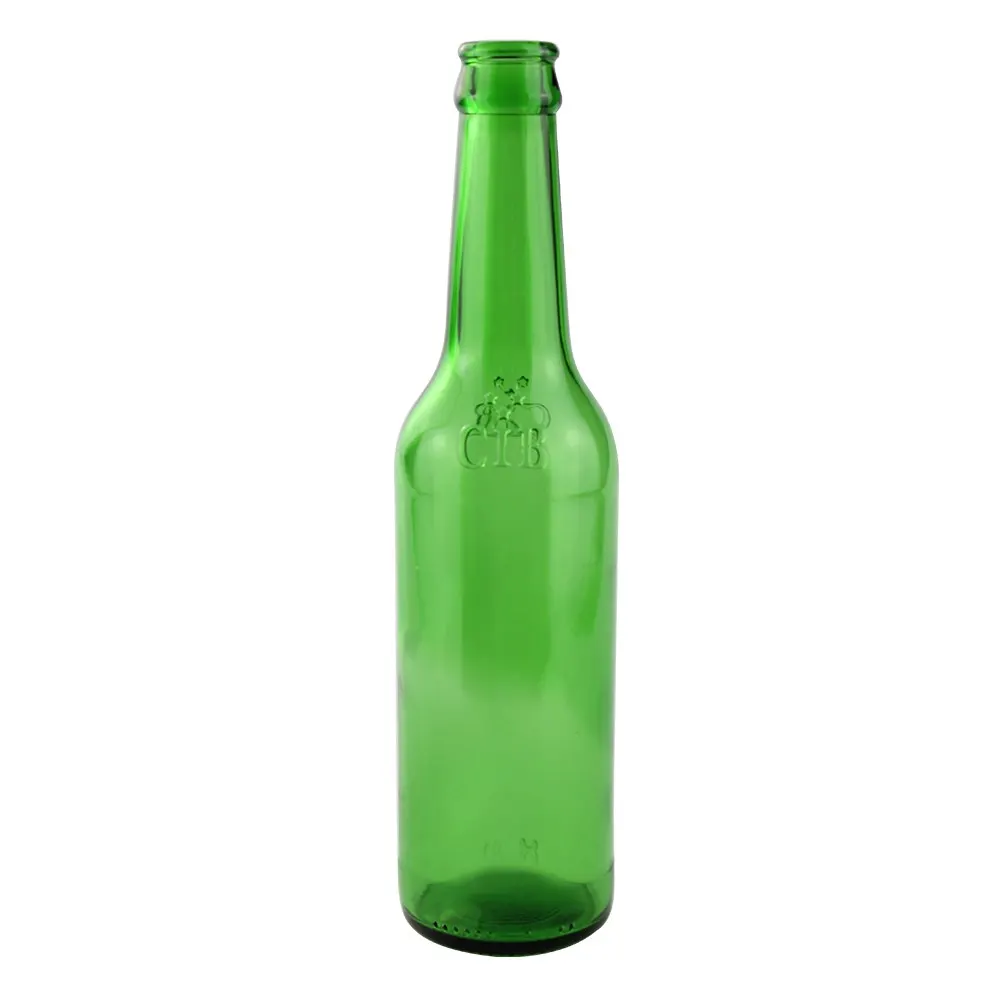
Beer Bottle Format Reference Table: Capacity, Finish, Weight and Line Fit
The table below is a working reference for the formats that appear most often in beer enquiries. Weight figures are indicative bands drawn from typical production, not a quotation, and every band moves with the mould, the wall distribution and the decoration. The signed drawing governs the order; treat this table as the shortlist you take into a technical discussion, not as a specification.
| Format | Nominal capacity | Neck finish | Reference weight | Fits which filling line | Common pitfall |
|---|---|---|---|---|---|
| Stubby | 330 ml | 26-611 crown, pry-off | Approx. 170-200 g, drawing governs | Standard pressure filler with body-handling change parts; short height keeps the sensor window narrow | Short body and wide shoulder make glass-to-glass contact more likely in accumulation; carriers are rarely set for it |
| Long neck (12 oz beer bottle) | 355 ml | 26-611 crown, pry-off | Approx. 175-210 g, drawing governs | Neck-handling lines, standard beer monobloc, wrap-around labeller | The most copied format in the market, so the neck ring height is where different suppliers diverge; specify it |
| Steinie | 330 ml | 26-600 crown, pry-off | Approx. 180-215 g, drawing governs | Same filler as long neck, but check label belt position because the straight body runs higher | Finish is often assumed to be interchangeable with long neck; a crowner set for 26-611 will not seal it correctly |
| Vichy | 500 ml | 26-611 crown, pry-off | Approx. 280-340 g, drawing governs | Higher-speed beer lines; tall format suits multi-lane accumulation | Height and mass combine to raise pallet pressure and top-load risk; confirm the case and pallet pattern early |
| Vichy with swing top | 500 ml | Swing finish, bail wire | Approx. 330-420 g including closure, drawing governs | Small-batch and craft lines with manual or semi-automatic closing; not a high-speed crowner format | Bought as a 500 ml substitute for crown Vichy without checking that the capper can be bypassed |
| Belgian style | 750 ml | 26-611 crown, pry-off, or swing finish | Approx. 480-620 g, drawing governs | Lower-speed specialty lines, often with manual handling and secondary refermentation | Pressure is the real limit, not the format; refermentation raises internal pressure and the closure choice has to be made for that |
Read the table as a sequence of eliminations rather than a menu. Start with the closure your market and your beer style require, because that fixes the finish family and therefore the mould. Then remove every format whose body diameter falls outside the acceptance window of your existing change parts. Then remove formats whose height puts the finish outside the crowner’s stroke or outside your sensor window. What remains is usually two formats, and the choice between them is a marketing decision about shelf presence rather than an engineering one. Buyers who work in the opposite direction, choosing a shape they like and then asking whether it runs, spend their engineering budget on change parts instead of on the beer.
What the Filling and Packaging Line Needs Before a Format Can Be Confirmed
Format approval is not a bottle-only exercise. Before a format is frozen, the following line information has to be collected and compared against the drawing. Without it, any answer a supplier gives is a guess.
- Conveyor lane width and rail setting. The acceptable body diameter window, including the largest permitted diameter on the drawing, not just the nominal one.
- Star wheel and change parts. The pitch and pocket radius the machine is tooled for. A format change of more than a fraction of a millimetre in body diameter usually means new change parts, and that is a cost and a lead time item to be planned before the order, not discovered during commissioning.
- Handling method. Whether the line grips the bottle by the body, by the neck, or by air above the neck ring. Neck handling is far less tolerant of neck ring height variation and of lean.
- Filler type and valve pitch. Counter-pressure, gravity or volumetric filling, and the valve centres. The bore of the neck interacts with the fill nozzle clearance and with foam generation.
- Crowner or capper head. The head’s crown size, the crimping dimension and whether it has been qualified on the exact finish code in question. This is the interface most often assumed rather than verified.
- Labeller type. Wrap-around, spot or roll-fed. Wrap-around labellers need a consistent body diameter and a predictable surface; a format with raised lettering or a strong taper changes label placement.
- Line speed and accumulation pressure. The target bottles per hour and the maximum back-pressure the accumulation table produces. Lightweighting a bottle to save glass cost without recalculating accumulation pressure is how breakage appears at the end of a run rather than the start.
- Fill temperature and carbonation level. Cold filling and higher carbonation both raise the pressure the bottle and the crown must hold, and they change the headspace and foam behaviour that set the fill height.
- Pasteurisation. Tunnel or flash pasteurisation adds a thermal cycle that stresses both the glass and the closure, and it should be declared at the specification stage rather than after the first order.
Two of these items are frequently missing from enquiries and cause most of the avoidable rework. The first is the crown qualification: buyers confirm the finish code but not whether the capping head has actually been set and validated on that code. The second is the accumulation pressure at full line speed. Both are cheap to resolve in a written specification and expensive to resolve on a commissioning day.
Failure Modes That Trace Back to a Format Mismatch
The useful way to diagnose a line problem is to work backwards from the symptom to the dimension. The following patterns account for a large share of complaints that arrive described as quality problems when they are in fact format problems.
Jamming at the star wheel or at a transfer. Almost always a body diameter or roundness deviation, not a “bad batch”. Check the largest permitted diameter on the drawing against the lane and pocket setting. If the largest permitted diameter is larger than the incumbent’s, the format is the cause.
Crowns that leak or sit cocked. A finish profile mismatch, a crimping head set for another finish code, or excessive lean. Inspect the crown after crimping: an uneven skirt deformation points to lean or to head alignment, while a uniform but shallow crimp points to head pressure or a crown compound that is too hard for the finish.
Inconsistent fill heights across a run. Usually bore variation or foam behaviour, not a filler fault. Compare the actual bore against the drawing and re-check the fill temperature and carbonation level before blaming the valves.
Breakage at the labeller or at the palletiser. Often a wall distribution problem combined with top-load from the case. Weight alone will not show it; ask for the distribution specification and confirm the case and pallet pattern.
Scuffing and glass-to-glass abrasion. Contact damage during accumulation. Short and wide formats are more exposed because more of the body surface is in contact at any moment. Reducing line speed is a temporary fix; changing the rail setting or the format is the real one.
Label skew or poor adhesion on a wrap-around labeller. A body diameter variation that exceeds the label belt’s take-up, or surface geometry that the label was not trialled on. Trial the label on the actual format rather than on a sample of the format you used last year.
Height sensor faults and double-feeds. A height outside the sensor window, or a change in the finish height that moves the top of the bottle relative to the sensor. Confirm the overall height tolerance, not just the nominal height.
None of these are solved by changing supplier. They are solved by putting the dimension that governs the machine into the purchase order with a tolerance and a sampling rule, and by confirming the closure qualification on the exact finish code.
Where This Page Stops: Sourcing, Container Volume and Tooling
This page answers two questions and only two: which format, and whether that format will run. Three adjacent decisions sit outside it and are handled elsewhere on this site.
Container quantities, case and pallet configuration, loading patterns and the commercial terms that go with them are not format questions, and the format table above deliberately stops before them. If you already know your format and you need to work out how it loads, or to compare palletising options against a delivered cost, that work belongs on the beer glass bottles wholesale page. If your format is fixed and the open question is which supplier can produce it consistently and what evidence you should ask for before placing an order, that belongs on the beer bottle manufacturers page. If the format you need does not exist yet, or the finish is bespoke, or you need embossing or a non-standard shoulder, the decision moves out of selection and into development, and that belongs on the custom beer bottles page. If your interest is specifically the short, wide 330 ml format and how it behaves differently from a long neck on a modern line, that narrower discussion is on the stubby beer bottles page.
The boundary matters because the answers conflict. A format that is cheapest per pallet is not always the format that runs fastest, and a format that is ideal for a new mould is not always the one your existing crowner has been qualified on. Keeping the three conversations separate keeps the trade-offs visible instead of blending them into a single price.
Frequently Asked Questions About Beer Bottle Sizes
What is the standard beer bottle size for export orders?
There is no single standard, but four capacities cover most enquiries: 330 ml, 355 ml, 500 ml and 750 ml. The 355 ml format, often written as the 12 oz beer bottle, dominates North American craft and contract work, while 330 ml is the more common European reference point and 500 ml is widely used in continental Europe and in export markets that prefer a larger single serve. The deciding factor is usually the market’s labelling rules and the retail channel rather than the brewery, because the declared net content has to be permitted in the destination market and has to match the label artwork and the case configuration.
Is a 12 oz beer bottle exactly 355 ml?
No. Twelve US fluid ounces is approximately 354.9 ml, so the nominal figure is a rounded label value rather than a moulded capacity. The glass as produced will hold more than the nominal figure, because the fill height and the headspace sit below the rim, and the brimful capacity is the number that belongs on the drawing. When comparing suppliers, compare brimful capacity and fill height, then confirm the declared net content against the tolerance rules of the destination market.
Can I use the same crown on a 26-611 and a 26-600 finish?
The crown diameter is nominally the same, but the finish profiles differ in the crown seat and bead geometry, so the same crown will not necessarily seal correctly on both. In practice the capping head has to be set and qualified for the specific finish code. If you plan to run both formats on one line, treat that as two qualifications, and expect to reset or swap the capping head between them. Confirm the exact finish code on the drawing rather than accepting “26 mm crown” as sufficient.
Does bottle weight tell me how strong the bottle is?
Not on its own. Strength comes from the wall thickness distribution, the shape of the body and shoulder, and the thermal history of the glass, and a heavier bottle can still have thin spots in the areas that matter. A weight figure is useful as a consistency indicator across production runs, and as an input to pallet pressure and freight calculations, but it should always be read together with a distribution specification. Ask for the lightest and heaviest permitted wall thickness at defined points, not just an average.
Why do bottles that meet the drawing still jam on my line?
Usually because the drawing tolerance is wider than the machine’s acceptance window, or because the machine was set for the incumbent format rather than for the drawing. A line set up for a body diameter of 60.0 mm with a tolerance of plus or minus 0.2 mm will stall on a format that is compliant to the drawing at 60.4 mm if the lane width was closed to the incumbent’s worst case. When the bottles are inside tolerance and the line still stops, the mismatch is between two specifications rather than a defect in one of them.
Do I need a different format for a pasteurised or refermented beer?
Possibly. Pasteurisation adds a thermal cycle, and refermentation in the bottle raises internal pressure over time, so both change what the glass and the closure have to hold. The format does not automatically have to change, but the pressure the pack is designed for does, and that decision affects the closure choice as much as the bottle. Declare the process and the target carbonation at the specification stage, and confirm that the format and closure have been qualified for that pressure rather than for a standard fill.
What should be in the specification before I request a quotation?
Format name and nominal capacity, brimful capacity and fill height, finish code and closure type, body diameter with tolerance, overall height with tolerance, verticality limit, wall thickness distribution at defined points, glass colour, decoration method, process conditions including fill temperature and carbonation, pasteurisation if any, target line speed, and the destination market. Add the crown qualification status of your capping head and the sampling rule you intend to apply, including defect classes and the acceptance quality limit. A request containing those items can be answered with a technical response; a request containing only a capacity and a photograph can only be answered with a price and a promise.
Send Your Filling Line Specification and Target Market
Format compatibility cannot be confirmed from a capacity alone. If you send the finish code you intend to run, the closure type, your conveyor lane width and star wheel pitch, whether the line handles bottles by the body or by the neck, the filler type and valve pitch, the capping head’s current qualification, your target line speed, the fill temperature and carbonation level, and the destination market, we can respond on the specific interfaces rather than in general terms. The destination market matters because the declared net content, the label rules and the packaging expectations differ, and a format that suits one market may need a different fill height or label area for another. If you do not yet have all of those numbers, send what you have and flag the gaps; the gaps are usually the items that decide the format, and naming them early is faster than discovering them at commissioning.