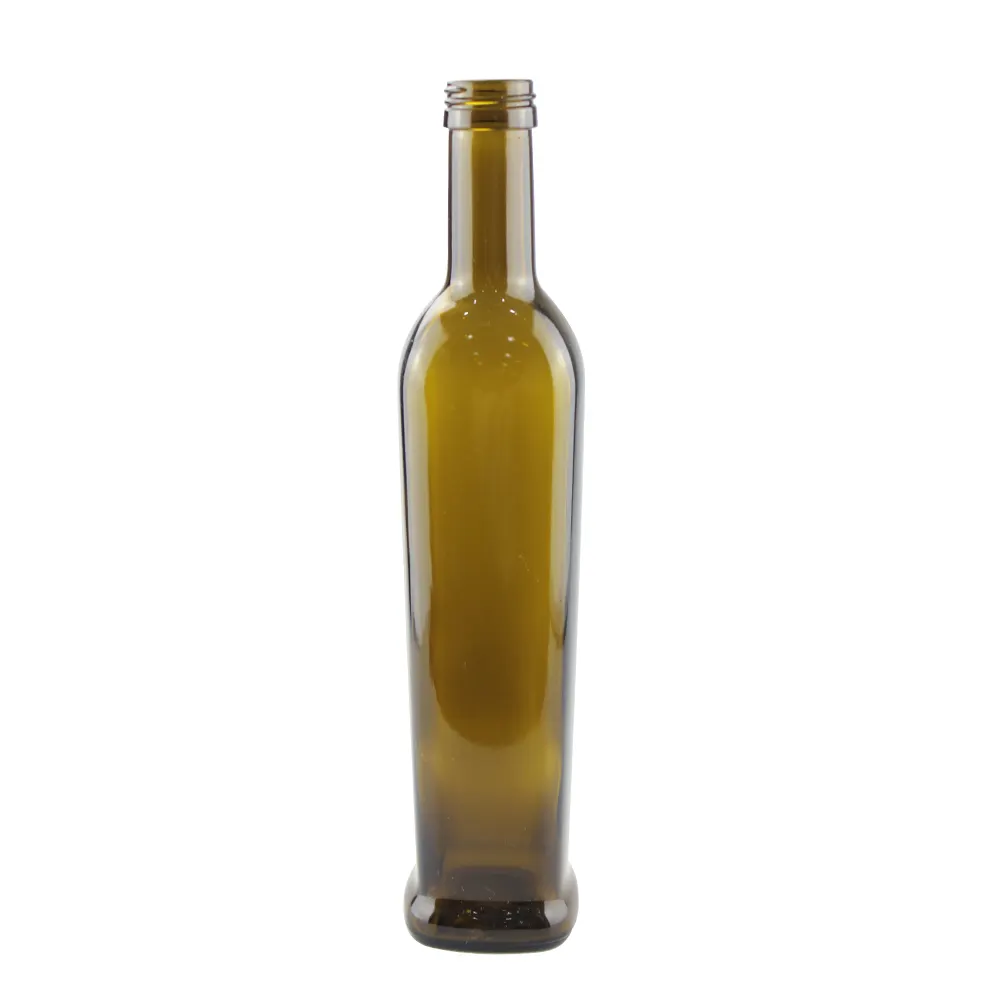
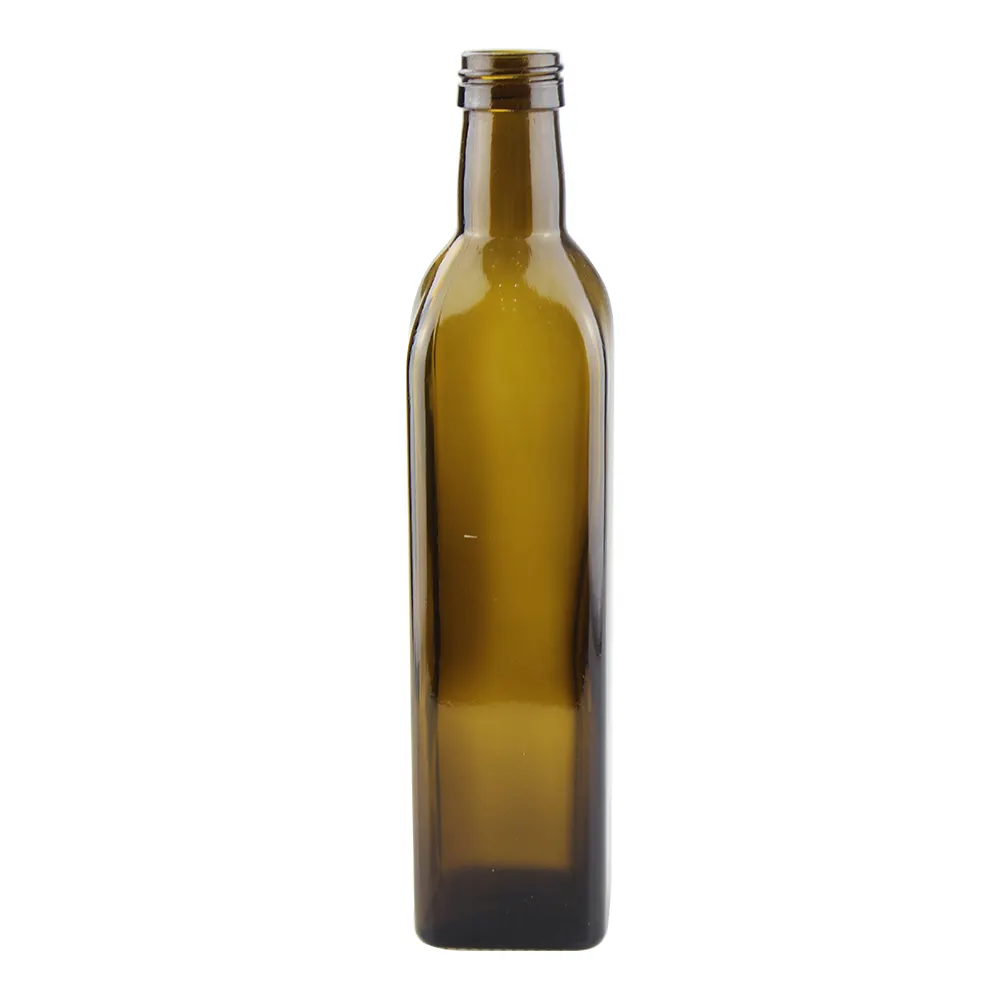
Filed under olive oil bottles wholesale; the moulds we quote for this are pictured at the foot of the page.
Olive oil is one of the few foods that actively degrades in the wrong package. Light, oxygen, and heat break down extra virgin olive oil within weeks, which makes the bottle a preservation device first and a branding surface second. Buyers searching olive oil bottles bulk are usually producers, estate bottlers, co-packers, or specialty food brands who need pallet-quantity glass that protects the oil and lands at a cost that keeps grocery and food-service margins alive. This page covers the two industry-standard bottle shapes (Dorica and Marasca), why dark glass is non-negotiable for premium oil, the closure systems from pour spouts to screw caps, and per-pallet pricing and export preparation for US-bound shipments. For the complete category view, visit our olive oil bottles hub; this page is about buying in bulk.
This page is deliberately scoped to bottle-shape selection and US export preparation. It zeroes in on how Dorica and Marasca differ on the shelf, in the hand, on the filling line, and on the pallet, plus the label and shipment paperwork an exporter actually needs. The stock-versus-custom-mold decision, the broader closure program, and the general light-blocking overview live on our glass olive oil bottles bulk page, and the full mold list is in the olive oil bottles wholesale catalog. Read that page when your question is “do I tool a private mold or buy a stock shape”; read this one when your question is “which stock shape, and how do I get it onto a US shelf.”
Light is olive oil’s enemy, which makes glass color a quality decision, not just a design one. This page is for oil producers buying in bulk: dark glass options, the classic marasca and dorica shapes, and closure systems from pourers to tamper-evident caps.
- Antique green and dark amber filter the light wavelengths that oxidize oil fastest
- Marasca (square) and dorica (round) are the two retail-standard silhouettes
- Core sizes: 250ml / 500ml / 750ml / 1L; tins take over above that
- Closures: pourer fitments for food-service, tamper-evident ROPP caps for retail
Related: olive oil bottles wholesale catalog
Dorica vs. Marasca: The Two Shapes That Rule the Category
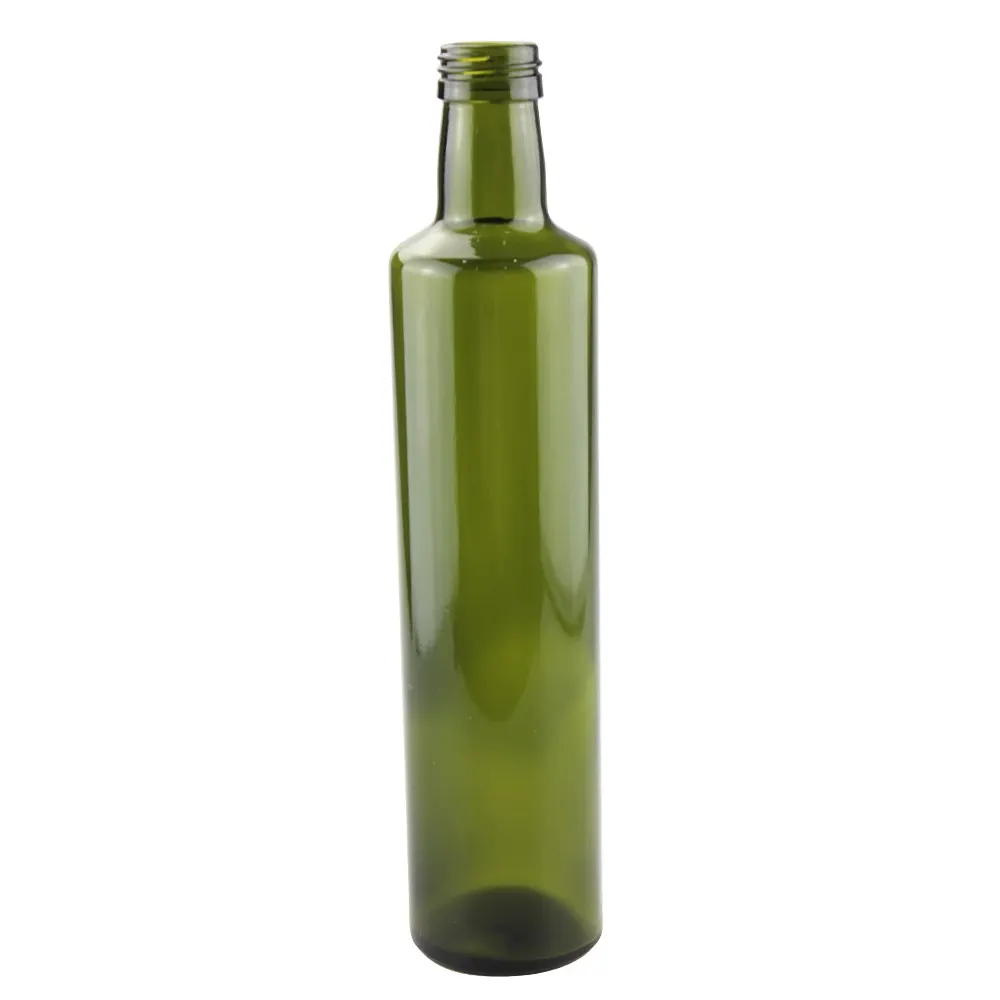
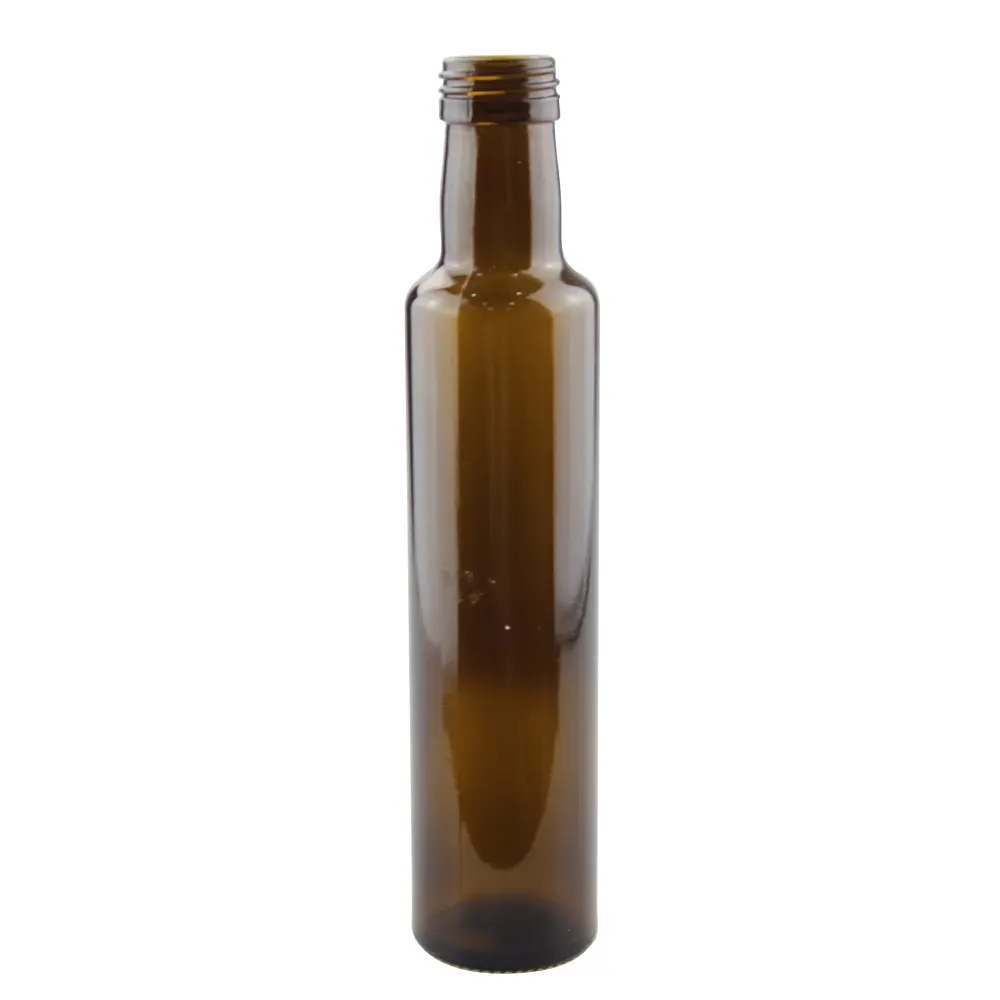
Walk through any US grocery olive oil aisle and nearly every bottle is one of two profiles. The Dorica is the tall, cylindrical bottle with a gently sloped shoulder — the classic Mediterranean silhouette that consumers read as authentic extra virgin. Its proportions (typically 250ml, 500ml, 750ml, and 1L) evolved for a reason: the slim diameter reduces the oil’s surface-area-to-volume ratio after opening, slowing oxidation in the consumer’s kitchen. Doricas label cleanly because the body is a single uninterrupted cylinder, and they pack densely, which matters when you ship olive oil bottles by the pallet.
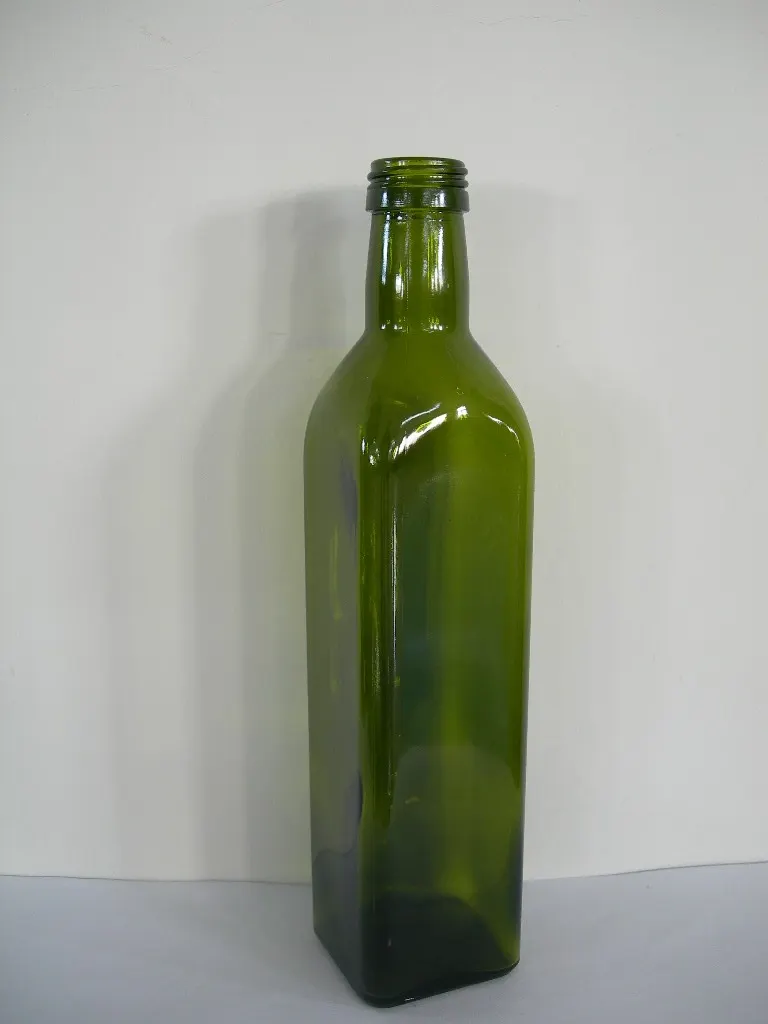
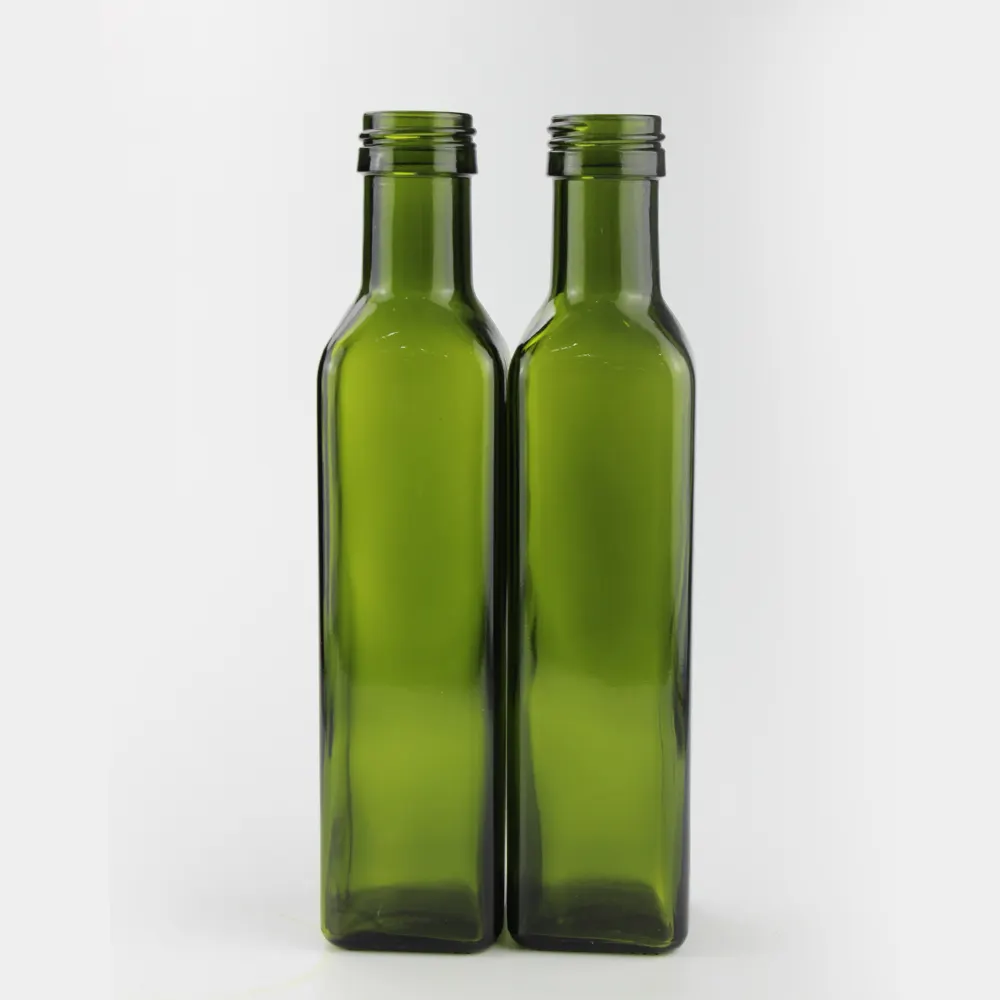
The Marasca is the square-bodied alternative — same capacity ladder, but with flat panels that give brands four generous label faces and a distinctive shelf block. Marascas stack and case-pack with almost zero wasted air, cutting carton and pallet volume versus round bottles at the same capacity. The trade-off: square corners concentrate stress, so Marascas run slightly heavier glass weights per bottle and need better case partitioning to avoid corner impact during transit.
How the two shapes actually differ in the market
The choice between Dorica and Marasca is rarely about which bottle “looks better” in isolation — it is about what each shape does at four specific points in the product’s life. On the shelf, Dorica reads as the traditional imported extra-virgin silhouette and blends into the Mediterranean block; Marasca reads as a deliberate, modern, design-led brand because its flat faces catch light differently and present a larger graphic area. On the hand, the Dorica’s round body suits a quick pour at the stove, while the Marasca’s flat sides give a surer grip for larger 750ml and 1L formats and resist rolling if a bottle is laid down. On the label, the Dorica offers one continuous wrap surface that is forgiving for low-cost pressure-sensitive labels; the Marasca offers four flat planes that suit multi-language or multi-variant ranges (grade on front, origin on side, recipes on back) but punish misregistration because any skew is obvious on a straight edge.
On the filling line, both shapes run on the same neck-finish standards, but the Marasca’s flat base and straight walls index more reliably in neck-handling monoblock fillers, while the Dorica’s round body can need a puck or star-wheel carrier at the labeling station to hold orientation. On case packing and palletizing, the Marasca’s right angles tile with near-zero void, so a given carton holds more bottles and a given pallet holds more cartons; the Dorica leaves small air gaps between cylinders that add up at container scale. The net effect is that Marasca typically reduces secondary-packaging cost per bottle, while Dorica keeps unit glass cost lower because it uses less glass weight for the same capacity.
What Drives the Price
In practice, the two shapes map onto different parts of the category. Single-estate and premium extra virgin lines lean Dorica because the silhouette carries the “authentic” signal consumers expect and because the lighter glass weight keeps the per-bottle cost down on a product that already carries a premium oil cost. Blended, private-label, and value-tier oils, plus brands that compete on shelf presence rather than provenance storytelling, lean Marasca because the extra label area and the denser case pack lower total landed cost at volume. Neither shape is locked to a quality tier — we regularly run both in antique green for premium clients — but the economic gravity pulls Dorica toward the high-oil-cost SKU and Marasca toward the high-volume SKU.
The “looks alike but not interchangeable” trap
The most expensive mistake we see new brands make is assuming a Dorica and a Marasca of the same capacity are drop-in substitutes. They are not. The neck finish may be the same nominal 31.5mm ROPP, but the shoulder geometry changes how a capper’s chuck seats and how a pour-spout insert drops in; a closure qualified on a Dorica can seat off-center on a Marasca and vice versa. The center of gravity differs, so the same filling-line puck that holds a Dorica upright may let a Marasca tip at the rinser. The label die is shape-specific — a wrap label cut for a Dorica cylinder will not lie flat on a Marasca panel. And the case dimensions are different, so your existing carton, shelf tray, and warehouse racking will not transfer. Before you switch shapes mid-range, requalify the closure, the label, and the case on physical samples, not on drawings.
Questions to ask your glass supplier:
- Can you supply both Dorica and Marasca in the same capacity and neck finish so I can benchmark them side by side?
- What is the per-bottle glass-weight difference between the two shapes at my target capacity, confirmed per project?
- Do you have reference case dimensions and pallet counts for each shape so I can model freight and shelf tray fit?
- Are the shoulder and neck drawings identical enough that my existing closure and capper will seat on both, or do I need separate qualification?
- Can you ship a mixed Dorica/Marasca sample set with my chosen closure so I can run a filling-line trial?
Why Dark Glass Is a Quality Decision, Not a Style Choice
Olive oil is chemically fragile in a way that most packaged foods are not, and the damage starts with light. Two classes of pigment in the oil — chlorophyll and carotenoids — act as photosensitizers. When they absorb visible and near-UV light, they pass that energy to oxygen dissolved in the oil and generate singlet oxygen and free radicals, which then attack the unsaturated fatty acids that make extra virgin olive oil valuable. The result is lipid oxidation that produces the grassy, peppery notes’ collapse into waxy, hay-like, and eventually rancid off-flavors. This is not a styling preference; it is the same chemistry that sets the shelf-life clock the moment a clear bottle hits a lit retail shelf.
The measurable markers move in a clear direction. Free fatty acid (FFA) and peroxide value (PV) — the two routine quality indices labs track — both trend upward as light exposure and the accompanying temperature rise accumulate; a bottle sitting under warm retail lighting warms slightly, and that warmth accelerates the same oxidation reactions. Polyphenols and tocopherols, the antioxidants that define premium oil, deplete faster under light than in the dark. The practical consequence is that the same oil held in dark glass retains its sensory and chemical profile through the typical 12-to-18-month packaged shelf-life window far better than the same oil in clear flint, where perceptible quality loss can appear within weeks under store lighting. Exact retention depends on the oil’s own chemistry, the storage temperature, and the lighting spectrum, so treat any specific number as indicative and confirm per project.
Dark green versus amber: a directional difference, not a percentage claim
Within dark glass, antique (dark) green and amber are the two workhorses, and they differ in which part of the spectrum they let through rather than in any simple “stronger versus weaker” ranking. Dark green transmits less in the blue/violet actinic band while allowing more of the red and near-infrared tail; amber cuts the blue and much of the visible band more aggressively and reads warmer to the eye. For olive oil the practical question is which residual transmission overlaps the wavelengths your oil’s pigments actually absorb — and that depends on the oil and the lighting, which is why we do not publish a single “blocks X percent of UV” figure: such a number would be meaningless without the exact lamp spectrum and the oil’s absorbance curve behind it.
What we can do is supply the evidence a buyer needs to make the call. Ask for spectral transmission curves from the furnace lab for the exact color and thickness you intend to buy, measured on a finished bottle wall rather than a thin coupon. Ask for a batch color-tolerance sample set so you can verify that successive production lots stay within an agreed Delta E range — color drift changes transmission, and a “green” that drifts toward flint loses protection. And where a retailer or buyer demands it, request a third-party light-exposure comparison (oil filled, stored under defined lighting, tested at intervals) rather than relying on a supplier’s marketing claim.
Questions to ask your glass supplier:
- Can you provide spectral transmission data for the exact antique-green and amber batches at my wall thickness?
- What Delta E tolerance do you hold between production lots, and can that be written into the purchase specification?
- Do you offer a UV-protective (near-opaque) variant for high-value single-variety oil, and how does its transmission compare directionally to standard dark green?
- Can you supply a light-exposure comparison report from a third-party lab, or refer me to one?
- Is clear flint available for boxed or food-service formats where the bottle lives inside opaque secondary packaging?
Closures: Pour Spouts, Screw Caps, and Tamper Evidence
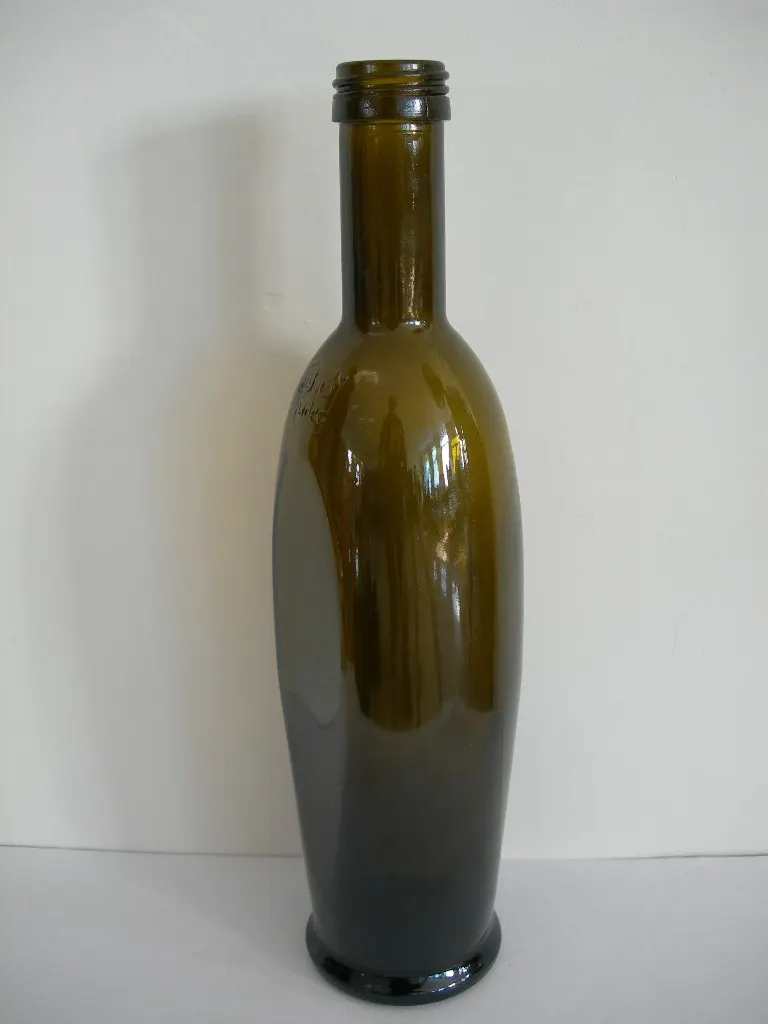
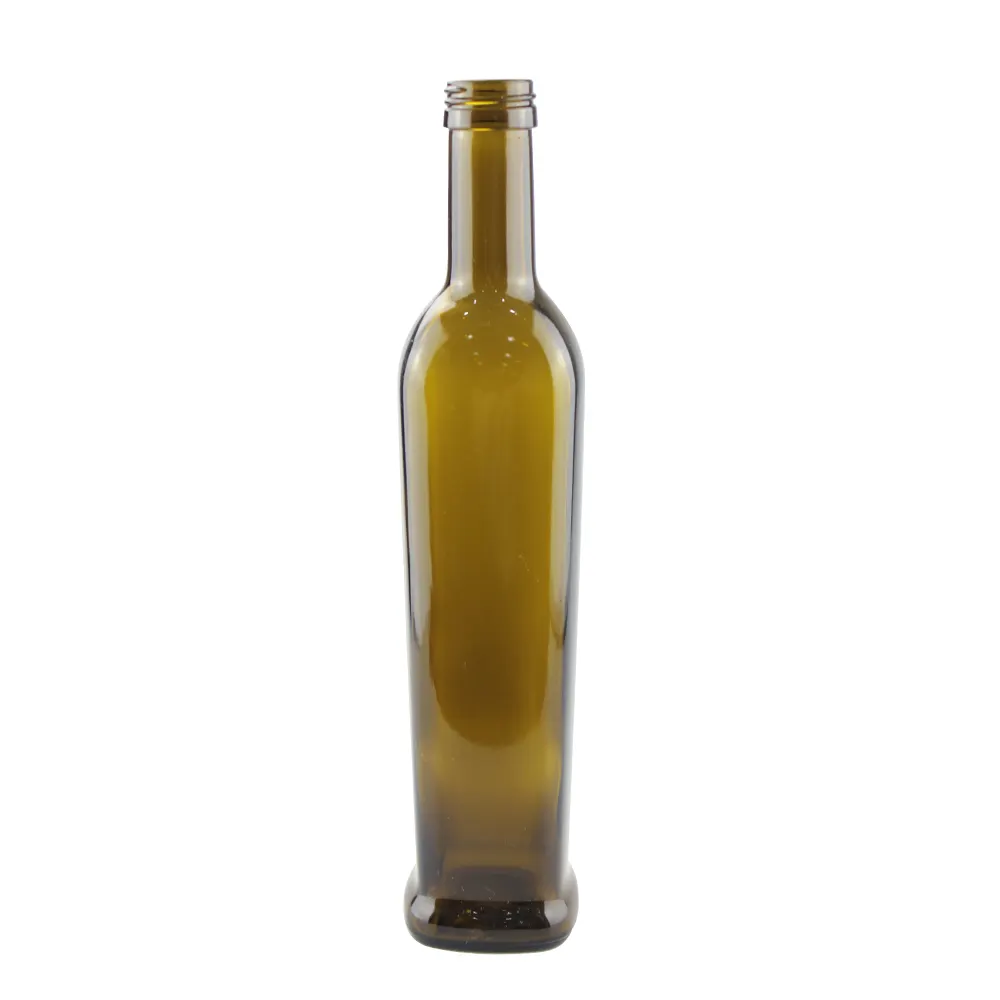
The closure decision shapes the consumer’s daily experience with your oil and, less visibly, your filling-line uptime. The dominant system for premium extra virgin is the 31.5 × 24mm aluminum ROPP screw cap with an integrated pour spout — a roll-on pilfer-proof cap containing a plastic pourer that meters flow and pulls back the last drop. Consumers trust it, it reseals perfectly, and the tamper-evident band satisfies US retail expectations. Alternative pourer inserts include flap-top spouts (a food-service favorite for controlled dosing) and slow-pour reducers for tasting-room and drizzle formats.
Standard 31.5mm and 28mm screw caps without pourers serve value lines and bulk food-service sizes. Synthetic cork T-tops (bar-top closures) position an oil as gourmet or gift-worthy and pair naturally with 375ml and 500ml formats. Whatever closure you choose, specify food-grade liners and confirm your capper’s chuck dimensions against our neck-finish drawings before the production run — closure mismatch is the most common cause of filling-line downtime we see from new oil brands.
Pour-spout types and how they meet the neck
Not all pour spouts are alike, and the difference matters on the line. A free-flow pourer gives a generous, fast stream and is the easiest to insert automatically because its geometry is simple and tolerant of orientation. A restricted or anti-drip pourer slows the stream and prevents the last drop from running down the bottle, which consumers reward with repeat purchases, but its insert is more orientation-sensitive and may need a dedicated insertion station or manual placement depending on the capper. The pourer must be matched to the neck finish: the 31.5mm ROPP thread profile, the land height, and the bore diameter all determine whether the insert seats without leakage. A pourer qualified on one closure-skirt dimension will weep if the cap it is married to changes, so qualify the cap-and-insert pair as a single component, not separately.
Screw cap versus T-cork for oil
The trade between a screw cap and a synthetic T-cork is a trade between resealing and reclosure versus gift positioning. A screw cap (ROPP or continuous-thread) reseals the bottle airtight after every use, which matters for an oil that is opened, poured, and returned to the pantry repeatedly; it also carries the tamper-evident band natively. A synthetic T-cork bar-top does not reseal as tightly, so it suits oils that are consumed relatively quickly or presented as gift and gourmet items where the unboxing signal outweighs daily reseal performance. For oil specifically, the screw cap’s tighter seal also slows the post-opening oxygen ingress that drives kitchen-shelf oxidation, so for a working pantry oil the screw system is the safer default and the T-cork is the premium-story option.
Tamper evidence and the filling line
Tamper evidence on olive oil is delivered three ways: the ROPP break-away band that splits when the cap is first turned, a shrink band over cap and neck (often printed), and a break-away ring on continuous-thread caps. For US retail, the ROPP band or a printed shrink band is the expected baseline; the choice is driven by your capper and your label artwork, not by the oil. The under-discussed point is line impact: a pour-spout insert adds a component that must be fed, oriented, and seated in sequence with the cap. Simple free-flow inserts can run on an automatic monoblock if the cap feeder is set for the correct orientation; restricted or drip-control inserts often need a separate insertion module or semi-manual loading, which lowers line speed and raises labor. Tell your supplier your target line speed and capper make up front so the closure is specified for automatic running rather than discovered to be manual-only after tooling.
Questions to ask your glass and closure supplier:
- What neck finish and thread spec does my chosen pour-spout cap require, and can you supply a drawing my capper maker can verify?
- Is the pourer insert free-flow or restricted, and is it qualified for automatic insertion at my line speed?
- Can the ROPP cap carry a tamper-evident band that meets my US retailer’s requirement without a separate shrink band?
- What food-grade liner material do you recommend for olive oil, and is a migration test report available per lot?
- If I switch from screw cap to T-cork, what changes in my capping equipment and my reseal claim to consumers?
Bulk Specifications and Per-Pallet Pricing
The matrix below lays out the highest-velocity bulk olive oil bottle configurations as a selection grid rather than a flat price list. Every figure is a range and must be confirmed per project at quotation — furnace schedules, carton specs, and freight rates move, so treat the numbers as planning references, not a firm offer. All weights and pack counts assume standard export cartons on compatible 48×40-inch (or ISO 3394 1200×1000 mm) pallets; if your warehouse uses a different pallet module, the per-pallet counts shift and should be re-quoted.
| Capacity | Shape | Glass Colour | Neck Finish | Closure | Case Pack / Pallet | Notes |
|---|---|---|---|---|---|---|
| 250 ml | Dorica (round) | dark green / amber | 31.5mm ROPP | pour spout / screw cap | 12–24 / 3,600–4,800 | Lightest glass weight; lowest per-bottle freight. Confirmed per project. |
| 500 ml | Dorica (round) | dark green / amber / clear | 31.5mm ROPP | pour spout / screw cap | 12 / 2,400–2,900 | Hero size for most US brands. Clear only for boxed/food-service. Confirmed per project. |
| 750 ml | Dorica (round) | dark green | 31.5mm ROPP | pour spout / screw cap | 12 / 1,800–2,200 | Premium EVOO standard. Slightly heavier wall. Confirmed per project. |
| 1000 ml | Dorica (round) | dark green | 31.5mm ROPP | screw cap / pour spout | 6–12 / 1,200–1,800 | Club and value formats. Heaviest single unit. Confirmed per project. |
| 250 ml | Marasca (square) | dark green | 31.5mm ROPP | pour spout / screw cap | 12–24 / 4,200–4,900 | Densest case pack of the range; lowest secondary-pack cost. Confirmed per project. |
| 500 ml | Marasca (square) | dark green / amber | 31.5mm ROPP | pour spout / screw cap | 12 / 2,600–3,100 | Flat panels suit multi-language labels. Confirmed per project. |
| 750 ml | Marasca (square) | dark green | 31.5mm ROPP | pour spout / screw cap | 12 / 2,000–2,400 | Higher glass weight than Dorica at same capacity. Confirmed per project. |
| 1000 ml | Marasca (square) | dark green | 31.5mm ROPP | screw cap | 6–12 / 1,400–1,900 | Corner stress needs partitioned case. Confirmed per project. |
| 500 ml | square (Costolata-style) | dark green / amber | 31.5mm ROPP | screw cap / pour spout | 12 / 2,400–2,800 | Rustic ribbed body; niche positioning. Confirmed per project. |
| 500 ml | round (amphora) | flint / green | 31.5mm ROPP | T-cork / screw cap | 12 / 2,200–2,600 | Gift and gourmet channel. T-cork needs separate capping. Confirmed per project. |
| 250 ml | round | UV-protective (specialty) | 31.5mm ROPP | pour spout | 12–24 / 3,800–4,500 | Near-opaque for high-value single-variety oil. Confirmed per project. |
| 750 ml | Marasca (square) | amber | 31.5mm ROPP | pour spout | 12 / 2,000–2,400 | Amber cuts more visible band than green; verify transmission per project. |
How pallet-scale pricing actually behaves
Bulk glass pricing is relative, not absolute: the per-bottle price falls as the number of identical pallets rises, because the furnace changeover and the carton setup are fixed costs spread over more units. The 500ml Dorica is usually the price floor in absolute terms because it is the highest-volume mold and the densest pallet for its weight class, while 1L and odd-shape formats carry a small premium from heavier glass and lower pallet density. Color moves price in a narrow band — antique green typically runs at or near the flint base in the furnace schedule, while specialty colors (deep emerald, dead-leaf green, UV-protective) add a modest percentage that should be quoted per project rather than assumed.
The part buyers underweight is freight. Glass is a weight-driven product: a denser, slightly heavier bottle does not just cost more per unit, it costs more per pallet to move, and that freight multiplier compounds over an ocean crossing. Marasca’s denser case pack can offset its heavier glass on a per-bottle-landed basis because you ship fewer cartons; Dorica’s lighter glass can win on a per-kilo basis but ships more air per pallet. Model both before you decide — the “cheaper” bottle can be the “costlier landed” bottle once freight is in. Pallet geometry follows the ISO 3394 module (1200×1000 mm, or the 48×40-inch North American equivalent); matching your carton footprint to that module is what lets a 40HQ container approach its bottle-count ceiling instead of failing on dimension.
Questions to ask your supplier:
- At my target annual volume, what per-bottle FOB tier unlocks, and at what pallet count does it step?
- What is the carton footprint and pallet count for my exact shape and capacity, and does it tile the ISO 3394 module?
- How much heavier is the Marasca versus the Dorica at 500ml, and what does that do to per-pallet freight?
- Is antique green priced the same as flint in your current furnace schedule, and what does a specialty color add?
- Can you model a mixed-size container load so I can see landed cost, not just ex-works price?
Decoration, Labeling, and Compliance for the US Market
Bulk olive oil bottles reach US shelves through decoration and labeling, and the two are planned separately. Decoration is what is fired or applied to the glass itself; labeling is what you print and apply. For runs under about 100,000 units, pressure-sensitive labels (PSL) are the default because they need no minimum and change with every artwork revision. Silk-screen direct decoration (one to three colors) suits minimalist premium brands that want the print to feel part of the bottle, and ACL (acid-etched ceramic label) gives a permanent, dishwasher-proof mark for gourmet and refill channels. All our edible-oil glass carries standard food-contact compliance, with migration test reports available per lot.
US olive oil label elements to prepare
The label content an importer or bottler must assemble for the US market typically includes: the grade (for example, “Extra Virgin Olive Oil”), the country of origin and any qualifying region, the net contents in fluid ounces and/or milliliters, the name and address of the importer or bottler responsible for the US market, a lot or batch code for traceability, and often a “best by” or harvest date. Some brands add a nutrition panel or a quality seal. This is a planning checklist of what material to gather — not a statement of what the law requires, because the compliance determination belongs to the buyer and the destination-country regulator, and rules change. Our role is to tell you what to prepare and what to ask, not to issue a legal conclusion.
What to ask your own compliance counsel and your glass supplier:
- Which grade and origin statements does my SKU need, and who holds the responsible-party address on the label?
- Does my artwork leave room for the lot code and any regulator-required text without crowding the brand panel?
- Can the glass supplier supply a food-contact migration report per lot so my documentation file is complete?
- If I switch from PSL to silk-screen or ACL, what lead time and artwork lock-in does that impose?
- Who confirms the label meets the destination requirement — my importer, my counsel, or a third-party review?
Decoration on dark glass: what actually shows
Dark green and amber bodies change the decoration math. Silk-screen on dark glass needs light or opaque inks to read at all; a mid-tone ink that looks fine on flint disappears on antique green, so premium dark-glass brands usually go white, cream, or a metallic. Pressure-sensitive labels perform well because the label stock itself provides the contrast, but a thin label on a curved Dorica shoulder can bubble if the die is not matched to the radius — flat Marasca panels are more forgiving. Hot-stamp foil reads as genuinely premium on dark glass because the metallic catches what little light the bottle admits, but foil is a slower, higher-cost process and is best reserved for gourmet and gift SKUs where the margin absorbs it. Pick the decoration to the bottle color, not the other way around, and request a decorated sample on the actual dark color before committing the run.
Placing a Bulk Order: Timeline and Terms
A bulk olive oil bottle order moves through a fixed sequence of nodes, and most delays come from missing inputs at the front, not from the furnace. The path is: inquiry and specification (you send capacity, shape, color, neck finish, closure, and decoration) → sample and first-article approval (physical bottles with your closure, verified on your line) → production scheduling (deposit and furnace slot) → casing and carton packing → container loading → ocean transit to the US port → arrival and delivery. Each node needs something from you, and the clock does not start until the node before it is complete.
What you should have ready before inquiry: your target net contents and capacity, the closure drawing or sample (or a clear specification of pour-spout type), your capper make and chuck dimensions, your label artwork and die shape, and any certification or migration-report requests written into the spec. Stock-mold bulk orders run a production window after deposit, then ocean transit to US ports; reorders of proven molds compress because the first-article work is already done. Standard terms are a deposit with balance against bill of lading copy, and pre-shipment inspection from a third party is available at cost for first orders.
Freight terms in plain text
The incoterms on your pro forma decide who carries risk and cost at each leg, and buyers should know the common ones as planning language, not as advice. Under EXW (Ex Works), you collect from the supplier’s gate and own everything after. Under FOB (Free On Board), the seller delivers the goods loaded on the vessel at the origin port, and risk passes to you there — you book and pay the ocean freight. Under CIF (Cost, Insurance, and Freight), the seller also pays ocean freight and insurance to the destination port, but risk still passes at the origin load. Under DDP (Delivered Duty Paid), the seller handles most of the chain to your door, including duties. Which term fits is your commercial decision and may be shaped by your freight forwarder and your import setup; we can quote against the term you specify. Buyers comparing formats across edible oils should also see our oil glass bottles wholesale range, which covers avocado, sesame, and specialty oil formats, and the glass olive oil bottles bulk page for additional stock molds. If you also bottle balsamic or wine vinegars, the same Dorica and Marasca molds serve both categories — our vinegar bottles page covers the closure differences, so a combined order can share glass and split only closures. For a breakdown of closure cost contribution, our olive oil bottle price guide details the line items.
Questions to ask before you place the order:
- What is the current production window and ocean transit to my specific US port, confirmed per project?
- Which incoterm do you quote by default, and can you re-quote on the term my forwarder prefers?
- What exactly must I supply for first-article approval, and how long does sample shipment take?
- Is pre-shipment inspection available, and what documents does it return for my import file?
- What is the reorder window once my mold is proven, and does it change my deposit terms?
FAQs: Olive Oil Bottles Bulk
What is the difference between Dorica and Marasca olive oil bottles?
Dorica is the tall, cylindrical classic associated with premium extra virgin olive oil; Marasca is the square-bodied alternative offering four flat label panels and denser case packing. They differ on the shelf, in the hand, at the label station, and on the filling line — and they are not drop-in substitutes, because the shoulder and neck geometry, label die, and case dimensions are shape-specific. Both come in 250ml to 1L capacities from stock molds.
Why should olive oil bottles be dark green or amber?
Because olive oil degrades through light-driven chemistry: its chlorophyll and carotenoid pigments are photosensitizers that, under retail lighting, generate singlet oxygen and free radicals that attack the oil’s fatty acids, pushing free fatty acid and peroxide values upward and flattening the fresh sensory profile. Dark green and amber glass cut the actinic part of the spectrum and keep the oil inside the typical 12-to-18-month packaged shelf-life window far better than clear flint; the exact retention depends on the oil, the storage temperature, and the lighting, so confirm per project rather than trust a flat percentage claim.
What closure is best for bulk olive oil bottles?
The 31.5 × 24mm aluminum ROPP screw cap with an integrated pour spout is the premium retail standard — tamper-evident, resealable, and drip-controlled. Plain screw caps suit value lines and food-service sizes; synthetic cork T-tops position oils as gourmet gifts but reseal less tightly. The right pick depends on your line (free-flow versus restricted pourer, automatic versus manual insertion) and your reseal claim to consumers, so qualify the cap-and-insert pair as one component.
What is the minimum order for bulk olive oil bottles?
Stock molds start at a per-size minimum that should be confirmed per project; pallet-quantity pricing tiers begin above that, and full-container loads deliver the lowest per-unit landed cost because furnace and carton setup are spread over more units. Mixed-size loading in one container is standard practice and usually lowers total freight per bottle versus a single size.
Can I mix bottle sizes in one bulk order?
Yes. Mixed-container loading is standard — most producers combine their hero size with one or two secondary sizes in a single 40HQ container to spread freight cost across the full range and match the retail assortment. The planning point is pallet module fit: keep carton footprints aligned to the ISO 3394 / 48×40-inch module so the mix still tiles the container instead of leaving dimensional void.
How much do bulk olive oil bottles cost?
Pricing is relative, not absolute: the per-bottle figure falls as identical-pallet volume rises, the 500ml Dorica is typically the floor, and 1L and specialty shapes carry a small premium from heavier glass and lower pallet density. Color moves price in a narrow band — antique green often runs near the flint base, specialty colors add a modest percentage — and freight compounds the picture because glass is weight-driven. Treat any specific number as a planning range and confirm per project at quotation.