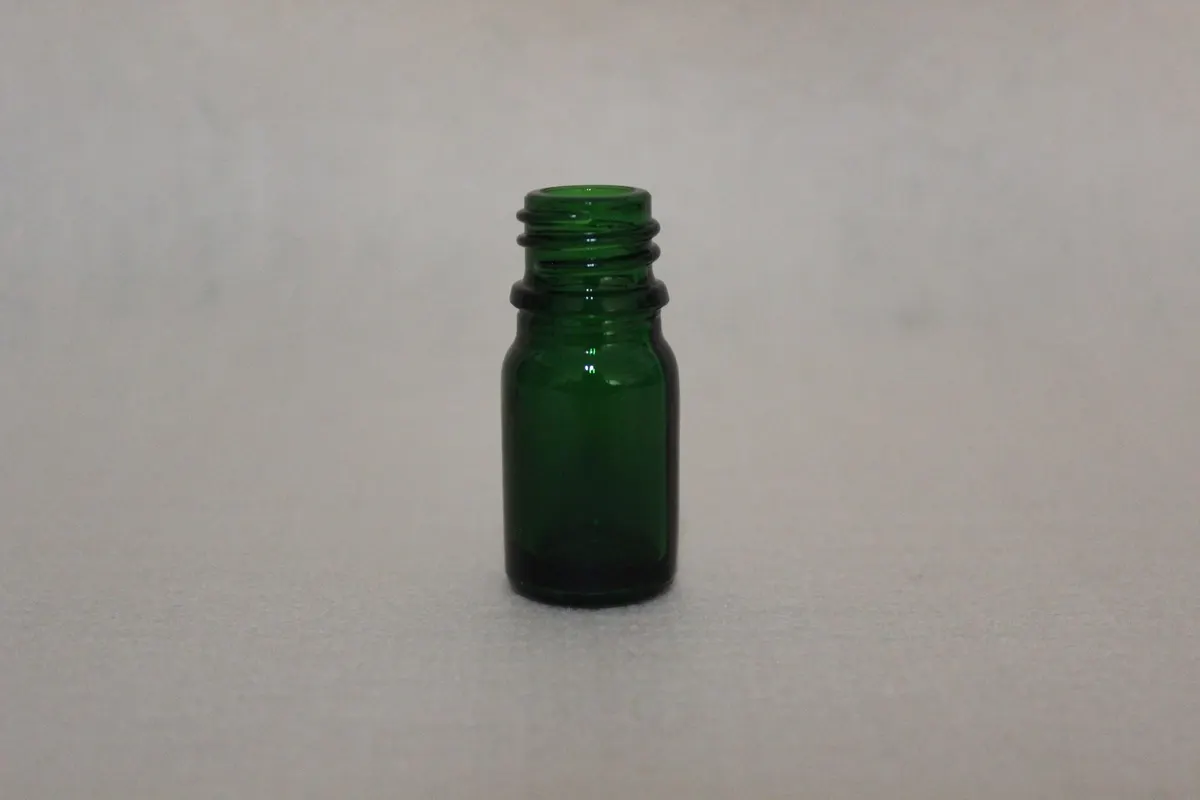
Part of our brown glass bottles range; the stock moulds are pictured at the end of this guide.
Match an amber glass spray bottle in this order: formula first, then mist or stream, then the neck finish, and only after that the depth of the tint. Amber deals with light and nothing else. A pumped bottle pulls room air in on every stroke, so the sprayer, its gasket and spring materials, the dip tube length and the fill volume decide whether the pack still mists properly and stays dry in transit. Every compatibility point below needs proving on a sample filled with your own formula.
Why a spray pack is specified differently from a capped bottle
A capped or dropper bottle is closed between uses. A spray bottle is not: for liquid to leave, air has to come in, either through a vent in the pump body or back down the dip tube between strokes. Each press swaps some of the headspace for room air, and across several weeks of use a face mist or aroma blend is aerated again and again near its surface.
That matters most for oxidation. Limonene-rich oils, citrus blends, conifer oils and many cold-pressed carrier oils react with oxygen, and daily pumping speeds the reaction compared with a bottle opened once a week. Tinted glass slows the light-driven share of the damage and leaves the air-driven share untouched, so amber alone is about half an answer. A pump with a tight vent path and a dip tube short enough not to churn the liquid makes a modest but real difference to shelf life, and deserves to be treated as part of the formula's protection.
The second difference is that the closure has a performance to deliver. A cap seals. A sprayer seals and also produces a pattern, a droplet size band, an output per stroke and a spray angle. Pumps that fit an identical neck can differ on all four, so one gives a soft mist and the next a spatter or a single jet with the same liquid. Neck size tells you nothing about this; only a sample does.
The third is frequency of use. A cleaner is pumped dozens of times in one session, a facial mist a few times, an aroma spray once or twice. Output and return speed are critical for the cleaner and nearly irrelevant for the aroma spray, and a pump tuned for cleaning is unpleasant on skin.
One practical consequence: the pump is a precision assembly of several materials, with at least one elastomer and often a metal spring. Field failures in spray packs sit in the pump far more often than in the glass, yet they usually reach the buyer described as a bottle problem.
Formula data to write down before choosing anything
Record these before looking at bottles, because nearly every later pump question is answered by one of them and none can be read off a product photo:
- viscosity at both filling and use temperature;
- pH, alcohol content and salt content;
- oil concentration;
- whether the liquid is single-phase or separates on standing;
- any suspended particles, gums or waxes;
- how sensitive each component is to light and to air.
Four properties do most of the work. Viscosity decides whether a fine mist is possible: past a modest thickness a fine mist pump sputters or delivers nothing, and the remedy is a stream sprayer with a bigger orifice or another pack format. Chemistry decides material compatibility. Vinegar or citric acid cleaners, salt solutions, high-alcohol formulas and concentrated aroma blends each stress a different part of the pump, and a spring that copes with fragrance may not cope with acid.
Light sensitivity sets the tint, and it varies inside one formula: citrus and conifer oils, certain absolutes and several plant extracts are far more fragile than a preserved hydrosol or a basic surfactant cleaner. Volatility sets how the pack fails. Formulas high in alcohol or terpenes find any weak point in the seal, and an overfilled bottle pushes liquid out through the vent as it warms.
How the sales route changes the pack
Retail skincare and cosmetics leave the pump with a consumer for months, so the pattern has to hold after repeated use, and the shopper judges collar, tint and label together in a single look. Professional and refill routes (salon products, cleaning concentrates, refillable household lines) run the pump through a much longer duty cycle and often expect the user to unscrew it, top up with water and refit it, which points to a screw neck over a permanent crimp. Trade and hospitality buyers of amenity mists, room sprays and linen sprays purchase by the case and handle packs roughly in trays; this is the route where a transit leak is most likely to be found by somebody other than you.
Fine mist or stream, and the neck finish each needs
Words such as "mist", "spray" and "stream" are loose. What separates the options is physical.
Output per stroke is the volume released by one press; pattern is the spread and droplet size leaving the nozzle. A skincare or aroma fine mist gives a small dose in a soft cone. A linen-spray mist pump gives more, in a narrower cone, so the liquid carries. A stream or trigger assembly delivers several times a fine mist's volume as a jet or fan, which is correct for a surface cleaner because the aim is to wet a surface. Put an atomiser on a cleaner and the user presses many more times for the same job; put a trigger on a facial mist and the face is soaked.
So a thin, particle-free liquid going onto skin or into the air takes a fine mist, and a thicker liquid, a higher output or a surface that must be wetted takes a stream or trigger. The two use different orifices and, usually, different neck sizes, which is why this choice shifts the bottle specification and has to come early.
Pre-compression
A pre-compression pump builds pressure before releasing it. The first press after a pause is then a full mist instead of a dribble, and the pattern stays even as the bottle empties. Pumps without the feature are simpler and adequate on a trigger or a product in continuous use; on a mist used once a day they are a frequent source of complaints.
Viscosity ceiling
Each orifice has a practical upper limit. Beyond it the pump still cycles, but output drops, the pattern coarsens and the nozzle blocks more readily as residue dries. Thicker body mists, oil-rich blends and gel-to-water products therefore tend to move to a larger orifice and live with a softer pattern. Where nothing in the available fine mist range can handle the liquid, a different pack type may be the honest answer.
Reading the neck callout
Screw sprayers fit standard neck threads, written as a diameter followed by a thread code. The 18 mm, 20 mm, 24 mm or 28 mm figure is the diameter; the code after the stroke is the thread form. A 24-410 and a 24-415 have the same diameter and thread pitch yet differ in a dimension the sprayer depends on, so two collars both described as 24 mm may not interchange.
When bottle and sprayer come from separate suppliers, both must work from one identical callout. A mismatch here is the most common reason a pack turns up with a pump that will not seat. The finish is also cut into the mould, and it determines which sprayers exist for the bottle at all. Amber depth can often be adjusted within an existing body mould; the neck cannot change without tooling. Settle the interface first, the colour second.
A crimped sprayer is a separate case. It cannot be taken off, so the bottle is not refillable and a worn pump cannot be swapped. That is normal for a fragrance-style pack and unusual for a cleaner the consumer expects to refill.
Contents-to-sprayer matching table
Use the table to frame a sample request. It is not a specification: change the concentration or the temperature and a formula can move to another row. The final column lists what should come back from a supplier as a named material, a dimension or a physical sample, never as a general reassurance.
| Contents and light sensitivity | Amber tint | Sprayer type | Neck finish | Typical failure | Confirm with the supplier |
|---|---|---|---|---|---|
| Neat or lightly diluted essential oil blend (citrus, conifer); highly sensitive to light and oxidation | Deepest amber in the range; the fill level becomes almost invisible | Fine mist, low output, pre-compression for a full first press | Small collar, typically 18 or 20 mm screw, depending on pump range | Clogging by resins, waxes and heavy oil fractions; gasket swelling after long oil contact | Orifice diameter; elastomer in gasket and inner seal; rating for continuous oil contact; dip tube material |
| Hydrosol, floral water or preserved water-based mist; moderately sensitive | Medium amber, where the level still shows as a dark line against the light | Fine mist, standard output, dip tube sized for a thin liquid | Mid-size screw such as 20 mm or 24 mm | Weak or dripping spray, often from a tube too thick or too short for the bottle | Tube diameter and trimmed length for the real bottle height; return speed; whether reuse after refilling is intended |
| Facial or body mist containing gums, polymers or dispersed actives; moderate to high sensitivity | Amber, or clear glass in a carton when shelf visibility outweighs tint | Fine mist, wide soft pattern, low output (a coarse spray streaks on skin) | Mid-size screw, usually 20 mm or 24 mm to suit a cosmetic pump | Polymer drying in the nozzle between uses; uneven pattern once part-used | Particle or polymer load the orifice passes; spray angle and droplet band; removable nozzle or protective overcap |
| Natural cleaner based on vinegar, citric acid or salt solution; low light sensitivity | Light or medium amber, picked for branding since the contents are not light-critical | Stream or trigger, higher output, to wet a surface | Larger screw, commonly 28 mm, as a trigger body needs a wider collar | Acid corroding the spring and attacking seals; vent leakage when a full bottle sits in a hot vehicle | Spring and gasket suitability for the acid and salt level; maximum fill for the headspace; expected transit temperature |
| Two-phase oil-and-water body spray shaken before use; moderately sensitive | Amber transparent enough to show the separation | Fine mist with a slightly larger orifice and a softer pattern, to keep the oil phase moving | Mid-size screw with a bore that takes the larger assembly | One phase drawn first, giving uneven output; oil film building on the nozzle | Tube reaching the lower phase at the planned fill; viscosity range the pump is calibrated for; pattern after shaking |
| High-alcohol sanitiser, room spray or linen spray; low light sensitivity, very volatile | Amber for looks only; tint has no effect on pack behaviour | Fine mist with alcohol-compatible pump and gasket and a tight vent path | Small to mid-size screw, matched to the pump range on offer | Evaporation through the vent; pressure leakage when warm; visibly falling level | Alcohol concentration the pump and gasket are rated for; vent design; need for a transport overcap; fill volume against headspace |
The sprayer column alters the pack most. The failure column is what customers will tell you about. The last column is what enquiries tend to omit.
How dark the amber should be
Amber runs from pale straw to a deep brown that is close to opaque where the wall is thick. Depth is a working variable, because protection and visibility pull in opposite directions and you have to pick a point between them.
Darker glass passes less visible light and removes more of the short wavelengths behind photo-oxidation in oils and natural extracts. A citrus-heavy blend, a rose absolute or a cold-pressed oil expected to spend a year on a shelf belongs at the dark end, where protection is worth more than appearance. Be wary of light tints on thin walls: nominally "amber" glass of that kind can shield far less than a photograph suggests.
Visibility is the side buyers underrate. Spray packs are used repeatedly, and one that feels empty gets thrown out. Deep amber is effectively opaque against a bright background, so the level only shows when the bottle is held to a lamp in a dark room. Refillable cleaners suffer more, since the user dilutes a concentrate to a mark that cannot be seen. There are three ways out, each with a cost:
- a label window or an unprinted sight band down one side, which shows the level for a small loss of protection;
- a frosted or clear bottle in a printed carton, protected on the shelf and fully visible once unboxed;
- clear glass with no secondary protection, legitimate where the formula is not light-sensitive, such as a simple surfactant cleaner.
Choosing amber for that last kind of product is a branding decision. That is fine, provided nobody mistakes it for a technical one.
Tint also affects how the other components read. Deep amber makes a metal-look collar or a gold or bronze overcap look intentional, and it changes how a bright, saturated label colour appears against the dark body. Glass colour varies from batch to batch, and the variation shows more on a deep tint. Agree acceptance against a physical standard instead of a screen image; where colour is critical, ask for a retained reference sample with a stated tolerance and judge deliveries on a quality basis such as an AQL scheme. The colour specification itself, including how tint is measured, body amber versus sprayed finishes and batch acceptance, is covered in our guide to brown amber glass bottles as a colour specification.
Pump materials, dip tube and collar colour
Pump body, spring, gasket, dip tube and inner seal each have a material and a grade: typically plastic for the body, metal for the spring and elastomer for the gaskets. Acids attack some springs. High alcohol attacks some elastomers. Concentrated oils swell and soften certain grades over time. Put the compatibility question to the supplier in writing for every part, since the reply decides whether the pack lasts a year on a shelf or two weeks on a windowsill.
The dip tube is a cut length, not a standard part, so it goes in the order specification. Trimmed correctly, it ends near the base without resting on it. Cut short, it leaves the last of the formula behind. Left long, it curls against the base and draws air; a tube touching the bottom will also pull air when the bottle is slightly tilted. In a slim amber bottle the tube has to be thin enough not to straighten against the wall when the pack is inverted, and in a two-phase product it must reach the lower phase at the intended fill level.
Collar, shroud and overcap are colour choices too. They are moulded parts whose shade can drift between batches, and a repeat delivery in a slightly different shade looks like a defect beside earlier stock. Approve the colour on a physical sample and ask how consistently it is held, exactly as for the glass.
Evidence and standards to settle before the pump is ordered
For cosmetics and anything applied to skin, the pack counts as part of the product. Buyers are normally expected to hold evidence that each component touching the formula is suitable, which is why elastomer and spring materials need stating instead of assuming. The references usually cited are:
- EU framework regulation 1935/2004, where food contact is in scope;
- the plastics measure 10/2011, for plastic parts in contact;
- the food contact provisions of FDA 21 CFR, where the pack touches food or a food-adjacent product.
Fragrance concentration in an aroma spray normally falls under the fragrance industry's IFRA standards. That is the formulator's responsibility, not the bottle supplier's, but agree it with the fragrance house before fixing the pump: a higher concentration alters viscosity and clogging behaviour.
Distribution is the other area. Temperature and trapped air are enough to pressurise a spray pack relative to a plain bottle, and the ISTA series of distribution tests is the usual reference when you want to state that a parcel-shipped pack has been validated. None of this is unusual, and all of it is easier to resolve before a pump is ordered than once artwork is on the shelf.
Filling, capping and testing the finished pack
Headspace and fill volume
The space above the liquid has to hold the pump body and the air the pack exchanges, and leave room for thermal expansion. In a spray bottle expanding liquid has an exit: in a hot delivery vehicle, pressure drives it up the dip tube and out at the vent or nozzle, and the result is reported as a leaking bottle. State the fill in millilitres at a stated temperature, never as ounces of bottle size, and keep it under the level where the pump body would meet the liquid.
Fill by weight
Level filling assumes every bottle has the same internal volume, which is the property that varies most in moulded glass, and the pump body's displacement adds another variable. Fill by net weight and calibrate with the real formula at the real temperature. A liquid whose density shifts with temperature will not reach the same volume at the start and end of a shift.
Tube trim and capping torque
Dip tubes generally arrive long and are cut on the line, or come pre-trimmed to the bottle height. In both cases, record the cut length in the specification and check it against a bottle when the run starts; an error of a few millimetres gives a weak spray that looks like a faulty pump. A screw sprayer needs to be tight enough to seal without distorting collar or gasket, so the setting is a torque range and belongs on the line sheet.
Tests on the assembled unit
Test the complete pack, not loose components. Fill it, cap it, stand it, invert it, shake it, cycle the temperature, pump it two hundred times and compare the pattern at the beginning and the end. Leak-test in the orientation of travel: upright for a case, inverted and shaken for a parcel, and for long enough that a slow weep shows. Include a run above the highest temperature expected in transit.
Check dispensing on the finished unit as well, because pattern depends on tube length and fill level as much as on the nozzle. Set an acceptance quality limit for the leak and pattern checks so that passing is a number, not a judgement. A pack that passes with water and fails with the real formula has not been tested.
Appearance comes last. Collar colour, overcap, label clearance and the way the tint sits beside the label depend on every earlier choice and are the easiest things to change.
What to send with an enquiry
A photo of a bottle is not enough to specify a spray pack. We can match a project to a suitable bottle and pump when the brief includes:
- the content type and its light sensitivity;
- viscosity, plus any oils, gums, particles, or high alcohol or acid content;
- the use: misted onto skin, into the air, onto a surface or onto fabric;
- the output and pattern wanted, and roughly how often the pack is used;
- fill volume per bottle, bottle capacity and the tint in mind;
- the quantity for this order and the annual volume behind it;
- whether the consumer will refill it, which decides crimp or screw;
- whether it ships as a parcel, since that transit test differs from the one a palletised case faces.
With that information the reply can address tint, pump type, neck finish, dip tube length, fill volume and capping specifically, and the first sample has a much better chance of being right.
Two neighbouring decisions are handled elsewhere. If glass colour, capacity and pack type are all still open, begin with the overview of essential oil bottle formats. If the pack ends in a cap and liner instead of a pump, the closure interface is worked through under Boston round bottles and their caps.
Frequently asked questions
Does a spray bottle have to be amber?
No. Amber manages light, so it is justified when the contents include oils, extracts or actives that degrade under it, as most aroma blends, body oil mists and botanical facial mists do. A plain alcohol spray or an aqueous surfactant cleaner is not light-critical, and amber there is a matter of brand look. If a sensitive formula also needs to be seen, a clear or frosted bottle in a printed carton covers both needs.
Which sprayer will fit my amber bottle?
The one made for the bottle's full finish callout, for example a 24 mm diameter with either a 410 or a 415 thread form. A sprayer built for one code may not seat on the other. Quote the complete callout when ordering each part, and if two suppliers are involved, have both confirm it in writing instead of working from a sample photo.
Why does the mist get worse after a few weeks?
Most often the orifice is partly blocked and the pump itself is sound. Gums, polymers, waxes and heavy oil fractions dry to a film in the nozzle between uses, narrowing it until the mist turns into a coarse jet. Next most likely is a dip tube that has shifted, curled on the base or worked loose, giving a weak or intermittent spray. A low fill level does the same once the tube end is above the liquid.
Can vinegar or citric acid cleaners go in an amber glass spray bottle?
Yes, with a pump selected for the chemistry. Glass is not at risk; the metal spring and elastomer seals are, and a strongly acidic or salty solution can corrode or swell them over time. Ask which materials the spring and gasket are made from and confirm both suit your acid concentration and salt content. Confirm the maximum recommended fill too, since vent leakage in a warm vehicle damages the goods and trust in the pack alike.
Should the sprayer colour match the glass?
It need not, and many ranges use contrast on purpose. Consistency from one delivery to the next is the real requirement, and it is secured by approving a physical colour sample and asking how tightly the production shade is controlled.
Crimped or screwed?
Decide by refilling. Screw sprayers come off, which suits cleaning concentrates, refillable household products and anything sold alongside a refill bottle, and allows a worn pump to be replaced. Crimped sprayers stay on, which suits a fragrance or amenity pack used once, where appearance outranks refillability. Because the choice changes the neck, make it before a mould is cut or a stock bottle is selected.
How full should the bottle be?
Below nominal capacity. A bottle filled to the shoulder looks generous at the filling line and leaks in a delivery van. Ask for the recommended maximum for your particular bottle-and-pump combination and verify it with the temperature test described above.