Part of our beer bottles wholesale range; the stock moulds are pictured at the end of this guide.
For most cider SKUs the choice comes down to three stock capacities: a 330 ml bottle rated up to 4.0 bar for still and lightly sparkling cider, and 500 ml and 750 ml bottles rated up to 5.0 bar for sparkling cider. All three take either a 26 mm crown or a 28 mm swing top and come in clear flint, amber or emerald green. Sparkling cider usually sits at 3 to 5 bar, well under the 6 to 8 bar a champagne bottle is built for, so a cider bottle can be much lighter than sparkling-wine glass and still pass burst testing.
Stock sizes, weights and pack-out
The catalogue figures below are the usual starting point. Any of them can be changed with custom tooling, inside the tolerance bands shown.
| Capacity | Shape | Finish | Glass weight | Rated internal pressure | Bottles per case | Cases per pallet |
|---|---|---|---|---|---|---|
| 330 ml | Slim Euro stubby with a short shoulder | 26 mm crown or 28 mm swing top | 180 g ± 8 g | Up to 4.0 bar (still to lightly sparkling) | 24 bottles | 96 cases |
| 500 ml | Classic Euro cider profile with a gentle shoulder | 26 mm crown or 28 mm swing top | 245 g ± 10 g | Up to 5.0 bar (sparkling cider) | 12 bottles | 108 cases |
| 750 ml | Tall share bottle with a refined shoulder | 26 mm crown or 28 mm swing top | 320 g ± 12 g | Up to 5.0 bar (sparkling cider) | 12 bottles | 90 cases |
Catalogue bottles are held to ± 1.0 mm on height and ± 0.5 mm on diameter. Finish concentricity is controlled tightly enough that a well-maintained line should see capping rejects below 0.5 percent. Cidermakers tend to care about this more than anything else on the drawing, because one bottle outside the weight or finish band can jam a filler or cause foaming loss at the crowner.
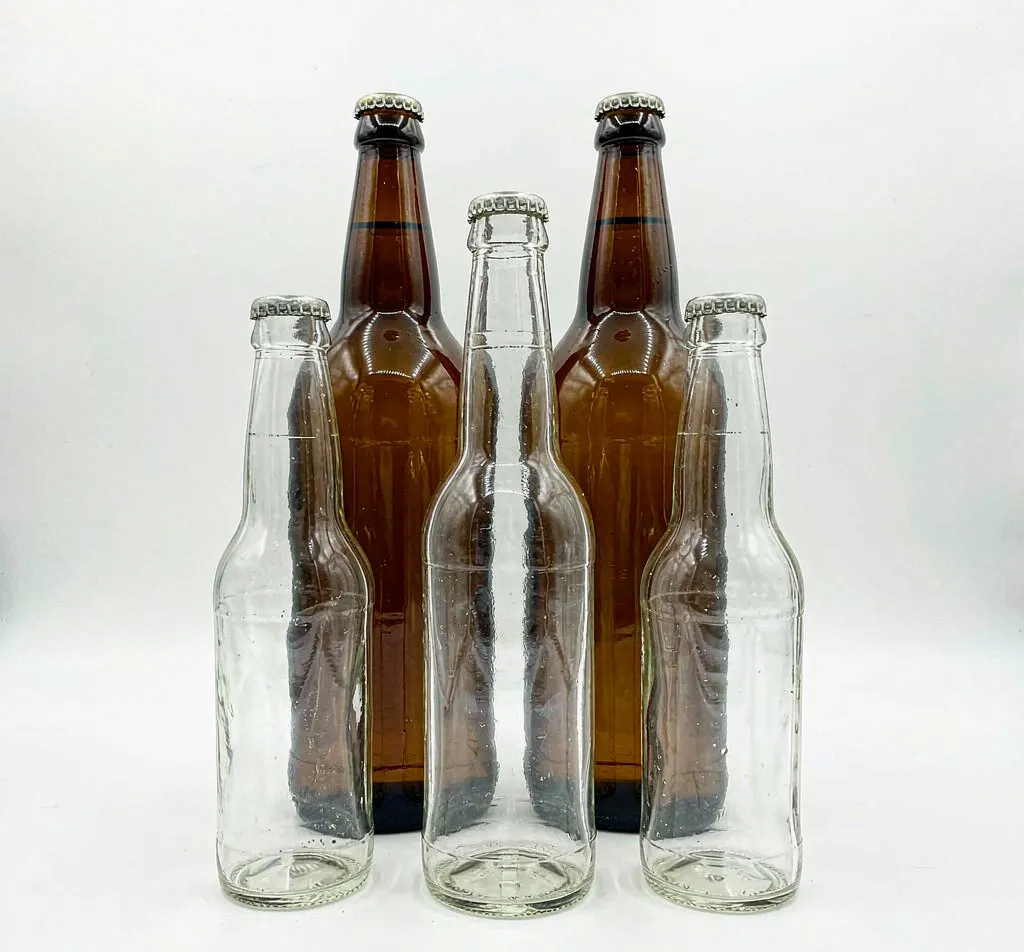
How a cider bottle differs from beer and champagne glass
Beer is mostly bottled in amber or green longnecks and stubbies that hide the liquid. Cider is more often sold in clear flint, because the pale gold, straw or rosé colour of the drink is part of what the shopper buys. The category also leans toward the European 500ml profile, with a shorter shoulder and a cleaner outline than a typical beer bottle.
Against champagne the difference is pressure. A champagne bottle is heavy and thick-walled because it has to contain a secondary fermentation at around 6 to 8 bar. Much cider is still or only lightly sparkling, and the sparkling styles typically need 3 to 5 bar. A bottle rated to 5.0 bar covers them at a fraction of the glass weight.
The same reasoning makes these bottles a common choice for kombucha, hard seltzer and other lightly carbonated fruit drinks that need a clear, pressure-capable container. For still, cold-filled products next to that group, the cold brew coffee bottle range is a useful comparison.
Matching format, colour and closure to the product
Craft cider and taproom bottling
Small and mid-sized producers usually put a dry or semi-dry flagship in the 500 ml bottle with a crown cap, which runs quickly on standard bottling lines. Clear flint with a simple paper label is the popular combination, since it shows a bright, clean cider. The 330 ml size suits taproom-only runs and festival fills, where a smaller tasting pour encourages people to try something new.
Orchard and estate cider
Estate producers often position their cider nearer to wine than to beer. The 750 ml reads as a share bottle, and amber or emerald green glass shields a delicate, often unfiltered cider from light-induced flavour change. A swing top fits this positioning: it looks deliberate, reseals after opening, and supports a higher perceived value at farmers markets and estate shops. When these producers add a lightly sparkling cider, the 5.0 bar rating of the 750 ml already covers it.
Sparkling cider and carbonated fruit drinks
Carbonation may come from secondary fermentation, forced carbonation or a kombucha-style culture. In every case the bottle has to hold pressure without base push-out or finish failure, so we point sparkling projects to the 500 ml or 750 ml with a crown finish, and offer the swing top where the brand calls for it. Internal-pressure testing follows the same protocol used for sparkling wine bottles, which many cider buyers use as a reference when writing a sparkling specification.
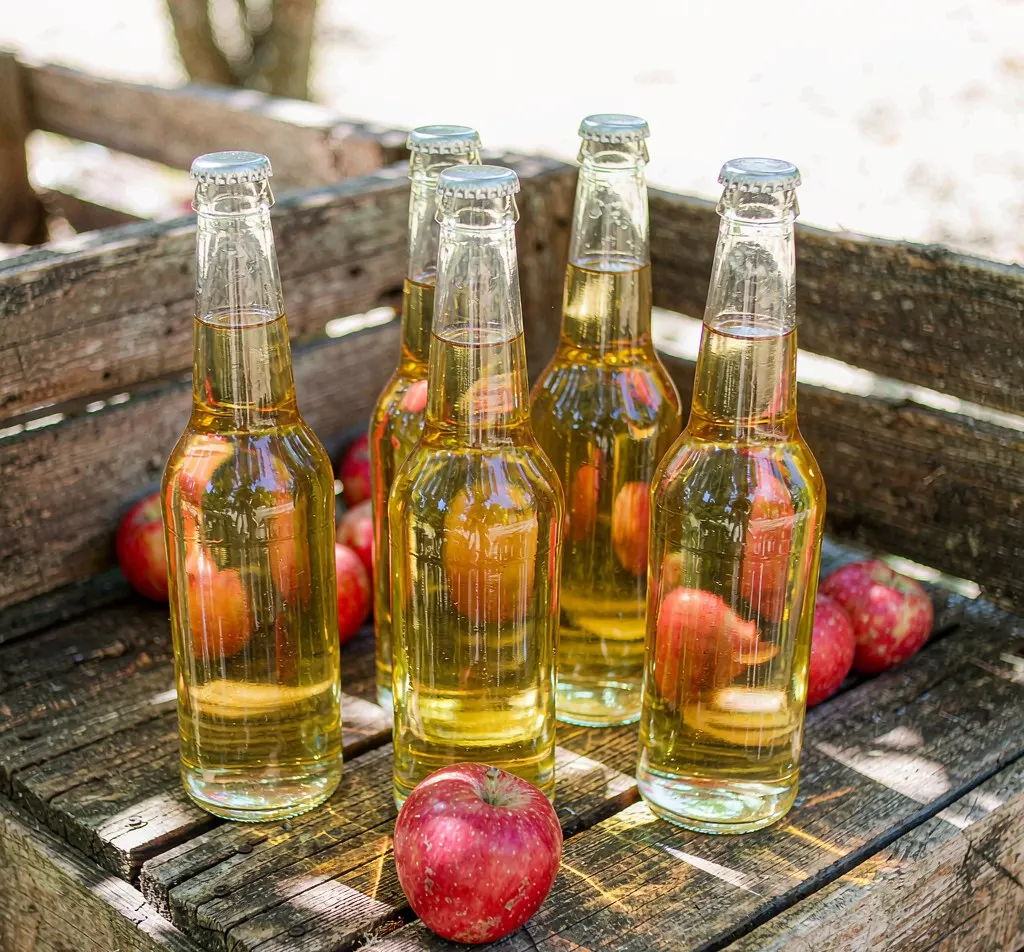
Clear glass is common here because the bubble stream and golden colour sell the drink. Choose amber or green instead if the aromatics are sensitive or the product will sit on a retail shelf for a long time.
Gift packs, private label and limited editions
Holiday packs, orchard gift boxes, corporate editions and retailer-exclusive blends treat the bottle as a keepsake. These projects lean toward the 750 ml with embossing, coloured glass and a swing top that survives repeated opening. Runs are smaller, so decoration quality carries more weight than it does on a volume SKU, and one-pass silk screen or ceramic ink work can be specified to withstand the cold chain and hand washing. Brands that refill on site sometimes pair the gift bottle with glass growlers.
Crown cap or swing top
The 26mm crown finish is the standard for high-speed lines and gives the tightest, most consistent seal on sparkling cider. Crowns can be pre-printed with artwork and supplied lined or unlined, depending on product pH and the filler setup.
The 28mm swing top finish accepts ceramic-and-rubber or all-stainless closures that reseal. It makes the capping step slightly slower and the closure itself costs somewhat more than a crown, which estate and gifting brands accept in exchange for the reuse story. Swing top finish geometry is checked on a torque and leak bench before bottles are released.
Colour and decoration options
Stock bottles get a project started quickly. On a crowded cider shelf, brands usually add one or more of the following, and they can be combined on one bottle.
- Custom tint. Beyond flint, amber and emerald green, tints such as soft blue-green, smoked olive and a UV-protective deep amber for light-sensitive recipes can be matched. Colour goes into the melt, so it cannot chip, fade or scratch off. A custom tint ties up a furnace for the run, which is why it is planned as a dedicated production quantity.
- Embossing and debossing. A raised shoulder logo or a mark sunk into the base survives every wash cycle. It needs its own mould cavity, so decide on it at the tooling stage. Keep the mark to a contained area so it neither weakens the wall nor interferes with label registration.
- Silk screen with ceramic bake-on inks. Printing straight onto the glass can replace the label or frame a paper one. Fired ceramic inks resist abrasion, pasteurization and condensation much better than self-adhesive labels in a chilled display. The artwork process is the same one used for custom soda bottles, which helps a brand that sells in more than one drinks category.
Glass, annealing and pressure testing
The bottles are soda-lime glass, the usual material for food and drink containers: clear, chemically inert, easy to form, and recyclable into new bottles without losing food-safety performance. A refined cullet blend with controlled iron content keeps the flint bright and the colours consistent from lot to lot.
Pressure. Samples from every production lot are proof-tested above the rated value, and burst-tested to 1.3 times the rating to confirm the safety margin. Testers record base push-out, finish integrity and sidewall stability, and the results are logged per lot for traceability.
Annealing. After forming, bottles cool gradually in a lehr so that internal stress is released. Under-annealed glass is the most common cause of failures that only appear in the field, such as spontaneous cracks, splits at the finish or weakness under pressure. Residual stress is therefore measured with a polariscope on each lot, and bottles ship only when strain is within tolerance.
Lightweighting. The 500ml bottle weighs about 245 g, where a generic import may run to 290 g or more, yet carries the same 5.0 bar rating. The saving comes from wall and base geometry that puts glass where stress concentrates, which is different from simply thinning the bottle. Less glass means lower freight cost, less raw material and a smaller carbon footprint per filled bottle. Each lightweight design is validated by thermal shock, internal pressure and vertical load tests before release.
Ordering: quantities, tooling and samples
Minimum quantities, pricing and lead times are quoted per project. They depend on the mould, the decoration, the production line and its schedule, and the order volume. Buyers who also purchase other glass, for example from the food jar range, can ask for the volumes to be considered together.
The standard shapes and finishes run on existing moulds that are shared between customers, with colours kept in separate runs. Before a production quantity is committed, buyers receive first-article samples with a dimensional report. Sample, inspection and claims terms are agreed before the order is placed.
A workable brief names the container, closure, decoration, quantity and destination, even if some of those are still provisional.
Frequently asked questions
Can I use a beer bottle for cider?
Both take a crown cap, but they are designed differently. Beer glass is amber or green to hide the liquid. Cider bottles are usually flint, follow the European 500ml shape with a gentler shoulder, and are tuned to cider's pressure range.
Will these bottles hold a carbonated cider?
The 500ml and 750ml are rated to 5.0 bar and lot-tested above that figure, which covers forced carbonation and secondary fermentation for typical sparkling cider. Keep the 330ml, rated to 4.0 bar, for still to lightly sparkling products.
Do I need champagne bottles for sparkling cider?
Not for typical sparkling cider. Champagne glass is built for 6 to 8 bar and is heavier as a result. A cider bottle rated to 5.0 bar contains the lower pressure safely with less glass.
What is the minimum order, and how long does delivery take?
Both are confirmed per project. The mould, any decoration, the line and its schedule set the figures, so they are given with the quotation and not as catalogue numbers.
Can the glass be coloured or printed?
Yes. Custom tints, embossing and ceramic bake-on silk screen are all available, and artwork is proofed before production starts.
Is the glass food safe and recyclable?
The bottles are inert soda-lime glass made under food-contact controls and are fully recyclable. Annealing checks and pressure results are recorded per lot, and the documentation can be supplied for a compliance file.