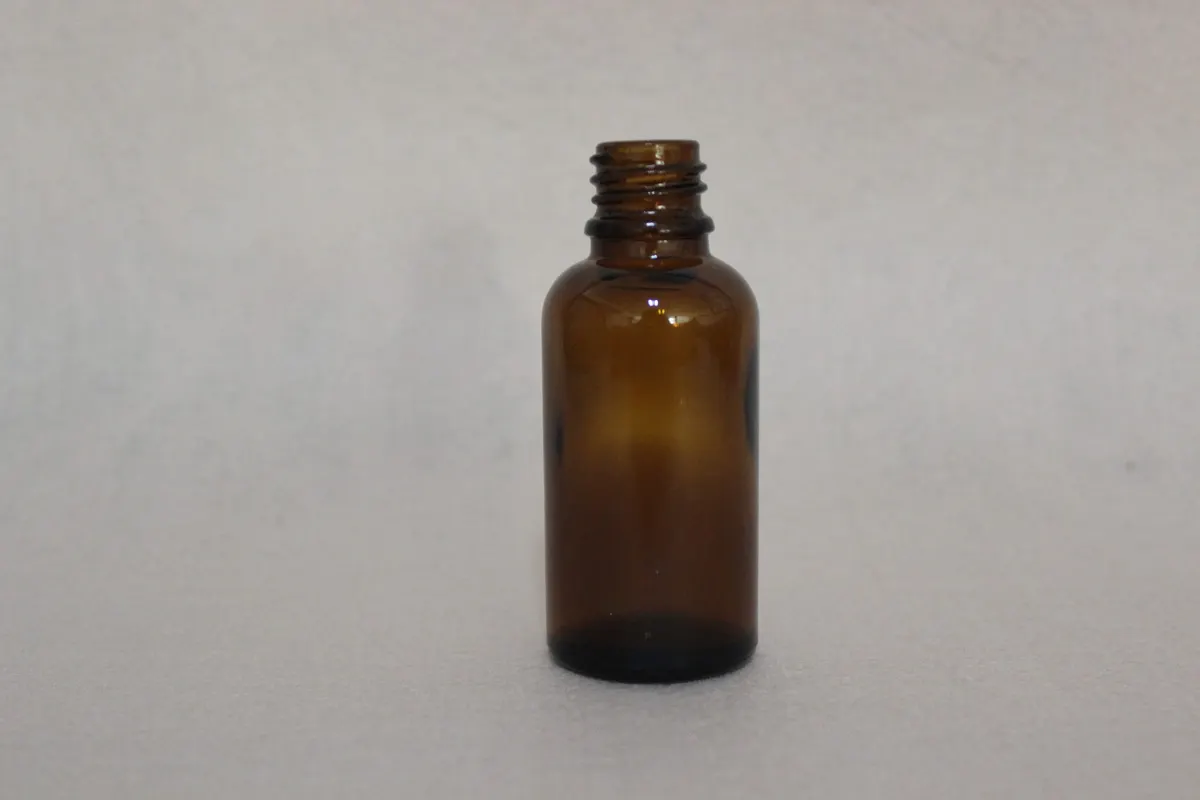
Part of our amber bottles and jars range; the stock moulds are pictured at the end of this guide.
A pharmaceutical glass bottle is defined by four things: glass colour, pharmacopoeia glass type, neck finish and closure system. For oral liquids, drops, tablets and supplements the usual answer is Type III soda-lime glass in amber or flint, on a PP 28, 28-400 or 18-415 finish chosen to fit the child-resistant or tamper-evident cap. Leave any of the four undefined and suppliers will quote different products under the same "100ml amber bottle" description, a gap that tends to surface only when stability testing or a regulatory review asks for the container specification.
The sections below follow the order in which those choices are made. Our glass packaging sourcing guides cover the wider procurement process.
Glass type under USP and EP
USP <660> and EP 3.2.1 sort pharmaceutical glass by hydrolytic resistance, meaning how much alkali the inner surface gives up under a controlled attack. The class you need follows from the dosage form.
| Class | Glass | Where it is used |
|---|---|---|
| Type I | Borosilicate, highest hydrolytic resistance | Injectables and parenteral preparations |
| Type II | Soda-lime with a treated, de-alkalized inner surface | Acidic and neutral aqueous parenterals |
| Type III | Untreated soda-lime | Oral liquids, tablets, capsules and powders |
Nearly all amber and flint medicine bottles fall in Type III. Asking for Type I borosilicate on a vitamin syrup adds cost and brings no regulatory advantage. The better use of a buyer's leverage is the test record: hydrolytic resistance results for each lot, dimensional reports checked against the agreed drawing, and certificates of analysis.
Amber or flint glass
Colour is a question about light. Amber glass gets its tint from iron and sulfur compounds in the melt, and a properly made amber bottle passes less than 10 percent of light between 290nm and 450nm, which is the USP spectral transmission limit for light-resistant containers. That band takes in the UV and near-UV wavelengths behind most photodegradation. Vitamins, plant extracts, essential-oil preparations and many APIs can fade in potency or shift colour within weeks under shop lighting when packed in clear glass.
Flint, the trade name for clear glass, suits formulas that are not light-sensitive, products where the user needs to see colour and fill level, and packs whose outer carton already does the light-barrier work. A frequent error is choosing amber "to be safe" for a bottle that sits in an opaque carton. The colour then costs money, hides the contents and protects nothing extra.
If stability data is thin, test before fixing the specification. Fill a few flint and amber bottles, keep them under the intended shelf lighting for four to eight weeks, and compare the two.
Standard formats and neck finishes
Most programs draw on a short list of established formats. The values here are typical planning figures; each project confirms them on its own drawing before production.
| Format | Nominal capacity | Brimful capacity | Neck finish | Weight |
|---|---|---|---|---|
| Amber dropper bottle | 15ml / 30ml | 18ml / 35ml | DIN 18, 18-415 | 25g / 42g |
| Amber syrup bottle | 60ml / 100ml | 68ml / 112ml | PP 28, 28-400 | 75g / 105g |
| Amber syrup bottle | 125ml / 250ml | 140ml / 275ml | PP 28, 28-410 | 130g / 210g |
| Flint oral liquid bottle | 100ml / 200ml | 112ml / 220ml | PP 28 | 100g / 165g |
| Tablet/pill packer bottle | 60ml / 150ml | 70ml / 170ml | 33-400, 38-400, 45-400 | 55g / 110g |
Bottles travel in export cartons with dividers, or on pallets as shrink-wrapped trays. Depending on format, a 40ft container holds roughly 80,000 to 140,000 pieces. Carton strength and pallet pattern are settled project by project.
Child-resistant closures and the finish they need
Where poison-prevention rules apply (16 CFR 1700 in the US, ISO 8317 internationally) the cap is a regulated part of the pack. Child-resistant closures, or CRCs, for glass are almost always continuous-thread polypropylene. Syrup bottles take push-down-and-turn caps in 28mm and 33mm; liquid extracts take 18mm CRC dropper assemblies.
The glass contributes the neck finish. A PP 28 or 28-400 finish with the right thread profile and transfer bead is what allows the cap to engage and hold its torque. Pick the closure first and then write the bottle finish to the cap maker's drawing. Programs that work the other way round are the ones whose caps loosen in transit.
Our closure selection pages set finish standards against closure families. For drops, dropper bottles sourced with their pipette assemblies come with torque and dose output recorded for each SKU.
Tamper evidence and liners
Tamper evidence sits on top of child resistance and is chosen to suit the filling line: a shrink band, a breakaway ring or an induction-seal liner. Induction sealing also gives a hermetic barrier against leaks and oxidation, which earns its place on liquids that ship long distances.
Match the liner to the formula. PE foam works for aqueous syrups; alcohol-based tinctures call for a PTFE-faced liner.
Stock, modified stock or custom mould
| Route | What changes | Where it fits |
|---|---|---|
| Stock mould | An existing bottle with your closure and label | Registration batches, market tests and most oral-liquid SKUs |
| Modified stock | Stock body with custom embossing, colour or a finish adjustment | Brand families that want an ownable detail at moderate volume |
| Full custom mould | Proprietary shape, weight and finish | High-volume flagship products with design IP |
Custom shapes seldom repay their tooling in this category, because a pharmacist is buying documentation and not a silhouette. We point most pharmaceutical projects to the first two routes and suggest spending the difference on closure quality and testing. Holding one neck finish across the whole range helps too, since cap volumes consolidate and the component count falls.
Documents that travel with the shipment
A standard pack contains the certificate of analysis for each production lot with its hydrolytic resistance results, dimensional reports against the drawing, pharmacopoeia or food-contact declarations where they apply, packing lists and the commercial shipping papers. Our export support service puts this file together to match what the destination market asks for, and any market-specific items are agreed when the project is quoted.
Frequently asked questions
Is Type I borosilicate required for an oral syrup?
No. Borosilicate is the requirement for injectables. Syrups, drops and supplements taken by mouth are accepted in Type III soda-lime under both pharmacopoeias, and that is the normal commercial choice.
Does amber glass block all light?
It does not. The USP limit applies from 290nm to 450nm, where no wavelength may exceed 10 percent transmission. Visible light above 450nm still passes, so a strongly light-sensitive product may need a carton as well.
Which finish goes with a child-resistant dropper?
DIN 18 or 18-415. CRC syrup caps are most widely available for PP 28 and 28-400.
Can bottle and cap arrive as one tested system?
Yes. We source sets of bottle plus CRC cap, tamper-evident closure, dropper assembly or liner that have been tested on the bottle's neck finish, with application torque and torque retention recorded per SKU.
How long does a project take from inquiry to delivery?
Timing is quoted for each project. It depends on whether a stock or custom mould is used, on any decoration, and on the production schedule.