Part of our amber glass bottles range; the stock moulds are pictured at the end of this guide.
Pick glass colour by how much light your product can tolerate, then by whether shoppers need to see the contents. Amber stops approximately 90-95% of UV radiation below 330nm, green roughly 60-70%, and clear glass lets about 75% of UV through. Cobalt blue, black, red and pink are brand-led choices that cost more to make and are harder to source at volume.
Colour comparison at a glance
The table below sets the six colour families side by side on the attributes that usually settle the decision. UV figures describe how much ultraviolet light the glass keeps out.
| Colour | UV protection | Typical products | Recyclability |
|---|---|---|---|
| Clear (flint) | Low (25%) | Vodka, wine, cosmetics, pharmaceuticals | Excellent |
| Amber | High (90%+) | Beer, whiskey, essential oils, medicines | Very good |
| Green | Moderate (60-70%) | Wine, champagne, herbal liqueurs | Very good |
| Blue | Moderate to high | Luxury spirits, perfume, upmarket cosmetics | Good |
| Black or dark grey | Very high (95%+) | Spirits, craft beer, skincare | Fair |
| Red or pink | Moderate | Limited editions, collector pieces | Fair |
By share of global bottle output, clear leads at approximately 60-65%, amber follows at 20-25% and green takes 10-15%. Everything else is a specialty run, which is worth remembering when you plan supply for a growing product.
Where the colour comes from
Bottle colour is not a coating. Metal oxides and trace minerals go into the raw batch before melting, so the tint runs through the full wall thickness. Scuffing, washing and age do not fade it, which keeps a brand colour stable over the life of the pack.
- Iron oxide (Fe₂O₃) is the workhorse colourant. Small doses give green or amber tones, and more iron means a darker glass.
- Chromium oxide (Cr₂O₃) gives emerald green and, blended with other elements, teal.
- Cobalt oxide (CoO) produces intense blue.
- Manganese dioxide (MnO₂) was long used to remove unwanted tint, and can itself give purple or amethyst.
- Selenium and cadmium compounds make red, pink and orange. They are rare and costly.
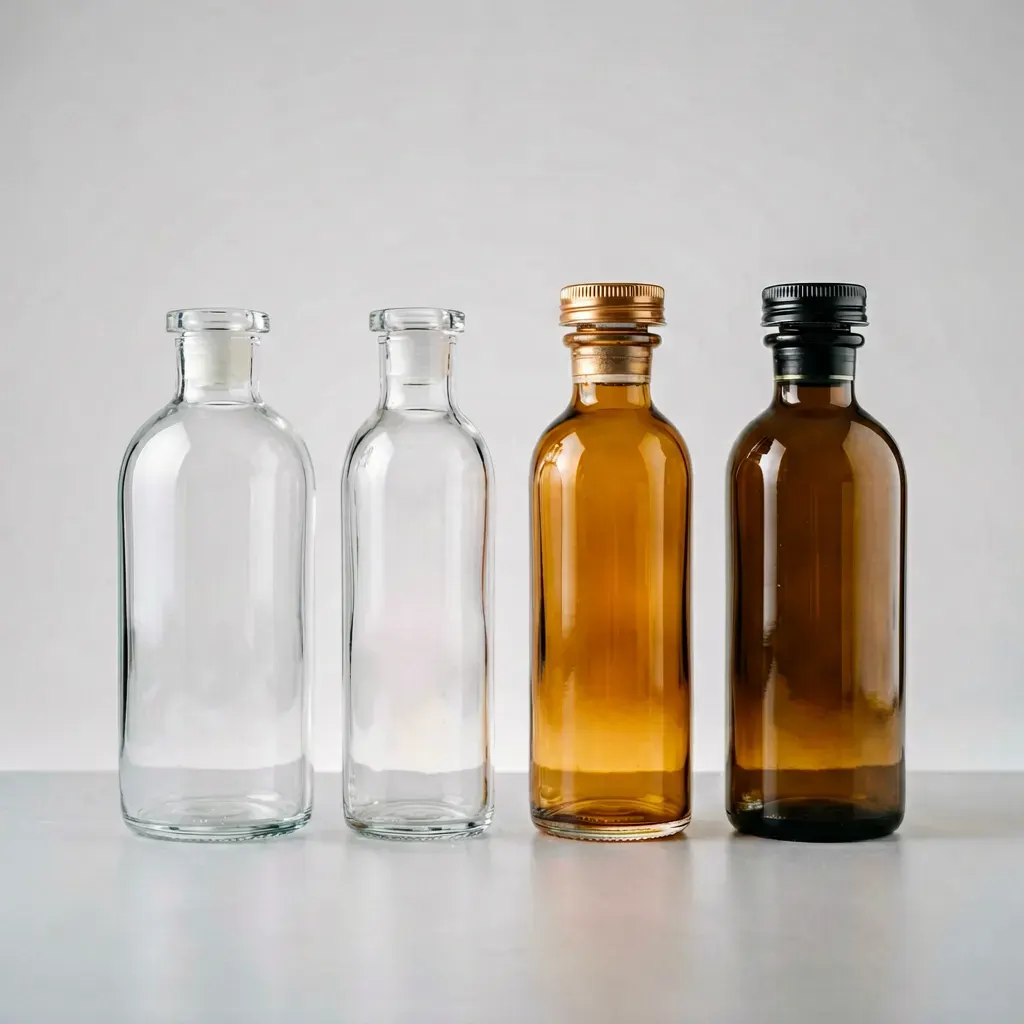
Clear, amber and green
These three colours cover nearly all bottle production, and most projects end up choosing among them.
Clear glass
Clear glass, also called flint, needs the fewest additives, so it is the cheapest colour to melt and the easiest to sort for recycling. Its selling point is visibility: the buyer sees the colour and clarity of the liquid, and any label artwork reads cleanly against a neutral background.
That suits vodka, gin and other clear spirits, white and rosé wine, olive and specialty cooking oils, juices and soft drinks, perfume and pharmaceutical products. The weakness is light. With around 75% of UV passing through, beer, some wines and natural cosmetics can pick up off-flavours, shift colour or lose potency over time.
Amber glass
Amber is coloured with iron and sulfur compounds, sometimes with selenium. It blocks approximately 90-95% of UV below 330nm and about 50% of visible light, the strongest protection among the standard colours.
- Beer: UV reacts with hop compounds and causes the "skunky" taint; amber prevents it.
- Wine: red and fortified wines benefit most.
- Essential oils: many degrade quickly in light, so amber is the default.
- Pharmaceuticals and supplements: light-sensitive formulas are routinely filled in amber.
Amber also signals heritage and natural ingredients. Distillers have used it for centuries, which is why it sits so comfortably on whiskey and bourbon bottles; our note on amber glass for whiskey goes further into flavour protection. Outside drinks it appears on aromatherapy bottles, organic foods and vintage-style sauce and condiment bottles.
Green glass
Green sits between the other two. Iron and chromium compounds give it its colour, and it keeps out roughly 60-70% of UV below 330nm: more than clear, less than amber. That is adequate for moderately light-sensitive products such as Bordeaux-style reds and whites, champagne and sparkling wine, herbal liqueurs and aperitifs, and some cosmetics.
The colour has a history. Early French wine bottles were green because impurities in the glass left a tint, and the shade stayed on as an identifier for Bordeaux even after clear glass became easy to make. It still reads as European wine tradition on wine bottles today.
Green is a range, not one colour:
- Pale or seafoam green feels light and is popular for artisanal spirits.
- Medium green is the familiar wine-bottle shade.
- Deep forest green looks richer and is used on higher-priced lines.
- Emerald is a vivid jewel tone found in cosmetics and perfumery.
Blue, black and other specialty colours
Specialty colours are chosen to stand apart on a shelf of clear, amber and green. Each brings a production constraint that should be weighed before artwork is approved.
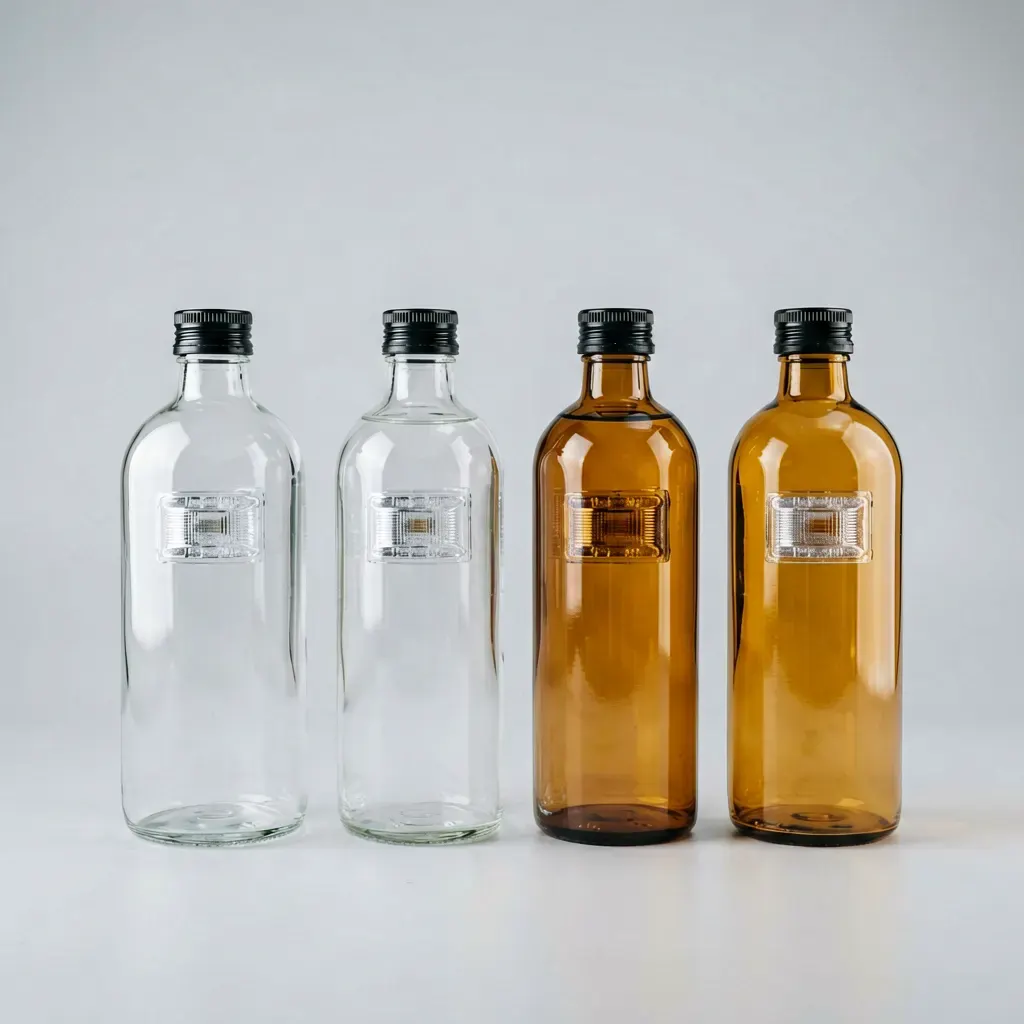
- Cobalt blue. Cobalt oxide is among the most expensive colourants, and the bottle cost reflects it. Brands use deep cobalt or azure for perfume, for luxury spirits, and for skincare serums where the dark glass also shields a light-sensitive formula.
- Black and dark grey. A high iron load or added carbon particles produces a near-opaque bottle. It is gaining ground in upmarket spirits, craft beer and cosmetics, and it hides the contents completely.
- Red and pink. The selenium and cadmium compounds involved are costly and hard to hold consistent from run to run. Expect these mainly on limited editions, collector items and luxury cosmetic packs.
- Frosted and opalescent finishes. Frosting is a surface treatment, not a glass colour. It gives a milky, translucent look that diffuses light, and it can go over any base colour. Perfume, cosmetics and spirits use it widely.
- Gradients and two-tone bottles. A bottle that shifts from one colour to another needs specialised moulding technique and is normally kept for commemorative or top-tier releases.
If the colour you want falls in this group, raise it early in a custom bottle brief, because not every plant runs every tint.
How to choose a colour for your product
Work through the questions in order. The first two usually narrow the field to one or two colours, and the rest settle it.
| Question | What to ask | Direction |
|---|---|---|
| Light sensitivity | How quickly does light damage the product? | Amber if high, green if moderate, clear if low |
| Visibility | Does the shopper need to see the contents? | Clear for full view, frosted for partial, amber or green for none |
| Positioning | Luxury, traditional or mass-market? | Blue or black for luxury, green or amber for traditional, clear for mass-market |
| Category convention | What colour do competitors use? | Match the norm or break from it on purpose |
| Sustainability | How will the bottle be recycled? | Every glass colour is recyclable; clear sorts most easily |
Colour does not change taste by itself. What it changes is how well flavour survives storage, which is why the same beer turns skunky sooner in clear glass than in amber. Decide colour together with the closure, since the two are seen as one object; our guide to cap types and closure systems for alcohol packaging covers that side.
Recycling and energy
Recycled glass, known as cullet, has to be separated by colour before it is remelted, because mixed cullet yields lower-grade glass. Clear cullet is the most valuable, then amber, then green. Keeping a range to one or two colours makes the packs easier to recover, a point developed in our guide to glass recycling and the circular economy.
Darker glass absorbs more heat while melting and may need slightly more energy. The gap is marginal next to the gain from using cullet, which can lower furnace temperatures by up to 30°C. For the wider picture, see the glass packaging sustainability data.
Briefing and approving a colour
When we match a project to a plant, colour approval follows the same sequence whatever the tint. Browsing the bottle collections first helps you see which shapes are already run in which colours.
- Judge physical samples. Screens misrepresent glass colour badly. Look at real bottles under the lighting your product will be sold in.
- Fill them with your product. Some liquids change how the glass reads quite sharply, so an empty sample can mislead.
- Agree a tolerance for batch variation. Small shifts between production batches are normal within a single colour specification. Put the acceptable range in writing.
- Confirm order terms for specialty colours. Blue, black and red are run less often than clear, amber and green, and the order terms reflect that. Settle them before you commit to the design.
- Check the colour can scale. Some specialty tints are hard to reproduce consistently in large quantities. If you expect growth, choose one the plant can repeat.
Frequently asked questions
Can one order include several glass colours?
Often, yes. Each colour change on the production line carries a set-up cost, so tell us the mix you need at the start and the quotation will account for it.
Can the exact shade be customised?
Custom colour matching is available at many plants, mainly for large volumes. You supply a Pantone reference or a physical sample and the batch is formulated to match it. Quantity and timing for a custom colour are quoted per project.
Does coloured glass cost more than clear?
Generally it does, and the gap varies widely. Amber and green sit closest to clear; blue, black and other specialty colours cost noticeably more because of the colourants and the production complexity. The figure for your bottle depends on the colour, the mould, the decoration, the quantity and the freight terms, so it is quoted per project.