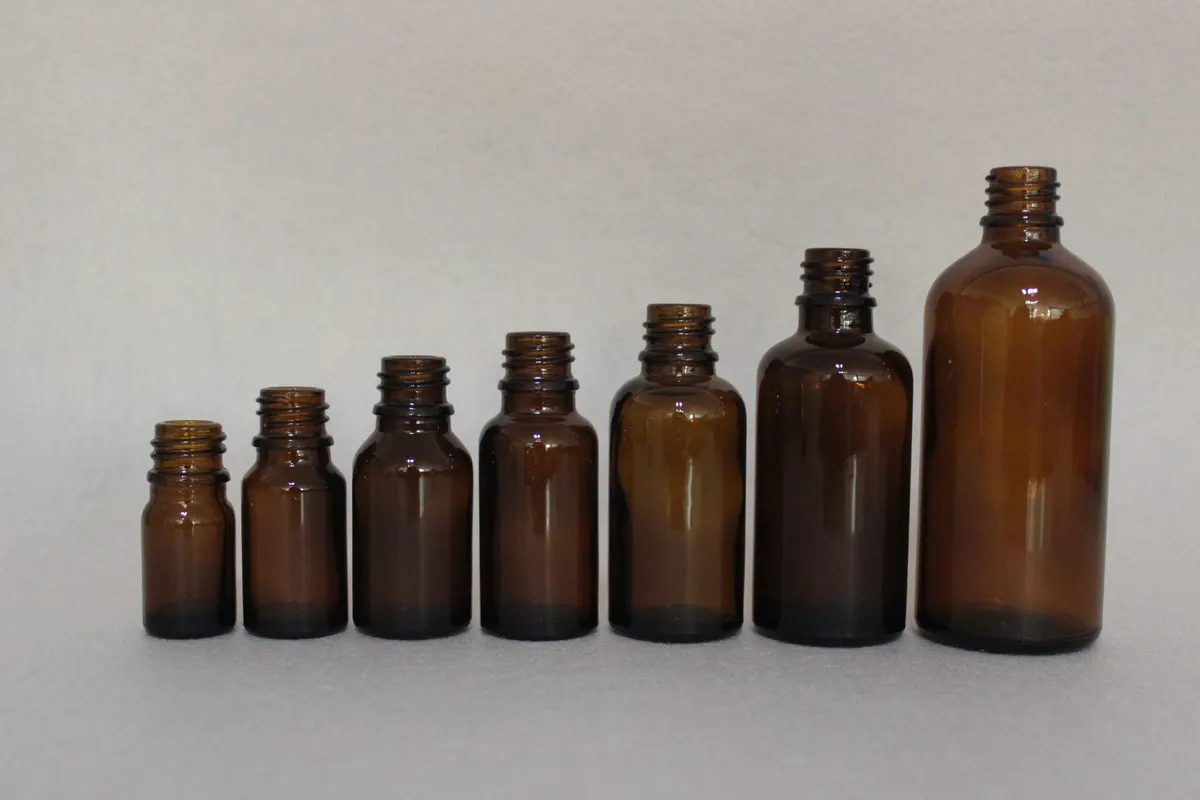
Filed under amber glass bottles; the moulds we quote for this are pictured at the foot of the page.
Vanilla extract belongs in amber glass with a closure built for alcohol: a Boston round or square bottle in 2 oz, 4 oz or 8 oz, a continuous-thread neck in 18-400, 20-400 or 22-400, an alcohol-compatible liner and an orifice reducer for drop dosing. The extract is at least 35% alcohol by volume under the FDA definition in 21 CFR 169.175, and its vanillin breaks down in light, so the glass colour, the wall thickness and the seal all belong in the specification. Leave any of them open and the product loses flavour or leaks in transit.
Why extract is hard on packaging
Three things go wrong with extract in the wrong pack, and each one maps to a line in the bottle specification.
Light
Vanillin, the phenolic aldehyde that gives vanilla its character, is photolabile. Retail shelf lighting typically runs from 200 to 800 lux. In a clear flint bottle the vanillin absorbs energy in the UV-A band (315 to 400 nm) and the violet-blue band (400 to 500 nm), and free-radical oxidation turns it into vanillic acid and other products that are colourless, flavourless or off-note.
Leakage
Ethanol at 35% to 40% ABV has a surface tension near 28 to 30 mN/m, about half that of water, so it creeps through any capillary gap the closure leaves. A plain flat polyethylene liner on an 18-400 or 20-400 thread does not seal hermetically against alcohol vapour. Long-haul freight makes it worse: a pack can swing from 5 °C in a winter trailer to 40 °C in an unshaded container, which puts roughly 8 to 12 kPa of pressure difference across the cap. Wet caps, stained cartons and a 3% to 6% loss of net weight on arrival usually trace back to a closure stack chosen for water-like drinks.
Dosing
Extract is measured in drops. A baker working at 0.5 mL per kilogram of dough, or a home cook adding four drops to a custard, cannot work with a free-pouring neck. One over-pour of 1 mL is about 0.4% of an 8 oz (240 mL) bottle; over a run of 10,000 units that adds up to the contents of 40 full bottles lost as spillage.
What amber glass does for the product
Amber soda-lime glass gets its colour from iron, carbon and sulfur compounds in the melt. They create a steep absorption edge that blocks radiation below approximately 450 nm. Typical spectrophotometry figures for amber are transmission below 1% at 290 nm, below 3% at 350 nm and under 10% at 450 nm, while 60% to 85% of visible light above 500 nm still passes, so shoppers can see the fill. That profile lines up with the United States Pharmacopeia limit for amber containers: no more than 10% transmission across 290 to 450 nm.
Glass is also inert to ethanol across the pH range of food extracts, typically pH 3.5 to 6.0. Some plastics allow trace aldehyde scalping or plasticizer migration; amber glass does not react with the alcohol, cloud or take up flavour. It does not let ethanol vapour through either, and it tolerates the −10 °C to 60 °C range an extract meets between cold chain and a tropical warehouse. The only route for vapour is the closure interface.
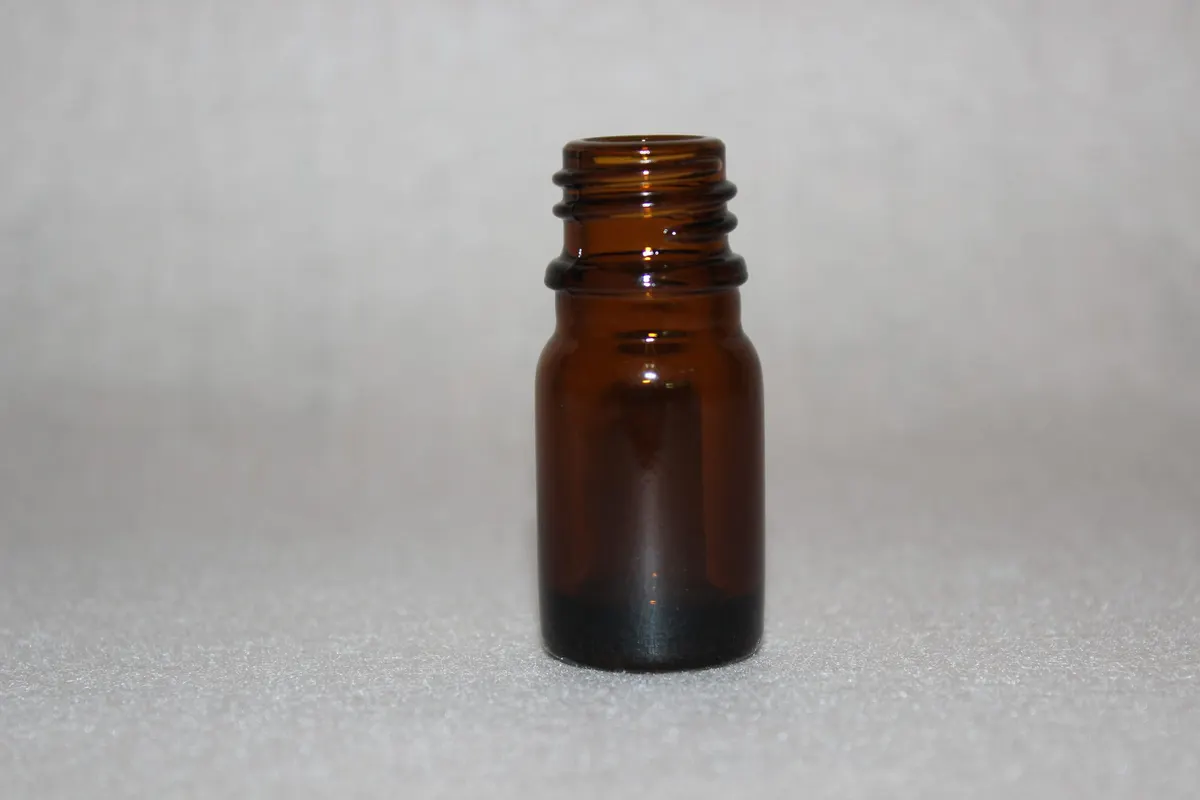
Wall thickness is part of the light barrier
The protection sits in the glass wall, not in the cap, so a thinner wall filters less. Sidewalls under 1.8 mm are still amber but can pass 4% to 7% of light at 400 nm, against the 3% of a wall made to specification. Put a minimum sidewall in the purchase specification and have it checked at incoming inspection with a wall-thickness gauge at four points around the circumference. A specification with no minimum wall leaves the main protective variable uncontrolled.
Shapes, sizes and neck finishes
Two shapes cover most extract lines. The Boston round, a cylinder with a rounded shoulder, is the long-standing choice: it stays upright on fast filling lines and under the labeller, and its constant radius makes wrap labels easy to register. Our page on Boston round bottles for wholesale orders covers the three volumes behind most extract SKUs: 2 oz / 60 mL for gourmet and gift packs, 4 oz / 120 mL for standard retail, and 8 oz / 240 mL for foodservice and bakeries.
The square, flat-sided bottle is less forgiving on the line. In return it packs 12% to 18% denser on a pallet and offers a bigger flat front for artwork, which helps when compliance text and brand story compete for the same space.
| Capacity | Shape | Neck finish | Bottle weight | Sidewall |
|---|---|---|---|---|
| 2 oz / 60 mL | Boston round | 18-400 | 92–104 g | 2.0–2.4 mm |
| 4 oz / 120 mL | Boston round | 20-400 | 138–156 g | 2.4–2.8 mm |
| 8 oz / 240 mL | Boston round | 22-400 | 188–214 g | 2.8–3.2 mm |
| 4 oz / 120 mL | Square | 20-400 | 145–162 g | 2.4–2.8 mm |
| 8 oz / 240 mL | Square | 22-400 | 196–220 g | 2.8–3.2 mm |
The neck finish decides which closures will fit. Extract bottles use continuous-thread (CT) finishes, and the first number is the outer diameter in millimetres: 18, 20 or 22 mm. An 18-400 neck is the classic match for 2 oz, 20-400 for 4 oz, and 22-400 for 8 oz and for square bottles where a wider pour is acceptable. Caps and orifice reducers do not swap between these finishes, so fix the neck before any closure tooling is ordered. Changing it later means qualifying the whole closure stack again.
Glass weight drives freight planning. As a guide, 2,000 pcs of 8 oz amber come to about 460 kg gross per pallet. Caps, reducers and secondary packaging are normally quoted as a separate closure line from the glass.
The closure stack
An extract closure has three working parts, plus optional safety and tamper features.
| Part | What it is | What it does |
|---|---|---|
| Shell | PP or urea cap in 18-400, 20-400 or 22-400 | Applied at 8 to 14 in-lb of torque, depending on finish |
| Liner | Foil-faced pulp, or a co-extruded PE/foam induction liner | Gives a tamper-evident hermetic seal that holds through thermal cycling |
| Orifice reducer | Moulded insert with a calibrated 0.8 to 1.2 mm opening | Sits in the neck and meters flow by capillary restriction |
| Cone plug | Tapered PE or silicone stopper | Seats in the neck when the cap closes; seals independently of thread torque |
| CRC cap | PP push-and-turn cap | Child resistance to ISO 8317 and US 16 CFR 1700.20 |
| Shrink band | PVC or PET-G sleeve | Locks cap to neck as tamper evidence |
Orifice reducers and cone plugs
The orifice reducer is also sold as a drip reducer or pour reducer. With a 1.0 mm opening and a 35% ABV extract, expect approximately 0.06 to 0.08 mL per drop, or roughly 18 to 22 drops per milliliter, repeatable within ±10%. That is what makes a recipe's "1/4 teaspoon vanilla" achievable by eye. It is also the part most often missing from a low quote, so name it in the purchase order and get its inclusion confirmed in writing.
A cone plug suits bottles that are opened and closed many times, because the cone reseats at every closure and does not depend on the liner keeping its compression memory. Combined with a reducer in a "reducer + cone" stack, it gives drop metering and a resealable seat together.
Child-resistant caps and tamper bands
Several jurisdictions require child-resistant closures on alcohol-containing extracts in household sizes. The test standard calls for ≥85% adult-open and ≤15% child-open results across a 50-child panel. CRC is a sensible default for 2 oz and 4 oz retail packs; for foodservice bottles of 8 oz and above, where the user is commercial, it is not something we recommend.
A heat-shrink band for 18-400 to 22-400 necks shrinks at 110 to 130 °C. A sequential lot code printed or laser-perforated into the band lets a distributor spot a diverted or refilled bottle. Decide on CRC and the band when the bottle is designed, so that neck finish and cap stack are qualified as one system and nothing has to be retrofitted.
Label area and decoration
Label space runs out faster than most teams expect. On a 4 oz Boston round the usable front arc is roughly 95 mm wide by 70 mm tall before curvature hurts legibility. A square 4 oz offers a truly flat face of about 105 mm by 75 mm, a 17% larger canvas. Onto that face go the compliance line ("Vanilla Extract, 35% Alcohol by Volume, Product of [origin], NET 4 FL OZ (120 mL)"), the nutrition or ingredient statement and the brand artwork.
A workable rule is to reserve at least 30% of the front for mandatory text and give the other 70% to the brand. If the artwork needs more, move to the square bottle or the 8 oz size. Shrinking the type until it cannot be read from 300 mm, a normal retail viewing distance, is the wrong fix.
For pressure-sensitive and shrink labels, amber glass should show a surface energy of 38 to 42 dynes/cm after flame treatment so the adhesive holds. Embossed logos are kept to a depth of 0.3 to 0.6 mm; deeper relief can weaken the sidewall or upset label registration. For most brands a discreet, permanent emboss on the base together with a screen-printed logo on the front is the balanced combination.
Gift sets are easier when the pieces share parts. Matching glass spice jars from the wholesale range in a coordinated amber let an extract and a spice or cocoa jar ship as one kit, and a common 20-400 finish means one cap SKU serves both.
Food-contact compliance and other products the bottles suit
The relevant rules are FDA 21 CFR 175.300, which covers resinous and polymeric coatings where any are applied, and the US FDA and EU 10/2011 limits on heavy-metal release. The release limits to quote are Pb < 0.5 mg/L, Cd < 0.05 mg/L and As < 0.2 mg/L. Ask for a Certificate of Conformity with each production lot and, where you need it, a migration test report from a third-party laboratory.
Glass is generally regarded as inert, so the real compliance variables are the liner, the reducer and any decoration. Hold every food-contact surface to the same extraction limits instead of relying on a statement about the glass alone. For import paperwork, glass bottles are classified under HTS 7010.90.
The same amber Boston rounds and squares work for neighbouring products that contain alcohol or react to light: almond, lemon and mint extracts, concentrated flavourings and essences, bitters, tinctures used in food preparation and high-oil baking ingredients. Shipping extract bottles, syrup bottles and spice jars in one mixed-SKU container is a common way to fill a full load.
How to evaluate a supplier for extract packaging
Treat the choice as a documented technical decision, not a tender won on price. Eight checks cover it, and they are the ones we apply when matching an extract project to a glass plant.
- UV performance. Ask for a spectrophotometry report showing ≤10% transmission at 450 nm. Without it, "amber" is an unverified claim.
- Alcohol compatibility. Require a migration test at 40 °C for 10 days on the liner and any coating, reporting heavy metals and non-volatile residue.
- Dimensional control. Request CPK ≥ 1.33 on neck finish OD and thread lead. Closure leaks follow directly from variation in the neck.
- Closure integration. Prefer a supplier that qualifies cap, reducer and liner as one system and quotes a validated stack, not a loose bottle.
- Decoration. Fewer handoffs between glass and decoration mean fewer gaps in quality responsibility.
- Documentation. CoC, lot traceability and migration reports should travel with every order.
- Samples. Expect a pre-production sample (PPS) and a willingness to have a deviation re-tested by an outside lab.
- Logistics transparency. An FOB figure is not enough. Ask for the DDP landed number so you compare the true cost of goods.
Frequently asked questions
How strong an alcohol can amber glass hold?
The glass is not the limit. It is inert from the 35% ABV minimum up to 40% and beyond. What needs checking is the liner and the reducer. If the formulation is above 40% ABV, say so when you ask for a quote so a liner rated for the higher solvent load is chosen; the glass wall stays as it is.
Is the amber colour functional or just traditional?
Functional. It cuts the UV-A and violet-blue wavelengths that drive vanillin photodegradation, provided the wall meets the minimum thickness in the specification.
Which neck fits a 4 oz extract bottle?
20-400. It has the widest choice of caps, reducers and CRC closures. Go to 18-400 only when dropping to 2 oz or when a smaller pour opening is needed, and to 22-400 for 8 oz or a wider mouth that fills faster.
What are the minimum order quantity and the lead time?
Both are quoted per project. They depend on the mould, the decoration, the quantity and the freight terms, and custom embossing adds a mould step that is scheduled in the same quote.