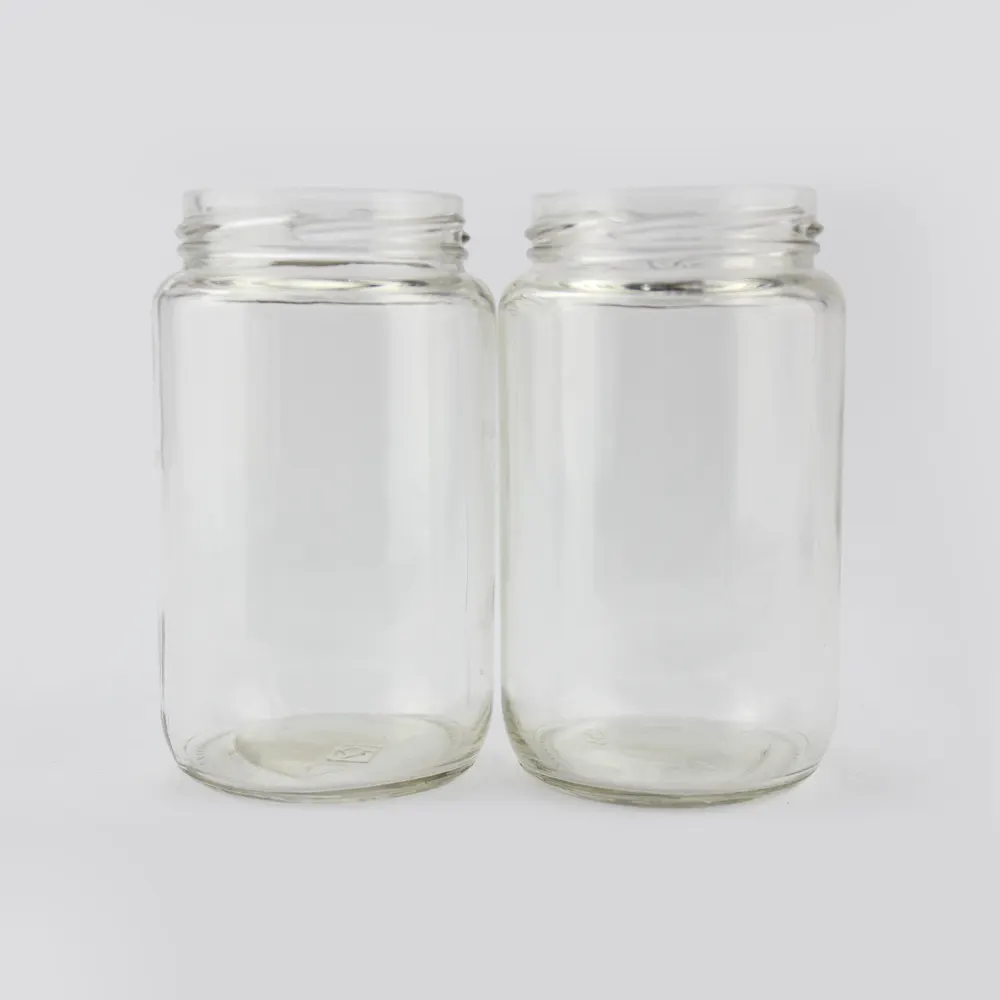
Filed under wide mouth glass jars; the moulds we quote for this are pictured at the foot of the page.
For food service, a large pickle jar means a wide-mouth glass container of one to five gallons that can sit in acid brine for months, take a hot fill and be handled every day. Size it from how you serve or produce, then fix the mouth diameter before anything else: 110 mm is the common food-service specification because a gloved hand and a whole cucumber both fit through it. Weight decides the rest, since a filled one-gallon jar is 10–12 lb and a filled five-gallon jar is 42–48 lb.
Capacity, pickle count and filled weight by size
A 32 oz (946 ml) jar counts as large on a retail shelf. Commercial pickling starts at one gallon (128 oz / 3,785 ml) and goes up to five gallons (640 oz / 18.9 L). The four sizes below cover most orders.
| Size | oz / ml | Where it is used | Whole pickles, 3–4 inch (approx.) | Filled weight (approx.) |
|---|---|---|---|---|
| 1 gallon | 128 oz / 3,785 ml | Deli counter display, back-of-house in a small restaurant, farmers' market fermenting | 35–45 | 10–12 lb / 4.5–5.4 kg |
| 2 gallon | 256 oz / 7,570 ml | Restaurant prep, catering, mid-size delis, kimchi and sauerkraut batches | 70–90 | 20–23 lb / 9–10.4 kg |
| 3 gallon | 384 oz / 11,356 ml | High-volume delis, commissaries, co-packer test batches | 105–135 | 29–33 lb / 13–15 kg |
| 5 gallon | 640 oz / 18,928 ml | Stadiums and institutions, deli wholesalers, commercial fermentation | 175–225 | 42–48 lb / 19–21.8 kg |
The counts are for whole cucumbers. Spears interlock and pack 15–25% more efficiently. The weights assume a 50/50 split of solids to brine by volume, the usual fill for shelf-stable pickles; brine-cured products often run 55–60% solids, which adds 5–8% to the filled weight. For production planning, a one-gallon jar carries roughly 5.5–6.5 lb of finished whole pickles including brine.
Smaller retail sizes sit in our wider pickle jar range. Case packs and lid options for the one-gallon size are on the page for gallon glass jars with lids, and where brine is sold or shipped as a liquid, a handled glass gallon jug is the usual container.
Mouth diameter and body shape
Buying on volume alone is the most frequent mistake with large pickle jars. A five-gallon jar with a 70 mm mouth is close to useless for whole cucumbers: no gloved hand fits inside, spears bridge across the opening, and cleaning between batches turns into a labor cost.
| Mouth | What it suits |
|---|---|
| 100 mm | The least that works for spears and chips; standard on one-gallon wide-mouth jars |
| 110 mm | Easy hand access for packing whole 3–4 inch cucumbers; the most common food-service specification |
| 120 mm and above | Sauerkraut, kimchi and whole-head ferments that must be pressed down under the brine line |
Check the shoulder next. A hard, square shoulder traps the last pickles when a worker tips the jar, and it concentrates stress when a 45 lb filled jar lands heavily on a stainless prep table. A gently sloped shoulder avoids both problems.
Straight-sided bodies pack more product and stack more predictably, and they accept a standard 4-inch or 6-inch fermentation weight. Tapered, crock-style bodies are easier to grip around the middle and resist vacuum paneling after hot fill slightly better, but they need weights sized to the jar.
Closures for acid brine
Pickle brine typically sits at pH 3.2–3.8 with 5–10% vinegar by volume. That attacks bare metal and many liner compounds, so most failures on large jars begin at the lid: rust spots, a liner peeling away, lost vacuum, off-flavors. Two closure types cover nearly all uses.
| Plastisol-lined metal lug cap | Continuous-thread (screw) cap | |
|---|---|---|
| Use | Hot-filled and pasteurized, shelf-stable product | Jars opened and closed many times a day |
| How it seals | The PVC-based plastisol softens during hot fill and cooling, molds to the glass sealing surface and holds a hermetic vacuum | Phenolic or polypropylene cap with a PE foam or pulp-and-vinyl liner gives a dependable reseal |
| Sizes | 4-lug or 6-lug on mouths of 100 mm+ | 89 mm and 110 mm |
| Limit | Not meant for a jar a deli dips into 30 times a day | Not suitable for shelf-stable hot-fill processing |
When specifying a lug cap, settle four points with the supplier:
- Lug count. Six lugs spread torque more evenly and are preferred on 3–5 gallon jars, where the glass expands more in the pasteurizer.
- Acid rating. Ask for a plastisol compound made for acid products and get its rating in writing, particularly if the brine holds more than 7% acetic acid.
- Application torque. A 110 mm lug cap on a five-gallon jar is typically applied at 55–75 inch-pounds. Too little and vacuum is lost in distribution; too much strips lugs or cracks the finish.
- Tamper evidence. Retail-bound jars, such as club-store gallon pickles, need a button-top vacuum indicator or a cap that takes a shrink band.
Five-gallon jars most often carry a 110 mm or 120 mm lug finish. Whatever the size, match the cap to the jar's finish drawing, not to a description such as "wide mouth".
Hot-fill and pasteurization limits
Glass copes well with hot filling at 180–195°F (82–90°C). The figure to watch is the gap between brine and glass temperature. Brine at 190°F going into a jar at room temperature (70°F) is a 120°F differential, inside the range for annealed commercial jars, which are typically rated to a 130–140°F differential.
Five-gallon jars have enough glass mass to make temperature gradients more severe, so pre-warming them to 100–110°F before filling is standard practice. Lug-capped large jars routinely go through pasteurization tunnels for 15–30 minutes at 165–180°F. Check the jar's annealing specification and the cap's plastisol rating against your real tunnel profile, not a typical one.
Headspace and venting for fermented pickles
Brine-cured pickles produce CO₂ while they ferment, and the brine level climbs as the product softens and gives off gas. Headspace is therefore a safety figure.
- Headspace. Leave at least 2 inches (50 mm) below the shoulder in one- and two-gallon jars, and 3 inches (75 mm) in three- and five-gallon vessels, which generate more gas in total.
- Submersion. Hold all solids at least 1 inch under the brine with a fermentation weight. Cucumber left exposed molds within days.
- Venting. Through primary fermentation, typically days 1–14 at 65–72°F / 18–22°C, keep the lid loose or fit an airlock. A sealed five-gallon jar can push brine past the lid or ruin the seal for good.
- Salt. Cucumber ferments normally run at 3.5–5% salt by weight of water. Stronger brine slows the ferment, but 2 inches of headspace stays the safe minimum.
Fermentation is finished when pH is stable below 3.6 and there is no visible activity. The product can then be hot-packed into lug-capped jars for shelf stability or kept refrigerated in the same vessel. If you ferment in one jar and pack into another, make the fermentation jars 15–20% larger than the pack-out volume to allow for headspace and weight losses.
Glass or PET for brine contact
| Factor | Glass | PET |
|---|---|---|
| Flavor | Inert to acetic acid, salt, garlic oils and spice volatiles | Slightly permeable; can scalp delicate flavors over a 12–18 month shelf life |
| Oxygen | Complete barrier | Slow ingress, typically 0.01–0.05 cc/package/day in large formats, which fades turmeric-brined color and softens texture in long storage |
| Fermentation | Handles CO₂ pressure, scrubbing between batches and 180°F sanitation rinses | Clouds and crazes over time under the same treatment |
| Empty weight, five gallon | Roughly 8–10 lb (3.6–4.5 kg) | Under 1 lb |
| Breakage | A real cost on tile floors, in lost product and safety procedure | None |
| Parcel shipping | Needs palletized freight to travel well | Survives parcel networks far better and cuts freight weight |
Many processors use both. Fermentation and hot fill happen in glass; the finished product then stays in glass for visible and craft-positioned channels or is repacked into PET for institutional distribution. Where flavor in contact with brine is the deciding issue, as it usually is for fermented products, glass is the right primary container. A glass crock on a deli counter also tells customers the pickles are made on site.
Lifting, case packs and pallets
Most staff carry a filled one-gallon jar in one hand. A three-gallon jar at about 30 lb takes two. A filled five-gallon jar reaches the recommended one-person lifting limit in most occupational guidelines, which is 35–50 lb depending on jurisdiction. Plan for a two-person lift, a tilting cradle, or a fixed position below the counter with a ladle-and-pump setup. Stadium and institutional kitchens often leave five-gallon jars on dollies and portion into smaller service containers.
| Size | Typical pack | Pallet notes |
|---|---|---|
| 1 gallon wide-mouth | 4 per case, 36–40 cases per pallet (144–160 jars) | About 700–800 lb empty; about 2,200–2,600 lb if shipped filled |
| 2 gallon | 2 per case, or bulk-packed at 24–36 per pallet layer | Filled pallets soon approach the 2,800 lb floor-load rating of standard racking; check the rack before double-stacking |
| 5 gallon | Shipped empty, 12–24 per layer with divider sheets, 48–96 per pallet depending on height limits | A 96-jar pallet weighs 800–950 lb before wrap |
For empty jars, ask for corrugated divider sheets between layers and full-height corner boards. For filled jars, add partition inserts between jars in the top two layers. Glass touching glass causes most breakage in filled-jar freight, and partitions prevent nearly all of it, which matters on a pallet that rides 500 miles of LTL.
What each type of buyer needs from the jar
- Delis and sandwich shops use the five-gallon counter crock, almost always in glass. Mouth access for tongs, counter footprint and appearance come first.
- Restaurants and caterers keep one- and two-gallon jars back-of-house for house pickles, giardiniera and fermented garnishes. They want dishwasher compatibility and a resealable continuous-thread cap, and often add freezer-safe glass jars for pickled components frozen ahead of a menu cycle.
- Stadiums, arenas and institutions go through spears and chips in volume and care about cost per serving and safe handling. PET is common out of sight, glass where prep is visible.
- Food manufacturers and co-packers hot-fill one-gallon retail and club formats. Their concerns are fit with the existing capping line, thermal specifications, pallet efficiency, annealing quality and consistent lug-finish dimensions.
- Fermentation brands and market producers ferment in two- to five-gallon vessels and pack out in one-gallon jars. They look for straight sides, adequate headspace and acid-rated closures.
What to confirm before ordering
- Finish drawing. The exact finish, for example a 110 mm lug finish, with confirmation that your caps match it.
- Closure acid rating. A spec sheet showing the plastisol compound suits your brine pH and acetic acid percentage.
- Thermal rating. Annealing quality and a rated thermal-shock differential of 130°F / 54°C or better, compared with your fill and tunnel temperatures.
- Finish tolerances. Essential for capping lines, because a lug finish that drifts jams the capper and loses vacuum.
- Packing. Jars per case, cases per pallet, pallet height, and whether dividers are included.
- Weight plan. Empty weight, and a handling routine that matches the filled weights in the capacity table.
- Sample trial. A fill-and-seal test on 12–24 jars to verify vacuum formation, the cap torque window and label adhesion on the real glass surface.
We check the finish drawing against the cap specification and coordinate the samples for this trial before a project is matched to a plant.
Frequently asked questions
What size jar does a typical deli need?
Full-service delis generally put their fastest seller, usually whole dills or spears, in a five-gallon counter crock and use one- to two-gallon jars for half-sours, pickled tomatoes or peppers. At 15–25 lb of pickles per week per variety, the five-gallon size turns over in 7–14 days without constant restocking.
Can a large glass pickle jar be hot-filled and pasteurized?
Yes, if the glass is commercially annealed and rated for at least a 130°F differential and the cap is a plastisol-lined lug cap for acid products. Jars are pre-warmed, filled, capped immediately, then either inverted briefly or sent through a tunnel.
What closure fits a five-gallon pickle jar?
Usually a 110 mm or 120 mm lug cap with four or six lugs, the six-lug version being preferred for hot-fill and pasteurized product. For jars reopened through the day in food service, a 110 mm continuous-thread cap with a PE foam liner is the practical choice.
How much lighter is a PET five-gallon jar?
Roughly 9 lb lighter when empty. Once filled the gap matters less, so the decision usually rests on breakage risk and how the product is shipped.
What is the minimum order quantity for large pickle jars?
It is quoted per project. The answer depends on the size and on whether the jar comes from a stock mould or a custom configuration.