Part of our series on glass sauce bottles — read the overview first if the format is new to you.
This page is for the brand owner, product developer, co-packer or sourcing manager who has already decided that a savoury sauce will be packed in glass, and who now needs to settle the capacity question before a mould can be chosen, an artwork laid out or two quotations compared. The decisions it serves arrive together rather than in sequence: which capacity tier the range should run, how much sauce that tier actually carries once the working fill line and the headspace are fixed, what neck bore the sauce can physically pass through, and what the fill route asks of the glass body and the closure. It is a conversion page, not a product list and not a buying page. Every figure below is a planning magnitude for narrowing a range, never a specification that can be printed on a pack without a measured fill trial on the real recipe.
The boundary is worth stating before the first table, because several pages on this site sit close to this one. A spooned preserve in a wide-mouth jar, where the pack lives on a vacuum drawn by a hot fill and the consumer eats the product with a spoon, belongs on the jam jar sizing page (jam-jar-sizes). A single-ingredient, high-viscosity, crystallising product sold in a wide-mouth jar and moved with a dipper belongs on the honey jar sizing page (honey-jar-sizes), and the contrast with this page is worth holding on to because the two categories sit at opposite ends of the sealing problem: a honey pack is built around moisture barrier and leak prevention, with a closure that keeps atmospheric moisture out and the product in rather than one that has to hold a vacuum, whereas a sauce pack is built around a hot fill that draws its own vacuum, the compatibility of an acidic or salty fill with the inner wall and the liner, and the pour geometry of a narrow neck. This page therefore solves the sauce side of that pair only, meaning hot fill adaptation and acid and salt compatibility, and the moisture-barrier, crystallisation and filling logic for honey belongs on honey-jar-sizes. A cold-filled drinking bottle, where the geometry is set by drinking rather than by pouring onto food, belongs on coffee-bottle-sizes or tea-bottle-sizes. This page covers savoury sauces: products that are poured, shaken or spooned onto other food, that are frequently hot filled, and that are often acidic or salty enough that the closure liner rather than the glass becomes the limiting component. Where the open question is the glass format range itself rather than a capacity decision, that is the glass bottle range overview.
What Do 5, 10, 12 and 16 oz Sauce Bottles Hold Once the Fill Line Is Set?
A sauce bottle described as 5 oz or 250 ml is being described by a volume figure that normally means the vessel filled to the brim. The sauce inside it is not filled to the brim. It is filled to a working fill line set below the rim, and the difference is the headspace. That gap is deliberate rather than sloppy: it absorbs the expansion of the product as it is heated, it keeps the product off the sealing land so the closure can seat, and on a hot fill it is the space into which the sauce contracts as it cools, which is the mechanism that pulls the vacuum and holds the closure down. For a sauce the headspace rule is usually tighter than for a preserve, because a savoury sauce is often filled hot and thin rather than thick and cool. A 3 to 6 percent allowance is the usual planning starting point, and tomato-based sauces that foam at the filler need the upper end of that band rather than the middle of it.
The second number that gets confused with the first is mass. Catalogue data and mould drawings describe a bottle in millilitres or fluid ounces, because that is how the glass is specified. A net quantity statement on a pack is a mass, in grams or ounces by weight, because that is what the product weighs. The two are linked by the density of the sauce, and sauce density is not a constant. A thin vinegar-based hot sauce sits close to water, in the region of 1.02 to 1.08 grams per millilitre. A tomato ketchup is heavier at roughly 1.10 to 1.15 because of the solids and sugar it carries. A soy or fish sauce is heavier again, around 1.18 to 1.25, because of its salt load. A mayonnaise-style emulsion moves the other way and sits below water, near 0.90 to 0.93, because oil dominates. The practical consequence is that the same 5 fl oz bottle, about 148 ml, will carry roughly 155 to 165 grams of ketchup, about 180 grams of soy sauce and only about 135 grams of mayonnaise. The divergence is smaller than it is for a sugar-heavy preserve, but it is large enough to move a net quantity statement onto the wrong side of a round number.
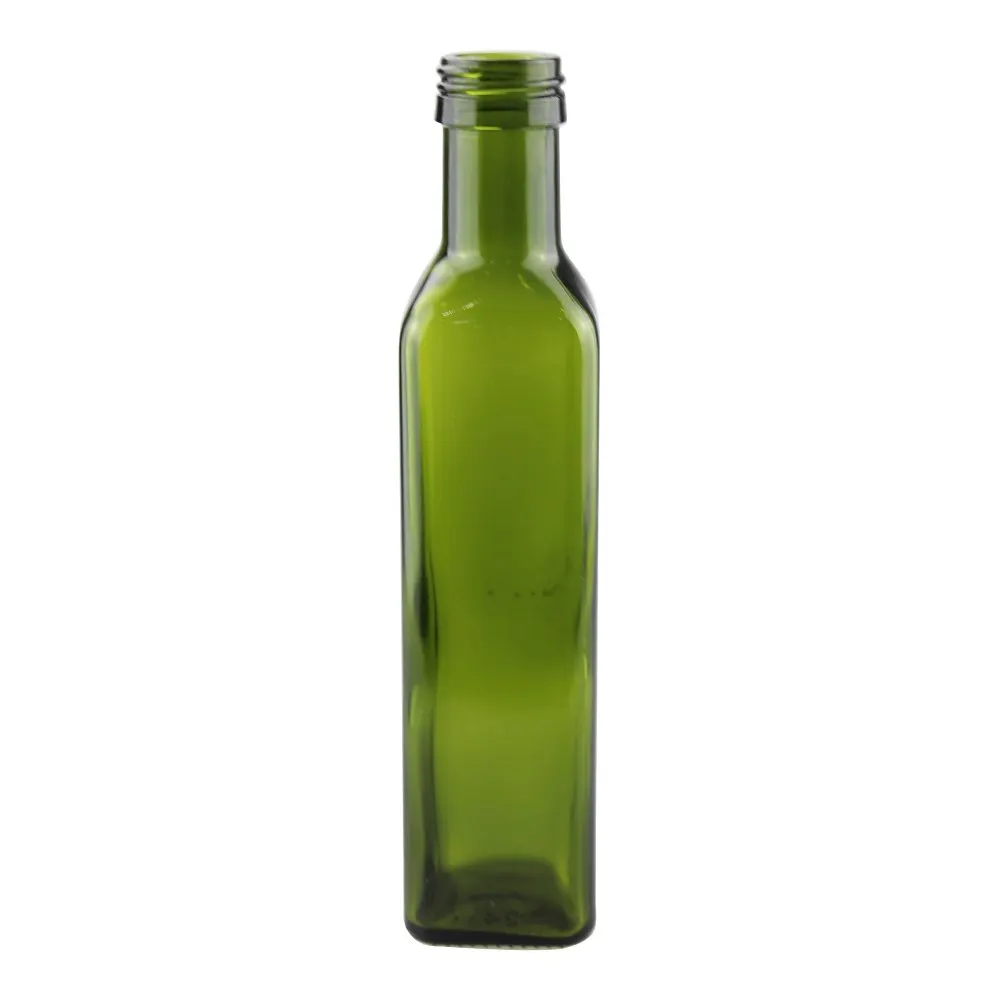
The tiers themselves are not evenly spaced, and each one exists because a particular serving occasion made it useful. In fluid ounces the common positions are 5 oz at about 148 ml, 10 oz at about 296 ml, 12 oz at about 355 ml and 16 oz at about 473 ml. In metric the parallel family is 150 ml, 250 ml and 370 ml. The two families describe almost the same bottles without lining up row for row: 150 ml is very close to 5 oz, 250 ml sits between 8 and 9 oz, and 370 ml lands near 12.5 oz. A range that is named in both units across a product line will look inconsistent to a buyer even when the bottles are effectively identical, so the cheapest discipline is to pick one unit convention for the mould list, one for the pack and one for the listing, and use them consistently rather than converting per document.
Capacity also drives cost through more than the sauce. A larger bottle carries more sauce per unit of glass, per closure and per label, so the material cost per ounce of product falls as the size rises. A smaller bottle carries a lower first-purchase price, a lower shipped weight and a higher cost per ounce. The two figures that decide the answer are how the product is used and where it is bought, not which number looks tidier on a spec sheet. A sauce used by the teaspoon on a restaurant table and a sauce used as a base ingredient in a kitchen are the same product in two different economics, and a range that tries to serve both from one capacity tier will usually under-serve one of them.
Which Capacity Tier Belongs to Which Sales Channel?
On a restaurant table the constraint is turnover rather than volume. A table shaker or a table bottle spends weeks in a hostile environment, is handled by every customer and is judged on how cleanly it pours, so the 5 oz tier at about 148 to 150 ml dominates it, with a restrictor insert doing the metering work. Back-of-house usage is a different brief from the same customer: a kitchen that decants sauce into squeeze bottles or ladles it into a service container is buying capacity and case economics, so the same account will order 10 oz, 16 oz or a bulk format while the table bottles stay at 5 oz. Treating a foodservice account as one decision rather than two is a common source of a range that is either too small for the kitchen or too large for the table.
Retail splits in a similar way. The 5 oz and 10 oz positions are the retail standard for sauces eaten a few teaspoons at a time, because the shopper is buying flavour rather than volume and the pack has to look priced sensibly beside competing brands. The 12 oz and 16 oz positions are the value and family tiers, where the shopper is buying volume and comparing cost per ounce on a shelf label. A brand that puts its premium recipe in the large tier and its base recipe in the small tier will usually find the pricing story confused, because the tier itself is a signal to the shopper before the label is read.
E-commerce changes the arithmetic more than any other channel, and it usually pushes a range upward. A glass bottle travelling alone through a parcel network is mostly packaging weight, and the carrier charges on the greater of actual and dimensional weight, so the glass mass matters more than the sauce mass. A 5 oz bottle shipped as a single unit tends to look expensive once carriage is loaded onto the price, and it also presents a small label face in a photograph where the shopper cannot pick the bottle up. Amazon-type listings and direct-to-consumer ranges therefore tend to settle on 10 oz, 12 oz or 16 oz, in a shape that fills the frame and survives a drop test in its secondary packaging. The bottleneck is rarely the glass strength; it is the corrugated insert, the divider and the void fill between the two, which is a packing decision rather than a bottle decision.
At the far end of the scale, a catering kitchen, a pizza operation or a sauce that is decanted into house containers buys on a different unit again. Where the requirement is repackaging quantities rather than retail units, the format question moves to what the site can supply in volume and on pallets, which is handled on the bulk glass container page rather than by a size chart. The useful planning rule is that the tier is chosen by the channel that will consume the unit, and a brand selling one sauce through three channels should expect three tiers rather than one, with all three sharing a neck finish so the closure part number stays common.
Sauce Type, Fill Route and Container Reference Table
Read the rows as planning positions rather than as stocked products. The net fill figures assume a sauce in the density band noted in the row, a working fill line that leaves a normal headspace for the closure type, and a bottle drawn to a typical wall thickness. Hot fill temperatures are quoted as industry ranges, not as this factory’s process, and closing torque is quoted as a band to be set on the capper and then verified after cooling. Every figure in the net fill, closure and heat columns has to be confirmed on a measured fill trial with the actual recipe in the actual bottle, and against the bottle’s own finish drawing for the closure.
| Sauce type and fill route | Capacity tier | Reference net fill after headspace | Container form and neck bore | Closure, liner and heat demand | Channel served | Where the tier breaks down |
|---|---|---|---|---|---|---|
| Thin vinegar or cayenne hot sauce, hot filled at 85 to 90 C and cooled in the bottle to draw its own vacuum | 5 oz, about 148 to 150 ml | Of the order of 140 to 143 ml; roughly 145 to 155 g at a density near 1.03 to 1.08 | Tall narrow bottle, neck bore around 20 to 24 mm with a restrictor insert doing the pour metering | Continuous thread cap with a plastisol or foam liner rated for an acidic fill, sealed warm so the liner takes a set as it cools; capping torque set hot, rechecked cold | Restaurant table, takeaway service, sampler sets, retail trial size | The label band is short and the circumference is small, so the mandatory text and the net quantity statement are the first things to run out of room |
| Tomato ketchup and smooth tomato sauce, hot filled at 88 to 92 C, foaming at the filler | 10 oz, about 296 ml; also common as 250 ml in metric markets | Of the order of 280 to 285 ml; roughly 310 to 330 g at a density near 1.10 to 1.15 | Short to medium neck bottle, bore around 24 to 28 mm; a squeeze or valve cap needs the larger bore | Liner has to tolerate both acidity and a short exposure to near-boiling product; headspace needs the upper end of the range because foam displaces the fill line | Retail table tier, supermarket own label, foodservice back of house | Foam collapse after filling leaves a fill line below target, so the net weight is short even when the filler volume was correct |
| Chilli garlic sauce, sambal and chunky chilli paste, hot filled or ambient filled depending on pH and water activity | 12 oz, about 355 ml; metric equivalent near 370 ml | Of the order of 335 to 345 ml; roughly 380 to 410 g at a density near 1.12 to 1.20 | Wide-mouth short-neck jar or a wide-neck bottle, bore around 53 to 63 mm, so pieces pass without bridging | Lug or twist-off closure with a lined panel; an ambient fill needs the same liner acid resistance as a hot fill, since the pH does not change | Retail mainstream and premium, deli counters, gifting sets | Wide mouth plus a high fill line puts the sealing land close to the product, so a smear during filling is a leak path |
| Salad dressing and vinaigrette, ambient filled with no process heat; shelf life carried by acidity, salt and preservative | 250 ml, about 8.5 oz | Of the order of 238 to 242 ml; roughly 225 to 245 g, since an oil-bearing dressing often sits near or below 1.0 | Slim bottle with a moderate neck, bore around 28 to 38 mm so solids and herbs pour | Liner must hold against oil as well as acid; oil migrating into a foam liner can swell it, and oil on the threads lowers removal torque | Retail, farm shop, foodservice salad service | Separation in the bottle is read by the shopper as a defect, so the tier chosen for a value price point can damage the perceived quality |
| Mayonnaise-style thick dressing and emulsified aioli, ambient or gently warmed fill, never boiled | 370 ml, about 12.5 oz | Of the order of 350 to 358 ml; roughly 320 to 335 g at a density near 0.90 to 0.93 | Wide-mouth jar or a wide-neck squeeze bottle, bore around 53 mm; a narrow neck will not release the product | Heat is limited by the emulsion, so the glass sees little thermal load and the liner choice is driven by fat contact rather than by temperature | Retail family tier, club store, foodservice | Naming the pack by weight makes an emulsion look lighter than a same-volume water-based sauce, which invites unfair price comparison |
| Barbecue and brown sauce, hot filled, sugar and solids high, viscosity high | 16 oz, about 473 ml | Of the order of 450 to 458 ml; roughly 560 to 590 g at a density near 1.22 to 1.30 | Short neck or wide mouth, bore around 38 to 53 mm; the fill nozzle has to pass a heavy body without stringing | Cooling is slow in a large unit, so the vacuum draws progressively; panel stiffness and removal torque both matter more than at 5 oz | Foodservice, family retail, barbecue season programmes | Heat penetration to the centre is slowest here, so a process time developed on a small bottle cannot be borrowed upward |
| Soy, fish and other high-salt dipping sauces, hot filled or ambient filled, salt load the dominant compatibility variable | 150 ml and 250 ml, about 5 oz and 8.5 oz | Of the order of 143 ml and 238 ml; roughly 175 g and 290 g at a density near 1.18 to 1.25 | Slim narrow-neck bottle, bore around 20 to 28 mm, often with a controlled-pour insert | Salt accelerates corrosion of any unprotected metal in the closure, so a coated or fully lined component is the safe direction; confirm compatibility for the specific fill | Foodservice decant, Asian grocery, retail condiment tier | A salt-heavy fill at a small size concentrates the compatibility question into the liner, where a marginal material fails faster than it would in a large pack |
Hot Fill: What It Asks of the Glass Body and the Closure
Hot filling is the reason most sauce ranges are sized the way they are, because the process route rather than the recipe sets the container requirements. In a typical hot fill the sauce leaves the filler somewhere between 85 and 92 C, the bottle is closed immediately, and the pack is then cooled, either in a cooling tunnel, in air, or simply on the pallet. The heat does two jobs: it reduces the microbial load in the product, and it creates the vacuum as the contents contract on cooling. Neither job is free, and both put the glass and the closure under conditions that a cold fill never does.
The first requirement is thermal shock resistance. The relevant number is not the fill temperature by itself but the temperature difference between the sauce and the glass at the moment of filling, together with the wall thickness and the thickness variation around the body. A bottle that has been stored in an unheated warehouse in winter can present a large difference, and a thin-wall bottle with an uneven distribution is the one that cracks, usually at the base or on the shoulder rather than in the body where it would be obvious. The practical controls are to pre-warm the bottles or to bring them into the filling hall ahead of the run, and to specify the fill temperature as a range with a floor rather than as a single number. The same reasoning applies at the other end of the process, because a rapid cooling ramp stresses the glass again in the opposite direction.
The second requirement is the interaction between the fill temperature and the closure. Torque is applied to a cap that is sitting on a hot, slightly expanded bottle neck, and the reading on the capper means very little until it is compared with the same cap after cooling. As the pack cools, the liner compresses and the internal pressure drops, so removal torque typically climbs. A torque set to look correct on a hot pack can end up uncomfortably tight for the consumer, and one set to look correct on a cold pack can end up too loose to hold the vacuum, which shows up weeks later as a leaking carton rather than as a line fault. The rule that saves time is to set the capper on the hot pack, then verify removal torque and seal integrity on a cooled sample from the same run, and to treat the pair of numbers as the specification rather than either one alone.
The third requirement is the liner, which is doing more work here than anywhere else in the pack. It compensates for the small irregularities in the sealing land, it provides the barrier against the fill, and on a vacuum pack it is the element that takes the compression set that holds the seal. A liner rated only for dry or neutral products is the wrong component for a hot acidic sauce, however well the cap fits. Where the question is which liner material suits a given fill and how to verify the choice, that is handled on the bottle cap liner page, and it is worth reading before the closure is fixed rather than after.
One further point is easy to overlook at the sizing stage. A hot fill raises the temperature of the glass only briefly and to a moderate level, whereas a tunnel pasteurisation or a hot water bath holds the whole pack, closure included, at temperature for a sustained period before the cooling ramp. The two processes look similar on a process sheet and demand different things from the same bottle. Deciding which of them applies belongs at the top of the sizing brief, not at the end of it.
Acid, Salt and Oil: What the Inner Wall and the Liner Must Tolerate
Sauce is chemically harder on the pack than most food categories, and the reason is the combination rather than any single ingredient. A vinegar-based hot sauce can sit at a pH between 2.5 and 3.5. A ketchup is acidic as well as full of solids and sugar. A soy or fish sauce is both salty and acidic. A dressing adds oil to the same acid load. Each of those fractions attacks a different part of the closure system, and the glass itself is the component that is least affected.
On the glass side, the useful concept is that glass is inert to food acids under normal shelf conditions but is not identical across every glass type. Soda-lime glass is the standard container material, and its resistance to a given acid load over a given shelf life is a property that belongs in the specification as a test item rather than as an assumption. Where a product has a long shelf life and an aggressive fill, the questions to put to a supplier are what glass type is used for that mould and what evidence exists for acid resistance on that specific item. That is a legitimate enquiry; it is not something a sizing page can answer for a specific bottle, and it is not a claim this page makes about any product.
On the closure side, the acid load and the salt load do different damage. Acid attacks a metallic component directly, which is why a plastisol-lined metal lug cap on a pH 3 fill needs the lacquer or the coating to be intact and rated for the job, and why a foil-composite liner relies on its lacquer layer rather than on the foil for protection. Salt accelerates the same corrosion process, so a high-salt sauce at a small size concentrates the risk into a small liner that has a large sealing perimeter relative to the pack, which is exactly the wrong ratio. Both fill types therefore push the liner selection toward materials with a documented resistance to acidic and salty foods, and both make migration testing a real item rather than a formality, since a liner is a food-contact material and the applicable rules in the destination market apply to it. Food contact framework rules such as EU 1935/2004 and the corresponding United States requirements are the reference points for that work, and they should be handled by whoever carries compliance responsibility for the product rather than inferred from a supplier’s general statement.
Oil raises a different set of problems, and it is the one that most often surprises a dressing brand. An oil-bearing fill migrates into a foam or fibrous liner and can swell it, which changes the compression set and can loosen the seal over time. Oil also creeps into the thread and onto the sealing land, where it acts as a lubricant: removal torque falls, and a cap that was correctly torqued at the capper may back off in transit. The remedies are usually a change of liner material toward a foil or coated construction, a check that the fill never reaches the threads, and a transit test that includes the actual carton rather than a single bottle. None of those is a capacity decision, but all of them change which capacity tiers are practical, because the surface-to-volume ratio of a small pack makes a marginal closure marginal sooner.
How Viscosity and Neck Bore Are the Same Decision
The size of a sauce bottle is not only a volume question, because the sauce has to leave the bottle and a thick sauce cannot leave through an opening that a thin sauce ignores. The neck bore and the container form are effectively chosen by the viscosity of the fill, and the capacity tier is then constrained by whatever form the viscosity has forced.
At the thin end, a vinegar-based hot sauce or a pepper sauce is close to water and pours almost too fast. The bore is therefore narrow, in the region of 20 to 24 mm, and the metering is done by a restrictor insert rather than by the bottle, because a consumer wants a controlled shake and not a gush. This is why the classic hot sauce bottle is tall and slim with a small neck: the body diameter is chosen for the hand and the shelf presence, and the neck is chosen for the flow, and the two are tuned together rather than independently. A thin sauce in a wide mouth is a pour nobody can control.
Ketchup and smooth tomato sauce sit in the middle, and they are the tier where the neck decision becomes awkward. The product is viscous enough that a narrow bore will not release it at a useful rate, which is why the classic ketchup pack either widens the bore to around 24 to 28 mm, uses a squeeze body, or fits a valve cap that only opens under pressure. All three of those routes change the bottle, the closure or both, so the capacity tier cannot be settled until it is known which route the brand intends. A thicker sauce at the same volume also fills more slowly through the same nozzle, which lowers the practical line speed and can push a brand toward the wider bore purely for throughput reasons rather than for the consumer’s sake.
Salad dressings need the pour to carry solids, so they usually take a moderate bore in the region of 28 to 38 mm and a slim body that allows the pack to be shaken without a wide grip. Once the product contains identifiable pieces, whether chilli flakes, herb fragments or diced vegetables, the calculation changes completely: the bore has to pass the largest particle without bridging, and the practical answer is a wide mouth in the region of 53 to 63 mm, which is a jar rather than a bottle. Chunky chilli paste, salsa and relishes are therefore jar products by physics, not by fashion, and the capacity discussion for them sits closer to the jar formats covered on the glass jar format page than to a narrow-neck bottle range.
There is one further link between the two decisions that is worth writing into a brief. The neck bore sets the maximum fill nozzle diameter, and the nozzle diameter sets the fill speed and the amount of turbulence at the fill point. A wider nozzle fills faster but produces more splash and more product on the sealing land, which matters most where the fill line sits close to the rim. On a small, narrow bottle the extra speed is rarely worth the defect rate, which is why small sauce bottles are frequently filled more slowly than their size would suggest.
Narrow Neck or Wide Mouth: Filling Head Against Spoon Fill
The choice between a narrow neck and a wide mouth is often presented as a consumer convenience question, and it is, but its operational consequence is larger. A narrow neck can only be filled through a nozzle, which means a filling head, a controlled volume and a line speed. A wide mouth can be filled with a filling head as well, but it can also be filled with a ladle or a spoon, which means a slower, more manual operation and a different set of failure modes.
Narrow-neck filling is fast and repeatable. The nozzle enters the neck, the volume is metered, the bottle indexes on, and the closure is applied. The complications are that the bottle must be located accurately enough for the nozzle to enter a small opening without chipping the finish, that the fill line has to be set so that a thin product does not splash back out of the neck, and that a viscous product strings from the nozzle and can leave a tail that runs down the outside of the bottle onto the sealing land. Narrow-neck lines are also poor at handling particulates, which is why they suit filtered sauces and not chunky ones. Cleanliness on the sealing land is the single most important control at this end, because the land is a narrow ring and a small contamination is a large proportion of it.
Wide-mouth filling is slower and more tolerant of product structure. A wide jar can take a piston filler with a wide nozzle, but it can equally be filled with a ladle on a low-volume run, which is what makes small-batch chilli paste and deli-style salsa viable without a line. The trade is that the fill line is much closer to the rim in absolute terms, so a splash reaches the sealing land and a smear of acidic sauce across the land defeats the vacuum or the liner seal. The other consequence is that a wide-mouth pack is heavier for the same capacity and has more glass in the base, which changes case weight and freight rather than the product cost.
For the sizing brief, the useful way to hold the two together is to write the container form and the fill method as one line rather than two. If the product contains pieces, the form is a wide-mouth jar and the fill method is a wide nozzle or a ladle. If the product is smooth and pourable, the form is a narrow-neck bottle and the fill method is a metering nozzle with a restrictor fitted after filling. Attempting to solve a particulate problem with a squeeze bottle, or a thin-sauce metering problem with a wide jar, is the sort of decision that appears correct on a spec sheet and fails on the line.
Which Sauce Categories Take Pasteurisation and Which Do Not
Every sauce range runs on one of a small number of process routes, and the route decides far more about the container than the recipe does. Sorting a portfolio into those routes before discussing capacity prevents a series of expensive corrections later.
The first route is a hot fill with no further process. The sauce is heated, filled at 85 to 92 C into the bottle, closed, and cooled in place. Its stability comes from the combination of the heat applied to the product before filling, the acidity of the formulation, and the vacuum that forms as it cools. This is the most common route for hot sauce, ketchup and barbecue sauce, and it is the friendliest to the glass because the bottle sees the fill temperature only briefly. It does require the closure to hold a vacuum for the whole shelf life, which puts the liner and the torque pair under permanent load rather than momentary load.
The second route is a hot fill followed by a pasteurisation step, either a tunnel pasteuriser or a hot water bath, where the sealed pack is held at an elevated temperature for a defined period and then cooled. Here the glass, the closure and the liner all experience a sustained thermal cycle, and the cooling ramp is part of the process rather than an afterthought. This route is used where the formulation is not acidic enough to carry the shelf life on its own, or where the market requires a validated process rather than a reliance on pH. It is the route that most often exposes a wall thickness that was chosen for cost rather than for thermal shock, and the route where a liner that survived a hot fill can fail.
The third route is an ambient fill with no process heat, where stability rests on acidity, salt or sugar content, water activity and permitted preservatives. A dressing, a high-salt dipping sauce and some fermented chilli products fall here. The glass is essentially unloaded thermally, so the entire burden moves to the closure: an ambient fill still sits against the liner for months at ambient temperature, and it still has to hold a seal against a product that may be acidic, salty and oily at the same time.
The fourth group is genuinely difficult to pasteurise and should be identified early rather than discovered in trials. Emulsified products such as mayonnaise-style dressings break if they are taken through a high-temperature hold, and some oil-based sauces with heat-sensitive aromatics lose the character that justifies their price. Those products run on an ambient fill with a tight specification on pH, water activity and preservative, and they frequently need a cold-chain or a shorter shelf life. There is also a regulatory dimension that should not be left implicit: in the United States, low-acid products of this kind can fall under the scheduled process requirements associated with FDA 21 CFR 113 for thermally processed low-acid foods, and whether a given sauce is classified as acidified or low-acid changes what has to be done. That classification and the associated process filing are compliance matters for the responsible food business, not for the glass supplier, and nothing on this page should be read as a claim about any certification.
The sizing consequence of all four routes is the same in shape. Fix the route first, because it sets the thermal load on the glass and the closure and therefore the practical wall and finish choices. Then choose the container form from the product structure and viscosity. Only then does the capacity tier become a free choice among the tiers that the channel supports.
Does the Capacity Leave Room for the Mandatory Label Text?
Capacity and label face are linked by geometry, and at the small end of a sauce range the geometry becomes the binding constraint. The label face on a bottle is roughly the circumference of the body at the label height multiplied by the height of the label band. A small bottle loses on both dimensions at once: it is narrower around and its straight body section is shorter, because the shoulder and the base take a larger share of the total height. Sauce bottles have one advantage over jars in this respect, since a wrap label can use the full circumference rather than a single panel, but the advantage does not remove the floor on type size.
What has to fit is not trivial. A typical mandatory set includes the name of the food, the net quantity in the units required by the destination market, the ingredients in descending order of weight, a declaration of allergens where they are present above the relevant threshold, a date mark, storage conditions where they matter, the name and address of the responsible food business, a lot or batch identifier, and an origin statement where one is required. Most markets also require a nutrition declaration, subject to provisions for small packages. In the European Union the food information rules set a minimum x-height for mandatory particulars and include limited provisions for packs that are genuinely too small; in the United States the labelling rules include small package and small business provisions that can relocate or remove elements of the nutrition panel. Those provisions have conditions and thresholds, and they are not a general licence to omit information.
The practical routes used at 5 oz are consistent across brands. The full wrap label carries the mandatory set at the smallest type size the destination market permits. Where the closure is a lug or a twist-off cap, the lid top can carry a portion of the information and offers a surprisingly large printable disc at a small diameter, but a narrow continuous-thread cap offers almost no lid area, so that route is not available on the classic hot sauce bottle. A neck wrap adds cost and a handling step. An outer carton or a sleeve is the most comfortable solution and is standard where the pack is sold in a multipack or through e-commerce, where the secondary packaging already exists.
Two labelling details are worth settling at the sizing stage rather than at artwork stage. The first is the unit convention of the net quantity statement, which is a legal statement and not a marketing one: a bottle described as 5 oz on the front panel may carry a net quantity declaration in millilitres, and the two are separate obligations. The second is that the smallest tier in a range is usually set by label area and the minimum type size rather than by the recipe or the customer’s preference, so a brand planning a 5 oz entry point should commission the smallest label first and confirm that the mandatory set fits before the mould is ordered. Discovering that constraint after artwork has been signed off is the most expensive version of a sizing mistake.
Where a Sauce Bottle Size Chart Gets Misread
Most capacity errors in this category trace back to a short list of misreadings, and naming them makes them easy to catch in a brief and easy to spot in a supplier’s reply.
The first is reading a brim capacity as a net fill. The difference is the headspace, and on a hot fill the headspace is also the vacuum space, so it cannot simply be trimmed to raise the net weight without changing the seal behaviour.
The second is treating fluid ounces and ounces by weight as the same unit. A bottle named by volume and a net quantity stated by mass describe different properties, and because sauce density varies from about 0.90 for an emulsion to about 1.30 for a barbecue sauce, the gap between the two numbers is neither fixed nor safe to assume.
The third is assuming a density near 1.0 when converting. A sauce portfolio spanning mayonnaise, ketchup and soy sauce spans a density range wide enough that one conversion factor will put at least one product’s net weight outside its legal tolerance. Each product needs its own measured density on the real recipe.
The fourth is confusing the pour control with the capacity. A restrictor insert, a valve cap or a controlled-pour fitment changes how fast the sauce leaves the bottle and does nothing to the volume inside it, yet ranges are sometimes resized because the pour felt wrong.
The fifth is copying a closing torque from one size to another. Torque is not a constant across diameters, and it is not a constant across fill temperatures either, because the reading taken on a hot pack and the reading taken on the same pack after cooling are two different numbers that both matter.
The sixth is applying a pasteurisation or hot-fill process developed on a small bottle to a large one. Heat penetration to the centre is slowest in the largest unit in the range, so the process has to be set for the largest pack and then checked downward rather than the reverse.
The seventh, and the most easily missed, is choosing the tier from a competitor’s shelf without establishing that competitor’s fill route. Two packs of the same capacity can be built to different wall thicknesses and different closures because one is hot filled and cooled in the bottle and the other is tunnel pasteurised, and reading only the capacity hides the difference that determines whether the bottle is suitable for the intended process.
The eighth is rescaling artwork rather than redesigning it. Label area does not scale linearly with capacity and mandatory text has a minimum type size, so a small bottle usually needs a different information layout rather than a shrunken copy of a large one.
When the Sizing Question Turns Into a Sourcing Enquiry
The conversion work on this page is finished when the range has stopped moving. Three signals mark that point. The first is that the capacity tiers are named as specific bottles rather than described as size bands, in one unit convention with the net quantity statement separated from the marketing description. The second is that the container form is fixed, with the neck bore and the closure family chosen and only the specific finish and liner still to be matched to the bottle drawing. The third is that the fill route, the fill temperature and the destination market are settled, because those three together determine the headspace, the thermal load on the glass and the information that must appear on the pack.
After that point the questions become selection and supply questions. Which bottle formats the site actually offers across shapes, wall thicknesses and neck diameters is the subject of the bottle format and neck finish range, and it is the right place to go once the tier has been decided rather than before. Where the format has turned out to be a wide-mouth jar because the product contains pieces, the jar range is the better starting point. Where the sauce is bought in repackaging quantities rather than as retail units, the volume question moves to pallet and container quantities, and the closure and liner compatibility that this page has treated as a constraint on sizing becomes the main subject in its own right.
What remains genuinely commercial, and therefore cannot be answered from a sizing page, is the part of a quotation that belongs to the specific bottle and the specific run: the finish tolerance on a given mould, the decoration method and its setup, the packing configuration, and whatever order quantity, tooling position and lead time apply at the time of enquiry. Those are commercial statements that have to come from the supplier against a real requirement and a real drawing, and nothing on this page should be read as this factory’s standing terms for any of them. The sizing arithmetic narrows the question; the enquiry answers it.
Questions Buyers Ask About Sauce Bottle Sizes
How many millilitres is a 5 oz sauce bottle, and how much sauce does it hold?
Five fluid ounces is about 148 ml, and the 150 ml tier used in metric markets is effectively the same bottle. Filled to a normal working fill line with a headspace allowance, it carries of the order of 140 to 143 ml of sauce. In weight that is roughly 145 to 155 grams for a thin vinegar-based sauce near 1.03 to 1.08 density, and less for an oil-bearing product that sits near or below 1.0. Confirm the figure by weighing a measured fill of the real recipe in the real bottle rather than converting from the capacity figure.
Can the same bottle be hot filled and tunnel pasteurised?
Not automatically. A hot fill exposes the glass briefly to the fill temperature and the cooling then happens in the pack, while a tunnel pasteurisation or hot water bath holds the whole sealed unit at temperature for a sustained period and then cools it on a controlled ramp. Both are thermal loads on the same bottle, but the second is far longer and it also loads the liner. A wall thickness and finish that work for a hot fill can fail under pasteurisation, so the process route has to be fixed before the bottle is chosen and the two routes should never be treated as interchangeable.
Which neck bore suits a thick chilli sauce?
It depends on whether the sauce is smooth or contains pieces. A smooth chilli sauce is usually a narrow-neck bottle with a bore in the region of 24 to 28 mm, possibly with a wider squeeze or valve closure to help the product out. Once the recipe contains identifiable chilli flakes, seeds or diced material, the bore has to pass the largest particle without bridging, and the practical answer is a wide-mouth format in the region of 53 to 63 mm, which is a jar rather than a bottle.
Why does a sauce bottle need a liner if the cap already screws on tight?
Because the seal is made by the liner, not by the thread. The liner compensates for the small irregularities in the sealing land, provides the barrier between the product and the cap material, and on a vacuum pack takes the compression set that holds the seal for the whole shelf life. An acidic, salty or oily fill attacks different liner materials in different ways, so the liner has to be selected for the specific product and then verified on cooled samples rather than assumed from the cap family.
Does hot filling change the closing torque?
It changes the numbers on both sides of the process. Torque is applied to a warm, slightly expanded neck, and as the pack cools the liner compresses and the internal pressure falls, so removal torque typically climbs. A setting that reads correctly on a hot pack can end up too tight for the consumer, and one that reads correctly on a cold pack can be too loose to hold the vacuum. Set the capper on the hot pack, then verify removal torque and seal integrity on cooled samples from the same run.
How do I choose between 12 oz and 16 oz for e-commerce?
Start from the parcel rather than from the shelf. Glass shipped alone is mostly packaging weight, and carriers charge on the greater of actual and dimensional weight, so the difference between the two tiers is smaller in carriage terms than it looks and larger in breakage risk terms. The 16 oz tier gives a lower cost per ounce and a larger label face for the mandatory set, while the 12 oz tier gives a lower unit price and a lighter carton. Test both in the actual secondary packaging, since the insert and divider usually decide whether the bottle arrives intact.
Why does the same stated size give different net weights on two brands?
Because the capacity figure describes the glass and the net quantity describes the product. The difference comes from recipe density, from the headspace rule the brand applies, and from the fill route. A thin vinegar sauce, a ketchup and a soy sauce have different densities, and a hot fill that draws its own vacuum leaves a different final fill height from an ambient fill in the same bottle. Fix the net weight by weighing a measured average fill of the real recipe in the real bottle, and treat any chart figure, including the ones on this page, as a planning range rather than an answer.
Send the Sauce Type, the Fill Route and the Channel
To get a capacity band and a closure direction rather than a general description of bottle options, send three things and the two constraints that usually sit behind them. The sauce type matters first, because a thin vinegar-based hot sauce, a ketchup, a chunky chilli paste, a pourable dressing and an emulsified aioli differ in density, in structure and in how they behave at the filler, and those differences move both the net fill and the container form. The fill route matters second, because a hot fill that draws its own vacuum, a pasteurisation step after closing, and an ambient fill held by acidity, salt and preservative each impose a different thermal load on the glass and a different duty on the liner. The channel matters third, because a restaurant table, a supermarket shelf, a parcel network and a catering kitchen each put a different premium on capacity, label face, pack weight and cost per unit. Alongside those three, the destination market and the target net quantity narrow the answer fastest, since they fix the labelling obligations and the number the pack has to carry.
With those in hand the reply can set out a recommended capacity band, the reference net fill for that band after headspace, the container form and neck bore direction that suits the viscosity, the closure family and liner direction for the fill chemistry, a check on whether the label face can carry the mandatory information at the destination market’s minimum type size, and an explicit list of what still has to be confirmed on a fill trial with the actual recipe and the actual bottle. Where the recipe is still moving, the reply will usually start from density, headspace and pH and treat the capacity as provisional. Where the pack is defined but the process route is open, it will usually start from the thermal load and work back to the wall thickness and the closure. Send the intended fill temperature and the pH or salt level as well if they are already known, because those two figures decide more of the container specification than the capacity does.