Filed under glass jars wholesale — start there for the stock moulds, then use the detail below to narrow the spec.
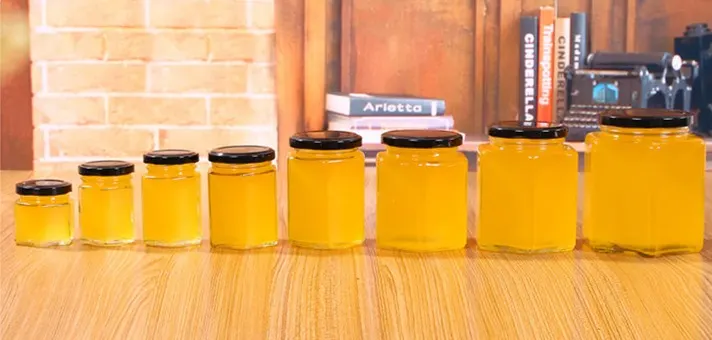
Hexagon glass jars are sold as a family of seven stock sizes, from a 45 ml sampler to a 720 ml jar that holds about 1 kg of honey, and every size uses a standard twist-off (lug) finish between 43 TO and 82 TO. That shared finish is the main thing a buyer needs to know: the lids, the capper and the torque settings are the same as for round preserve jars, so choosing a hexagon changes the look of the pack without changing the filling line.
Stock sizes and the lug finish each one takes
Capacity is quoted in millilitres, but honey is sold by weight, so the table gives both. The 190 ml, 280 ml and 370 ml jars account for most retail honey and jam.
| Nominal capacity | Honey fill, approx. | Twist-off finish | Where it is used |
|---|---|---|---|
| 45 ml | ~60 g | 43 TO | Samplers, wedding favors, hotel amenities |
| 100 ml | ~140 g | 48 TO | Gift sets, tasting sets of several varietals |
| 190 ml | ~250 g | 53 TO | Specialty shops, farmers' markets |
| 280 ml | ~380 g | 58 TO | The usual retail honey or jam jar |
| 370 ml | ~500 g | 63 TO | Main grocery SKU |
| 500 ml | ~700 g | 70 TO | Family size, farm shops |
| 720 ml | ~1 kg | 82 TO | Bulk retail and food service |
Lids, liners and hot filling
The closure is a metal lug cap with a plastisol liner. Under steam or the vacuum of a hot fill the liner softens and flows against the glass rim to make the seal, and a safety-button centre pops on first opening to show the jar has not been tampered with. Black, gold and silver caps are the common colours, and other colours can be specified.
Two variants let one jar serve more than one product. A deep cap accepts a honey lid with a dipper hole, and a shaker fitment turns the same jar into a spice pack; our guide to glass spice jars for dry goods covers that use.
A correctly annealed soda-lime hexagon jar takes a hot fill at 85-90 deg C, which is the normal process for jam, jelly and honey. Pre-warm the jars on the conveyor and keep the difference between jar temperature and fill temperature below about 42 deg C. The process side of jam production is explained in more detail on our page about jam jars and how they are filled.
What the six flat panels do for labeling
A round jar needs either a wraparound label applied while the jar rotates under control, or an orientation step before front and back labels go on. A hexagon has six identical faces, so a label can land on any of them: front and back labels are applied at any 60-degree position and the line needs no registration station.
The size of each panel is set by the mould. The figures a label converter needs are the width across the flats less the chamfer, and the height between the shoulder and the base radius. We check these on the label-panel drawing for the chosen mould and pass it on with the quotation, so die lines can be finished before the jars ship. Paper labels, clear film and direct screen printing all work on the flats. Many honey brands decorate only the two main faces and leave the other four clear so the product shows.
Packing density compared with round jars
Round jars set out in a square grid leave roughly 21% of the layer empty, and still about 9% when they are nested in a honeycomb pattern. Hexagons tessellate, so the sideways gap is close to nothing. A carton layer therefore holds more jars, and the jars support one another when the case takes a knock from the side.
A 370 ml hexagon jar normally packs 12 per case, and some carton designs do it without dividers. Layers sit cleanly on a 100×120 cm pallet. For brands shipping parcels direct to consumers, the tight fit means less void fill and fewer breakage claims.
Why brands choose the shape, and the square alternative
A round jar is cheaper to form, so the hexagon has to justify itself on the shelf and in the hand. It does so in three ways. The flat faces reflect light at different angles, which makes a row of jars look like separate hand-made items instead of one continuous block. The jars also line up face-forward and stay there, so the label always points at the shopper. And the flats give a better grip, including with wet hands, which matters for a product whose commonest complaint is a lid that will not turn.
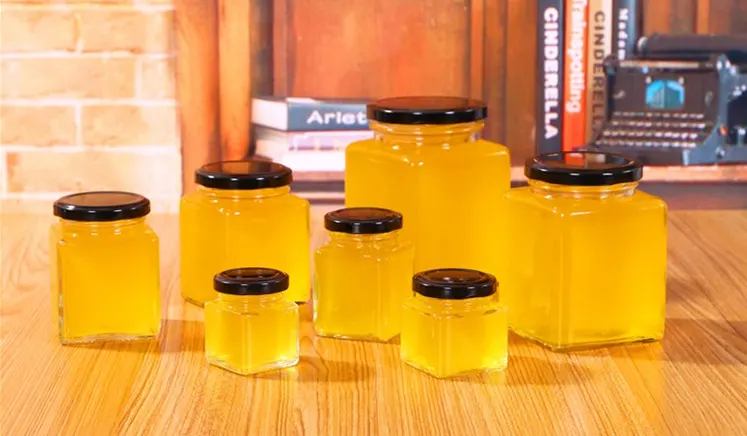
The nearest rival for a craft honey range is the square jar. Hexagons pack a little tighter; squares look a little more contemporary. Both can be sourced, and the broader choice of shapes is laid out in our overview of honey jars.
Frequently asked questions
Do I need different capping equipment for hexagon jars?
No. Lug caps go onto hexagon jars on an ordinary twist-off capper, inside the torque windows already used for round jars. One lid supplier and one capper cover the whole size range.
Which lid diameter fits which jar?
Lug caps come in 43, 48, 53, 58, 63, 70 and 82 mm, and the right one follows from the jar size as shown in the table above.
What is the minimum order for hexagon jars?
Minimums are quoted per project. They depend on the mould and on the line it runs on, and custom-printed lids have their own quantity threshold.
Are hexagon glass jars safe for food contact?
The jars are lead-free soda-lime glass that meets the food-contact requirements of FDA 21 CFR and EU 1935/2004, and the plastisol liners are formulated for direct contact with food. Ask for the migration test reports alongside the quotation.
What should a quote request include?
State the target capacity, the neck finish, the closure you prefer, the quantity and the destination port when you send us the request.