Part of our food jars wholesale range; the stock moulds are pictured at the end of this guide.
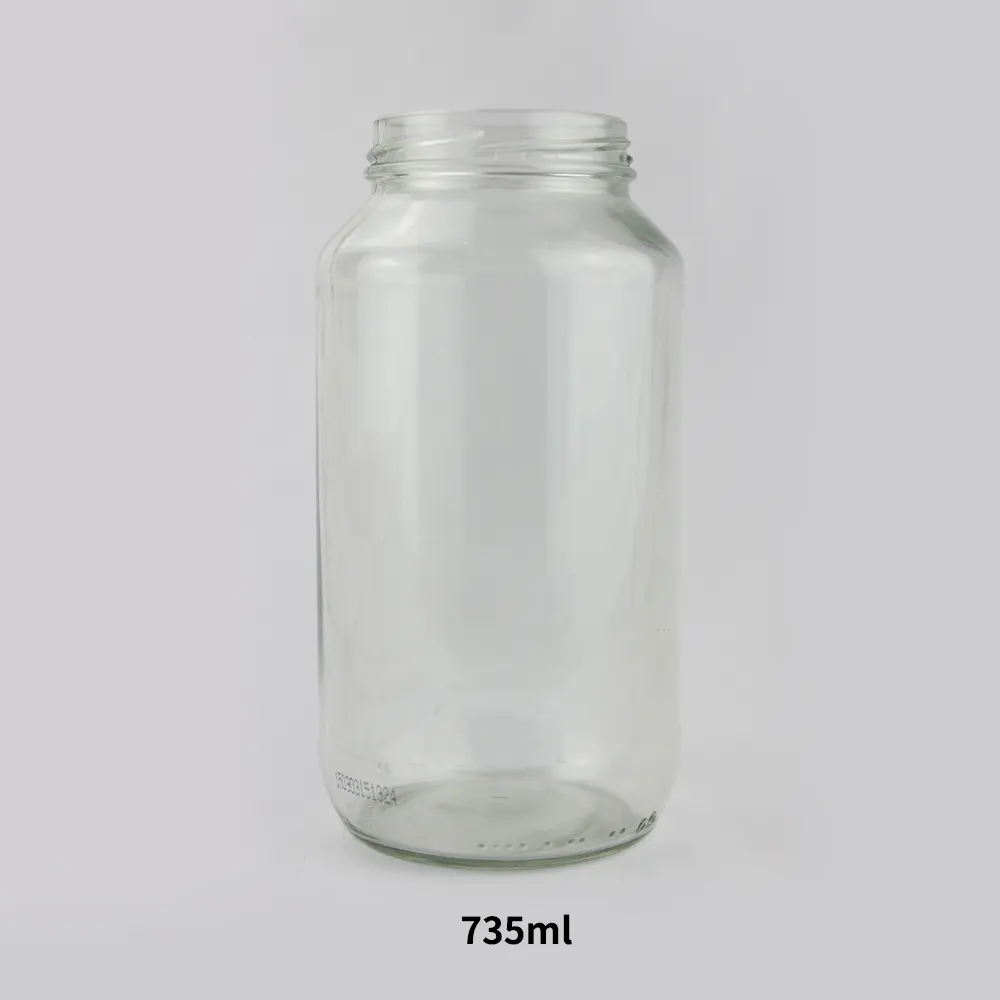
The North American pasta sauce jar is a wide-mouth round in 24oz (about 710ml) or 26oz (about 770ml) with a 63mm or 70mm lug twist-off finish. It is a standard package, so the buying risk sits in a few details: capacity tolerance on the drawing, lug finish dimensions, annealing quality, and the vacuum your line pulls after hot filling at 85–93°C. Get those written down before the first production run and most leaker and breakage problems never appear.
What to put on the jar drawing
Glass does not react with acidic tomato product, a wide mouth takes a ladle or depositor at line speed, and the consumer can spoon out the last of the sauce. That is why the format has barely changed. The commercial specification is equally settled:
- Finish: 63mm or 70mm lug. The 70mm is the usual choice for higher-end lines because it fills faster and looks more "homemade".
- Jar weight: 320 to 420 grams, depending on how far the design is lightweighted.
- Shoulder: a geometry that lets product slide off cleanly, so the headspace vacuum forms as it should.
- Capacity: nominal capacity, brimful capacity and tolerance, all stated. Experienced buyers write 710ml nominal with 740ml brimful ±3% for the 24oz class.
Capacity deserves the extra line on the drawing. Sauce is sold by weight but filled by volume, and a ±5ml swing in brimful capacity is enough to push the lightest jars toward a declared-weight problem.
Lug finish, cap torque and vacuum
Pasta sauce is a hot-fill-hold product. It goes into the jar at 85–93°C, is capped at once, then held or water-bath pasteurized long enough to kill spoilage organisms before cooling. The sauce shrinks as it cools and draws a headspace vacuum of typically 0.3–0.5 bar. That vacuum pulls the safety button in the cap center down, which is the visible proof of a seal, and it keeps the cap tight through an ambient shelf life of 18–24 months.
The cap is tinplate with three, four or six lugs that catch interrupted threads on the finish. Its plastisol lining flows into the finish profile under the heat and pressure of capping. Two things on the specification decide whether this works:
- Lug dimensions. Capper heads run a fixed cam profile, so the finish has to be consistent. Vertical lug position within ±0.4mm is the working standard; outside it, lugs strip or the cap ends up under-torqued.
- Torque and vacuum checks. Give the line a torque window. For a 63mm lug cap, removal torque after cooling is typically 8–14 lbf·in. Require vacuum testing during the first hour of every run, because cappers drift and only measurement catches it.
Thermal shock on the filling line
Sauce at 90°C meeting a jar at an ambient 20–25°C is a 65–70°C shock, close to the limit of what soda-lime glass tolerates. Commercial lines therefore warm the jars to 35–45°C before filling and cool them afterwards in water-cascade tunnels that step down in 15–20°C stages.
Both steps rely on properly annealed ware, so ask for thermal shock sampling on every production lot in a hot-fill supply agreement. A co-packer who drops jar pre-heating to save cost should expect 0.5–2% breakage in the line. Broken glass around open jars is a contamination risk, and no sauce brand accepts that defect.
Label panel, embossing and glass color
Most jars on the marinara shelf look alike, so the surface carries the brand. There are three choices to make.
Label area. The printable zone is the straight wall between the shoulder and the label groove at the base. On a 24oz round, a wrap label about 95–105mm high is standard. Full-body shrink sleeves are increasingly common on higher-end lines; they fit any shoulder shape but add a step to the line.
Embossing. A proprietary mold with an embossed brand mark, a measuring scale or "Nonna's kitchen" style lettering makes a stock-looking jar ownable. Depth runs 0.4–0.8mm, and the embossing must stay clear of the points where jars touch each other in the case, or it will scuff.
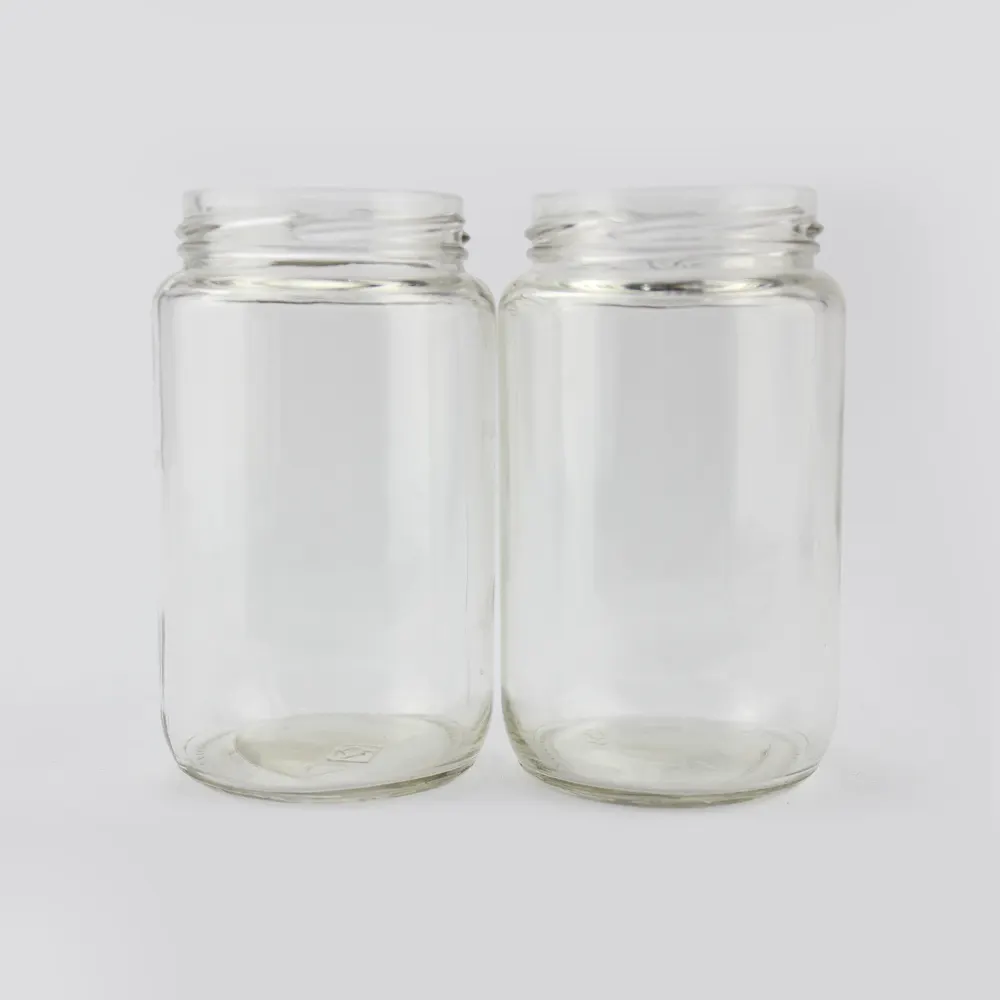
Glass tone. Standard flint shows the sauce color as it is. Low-iron flint makes reds visibly brighter under store lighting.
Consumers keep marinara jars for pantry storage, and a jar designed for that earns repeat purchases. In practice it means a smooth shoulder with no decoration that traps food, a standard 70mm finish that accepts aftermarket storage lids, and a label adhesive that comes away cleanly in hot water. If the range will grow into preserves, the finishes can be aligned with our canning jar formats and the wider food-grade jar range; the pantry storage jar guide covers the reuse side.
Why hot sauce bottles are a separate purchase
Buyers new to sauces often expect a single specification discussion to cover marinara and hot sauce. The two run on different equipment, and treating them as one leads to specification errors.
| Pasta sauce jar | Hot sauce bottle | |
|---|---|---|
| Opening | Wide mouth, 63–70mm | Narrow neck; the classic 5oz (148ml) woozy has a 24-414 finish |
| Filling | Depositors or ladle fillers on rotary lines, 100–250 jars per minute | Through the neck, at more than 400 bottles per minute |
| Closure | Lug cap applied by a lug capper | Continuous-thread plastic cap with a reducer fitment (dasher top), shrink-banded for tamper evidence |
| Label | Wrap-around paper or BOPP | — |
| Typical volume | Millions per SKU for national brands, which supports proprietary embossing | Often tens of thousands spread over many SKUs, which favors stock woozy molds |
The products force the split. Chunky marinara with 8mm vegetable dice will not pass a woozy neck, and a thin vinegar-based hot sauce would splash and foam on a wide-mouth depositor. Molds, closure suppliers, case packs and usually the production campaigns at the glass plant differ as well.
A portfolio with both should be run as two programs through a single sourcing contact. Our bulk hot sauce bottle page deals with the narrow-neck side, and the sauce bottle and jar overview shows the whole family. For thick, spoonable products such as dressings and spreads, mayo-style economy jars come in 48-70mm finishes and 2-32oz sizes with hot-fill specifications.
Case pack, pallets and container loads
At sauce volumes, logistics affect landed cost about as much as the glass does. The usual export configuration for the 24oz class is:
- 12 jars per RSC carton with full-height dividers
- 100–120 cases per pallet, or 1,200–1,440 jars
- roughly 21–23 pallets of empty jars in a 40-foot high-cube container, around 28,000–32,000 pieces
A filled case weighs 18–22kg, so specify case erectors and pallet patterns for that weight and not for the empty jar. The glass plant runs a mold in campaigns, which is why established sauce brands commit to an annual volume with scheduled releases instead of placing spot orders. Predictable call-offs also earn priority in the pre-harvest filling season, when every co-packer wants jars at the same moment.
When we qualify a plant for a sauce program, the audit points are annealing control, finish gauging capability and metal detection at pack-out; the same checks apply to any of the glass jar suppliers a buyer is considering. Agree carton specifications against the packing specification for glass bottles and jars, and drop-test the export cartons before the first shipment.
FAQ
What size is a standard pasta sauce jar?
Either 24oz or 26oz in a wide-mouth round. Both take a 63mm or 70mm lug finish, and the larger finish is more common on higher-end lines.
Can glass jars take hot-fill processing?
Yes, if the process is controlled. Jars are pre-warmed, cooled in stages and made from properly annealed glass, with thermal shock sampling on each lot.
What minimum order should a sauce brand expect?
Minimums are quoted per project. They depend on whether the jar comes from a stock or a proprietary mold, the decoration, the quantity and the freight terms.