Part of our series on wholesale sauce bottles — read the overview first if the format is new to you.
For a pourable dressing in the 8 oz to 16 oz (237 ml to 473 ml) range, three choices settle most of the specification: the body shape, the pour system in the neck, and whether the glass and cap suit a hot-fill or cold-fill line. A 12 oz (355 ml) French square at 300 g to 330 g with a 38-400 finish is the usual retail starting point. Move away from it only when the recipe, the filling process or the brand position gives a reason.
Start with the filling process
Dressings are either hot filled or cold filled, and the bottle and closure follow from that. Shelf-stable dressings and hot-fill vinaigrettes go into the bottle at 82 to 88 degrees Celsius, are capped, and are then cooled by inversion or a water cascade. The glass has to be annealed soda-lime with a thermal-shock differential rating of at least 42 degrees Celsius. Good container glass normally meets that figure, but ask to see it on the mill certificate.
The cap on a hot-filled bottle also has to hold vacuum. When 355 ml of dressing cools, the shrinking headspace draws 15 to 20 inches of mercury, and that vacuum is what makes the safety button click on first opening.
Cold-fill products, which include most refrigerated ranch and blue cheese, are filled at 4 to 10 degrees Celsius and depend on preservatives instead of heat. Holding vacuum matters less here. Oxygen barrier still affects shelf life, so the liner choice is not trivial.
Acid is not a concern with either process. Dressings sit between pH 2.8 and 3.9, and flint soda-lime glass stays inert over that whole range across a three-year shelf life: it takes up no flavour, develops no haze and does not react with acetic or citric acid. This is the main case for glass against PET, and it applies even more strongly to bottles for vinegar, where the contents are harsher still.
Body shape and glass weight
Shape decides how many bottles a retailer can face, how much label area you get, and whether the bottle fits a fridge door. The three common formats compare as follows.
| Shape | Label area | Shelf behaviour | Typical fit |
|---|---|---|---|
| French square | Flat panels take front and back labels without wrinkling | Twelve bottles face in the space of nine round ones | The default for retail dressings |
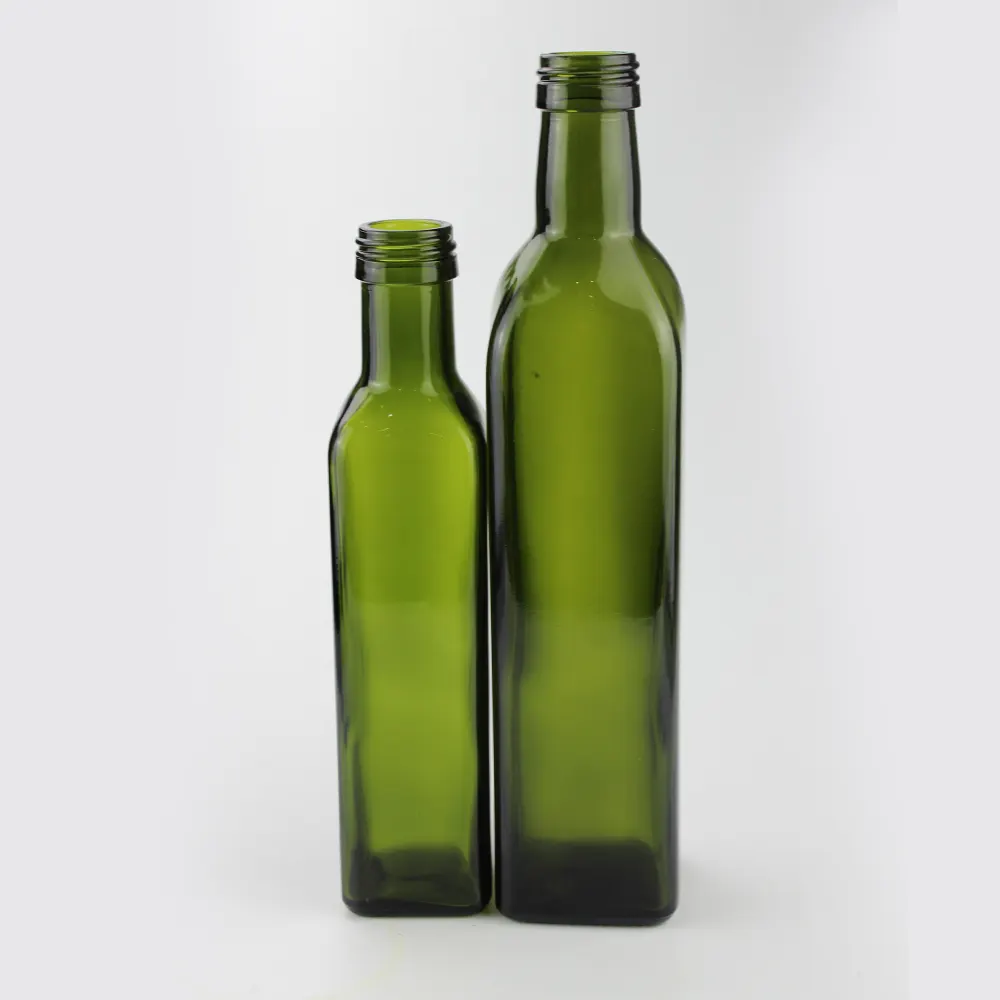
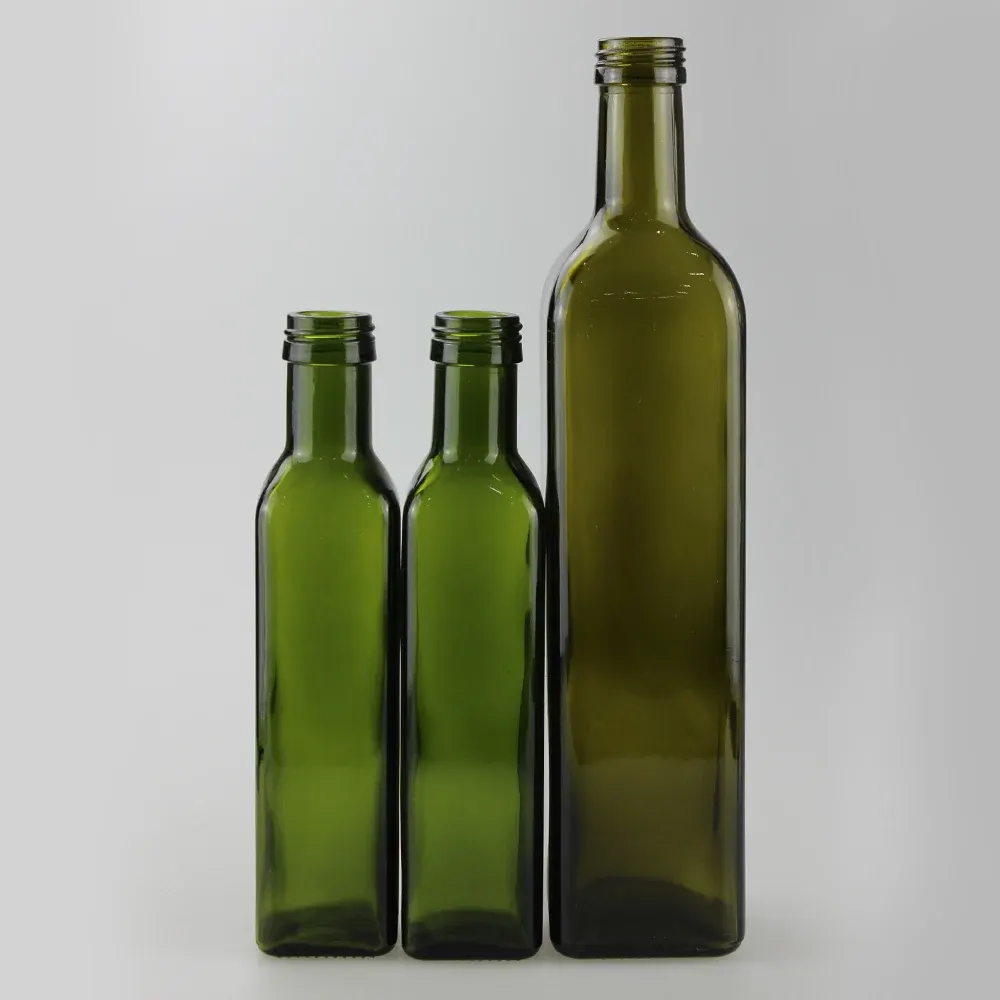
| Round ring-neck | Curved wrap label | Packs denser by count, looser by cube | Olive-oil-based vinaigrettes with an artisanal look, usually 250 ml and 500 ml Dorica and Marasca moulds |
| Hexagonal | Six flat facets | Wide stance that resists tipping | Private-label lines that need to look different from national brands |
A standard 12 oz French square is roughly 64 mm across the flats and 200 mm tall, and weighs 280 g to 340 g in flint soda-lime. The round ring-neck bodies come from the wine and oil trade and are the same ones listed in our olive oil bottle collection.
Buyers tend to underrate weight. At 12 oz capacity, a bottle below 250 g feels thin beside the category leaders, and one above 380 g adds noticeably to freight per pallet. We suggest 300 g to 330 g for retail dressings, going up to 360 g only where a heavy base is part of the brand position.
Check the shoulder angle on the drawing as well. A 45-degree shoulder lets a thick buttermilk dressing drain cleanly. A 90-degree square shoulder holds back the last 10 ml, and consumers complain about it.
Neck finish, cap and liner
The neck finish code on your RFQ decides which closures you can buy. Four GPI finish groups cover nearly all dressing bottles:
- 38-400 continuous thread for 8 oz to 12 oz retail bottles. It takes flip-tops, pour-fitment caps and plain screw caps.
- 43-400 and 48-400 for wider 16 oz formats, where a bigger opening helps thick dressings pour faster.
- Lug finishes 38TW, 43TW, 48TW and 58TW for hot fill. The quarter-turn lug cap carries a plastisol compound that makes the vacuum seal used on twist-off food jars.
Liners come in three grades: PE foam for cold fill, plastisol for hot fill and pasteurisation, and foil induction for extended shelf life. Write the liner grade on the purchase order. Co-packers have turned away whole cap lots because of a liner mismatch that one line of specification would have avoided.
During sampling, test thread engagement once. Cap the bottle at 12 to 18 inch-pounds of application torque, leave it 24 hours at room temperature, and measure the removal torque. If removal divided by application comes out above 0.6, the cap should not back off in distribution. If it is lower, ask the closure supplier for a different liner durometer before you approve a production run. Our guide to closures for glass bottles covers torque windows and liner selection in the detail a co-packer will ask for.
Pour inserts, flip-tops and tamper evidence
A drip-free pour insert is an LDPE or PP fitment pressed into the neck. It has a return channel that draws the last drop back inside, so no oil ring forms on the lip and creeps under the label edge. For vinaigrettes and other oil-forward dressings, specify a 6 mm orifice. For dressings with particulates, such as poppyseed or honey mustard, go up to 9 mm so the seeds pass without blocking.
A flip-top cap on a 38-400 finish builds the insert into the cap and works with one hand. That is why it dominates the refrigerated dressing shelf.
Retail bottles need tamper evidence. The two usual methods are a PP shrink band over the cap and neck finish, and a foil liner induction-sealed under the cap. Many brands use both, the foil for freshness and the band as the visible sign.
Case packs, pallets and container loads
A 12 oz French square goes twelve to a reshipper carton of roughly 290 mm by 220 mm by 215 mm. A GMA pallet takes 120 to 140 cases in five layers, which is 1,500 to 1,680 bottles. Filled, a 40-foot high-cube container reaches its payload of around 24 metric tons at 22,000 to 25,000 bottles.
Round 500 ml Marasca bottles pack more per case but waste cube in the gaps between cylinders. The difference in freight per bottle between square and round is therefore smaller than buyers expect.
Empty glass travels in bulk on pallets with layer pads and shrink wrap, at 4,000 to 6,500 empties per pallet depending on capacity. Freight on empty bottles is only a fraction of the filled-case figure that most buyers model first.
A brand building a wider condiment range can combine formats in one 40HQ once the total volume fills it: dressings in French squares, hot sauce in woozy bottles from the custom hot sauce bottle range, and marinades in larger sizes. If you are still weighing materials or other condiment formats, the wholesale sauce bottle overview covers the wider category. For a product to start from, many dressing brands take the square flint bottle series 1984 straight from stock moulds.
Questions buyers ask about dressing bottles
Which size sells best at retail?
In North American grocery, 12 oz (355 ml) leads by volume. The 8 oz size fits premium and refrigerated lines, and 16 oz suits club channels and lighter foodservice formats.
Will a glass dressing bottle survive a hot-fill line?
Yes, if it is properly annealed soda-lime glass with a thermal-shock rating above 42 degrees Celsius. Use a plastisol-lined lug or CT cap so the bottle holds vacuum as it cools.
Does a vinaigrette need a drip-free insert?
An oil-forward vinaigrette does, because the return channel stops the oil ring that stains lids and labels. Creamy dressings with particulates often leave the insert out and use a flip-top with a 9 mm orifice.
Which neck finish takes a flip-top cap?
For 8 to 12 oz bottles, the 38-400 continuous thread is standard for flip-top dispensing caps. On 16 oz bottles the usual choice is 43-400 or 48-400, which gives a wider pour opening.
How many bottles fit in a shipping container?
Empty, a 40-foot high-cube takes roughly 90,000 to 110,000 bottles of 12 oz, depending on the pallet configuration. Filled cases hit the weight limit first, at about 22,000 to 25,000 bottles.
What is the minimum order for stock dressing bottles?
We quote minimums per project. They depend on the mould and on the line it runs on.