Part of our cosmetic bottles and jars range, where the stock moulds for this are listed and quoted per project.
Body butter belongs in a heavy-wall, wide-mouth glass jar with an 83mm, 89mm or 100mm continuous-thread finish, and the jar has to be sized by the density of the whipped product, not by its weight in grams. Whipped butter runs at 0.75–0.92 g/ml, so a 200g fill needs about 235ml of brimful capacity plus headspace. Get that number, the mouth size and an oil-resistant liner right and the rest of the specification follows.
Work out capacity from bulk density
The mistake we meet most often is a brand that asks for a “200ml jar” to hold 200g of butter and finds on the filling line that the product will not fit. Whipping adds air, and how much depends on whip time. At 0.85 g/ml, 200g of product occupies 235ml before any headspace is allowed.
Weigh a sample of the formula as it comes off the production whip and ask your contract filler to confirm the fill volume. You can also send the sample to us: we measure it against candidate jars and send back a fill-height drawing.
Retail lines usually settle on 100ml, 150ml, 200ml and 250ml fills. The smallest works as a trial or travel unit; the largest suits salons and professional back-bar use.
Reference dimensions for 100–250ml fills
| Brimful capacity | Intended fill | Mouth finish | Diameter × height | Glass weight | Matching closure |
|---|---|---|---|---|---|
| 120 ml | 100ml | 83 mm CT | 72 × 62 mm | 185 g | 83mm PP or aluminium cap with PE foam liner |
| 175 ml | 150ml | 89 mm CT | 80 × 70 mm | 245 g | 89mm PP or aluminium cap with foam or induction liner |
| 235 ml | 200ml | 100 mm CT | 88 × 78 mm | 330 g | 100mm cap with oil-rated liner |
| 290 ml | 250ml | 100 mm CT | 94 × 85 mm | 395 g | 100mm cap with oil-rated liner |
These figures describe flint glass at standard weight. Amber is an option worth weighing for formulas built on unrefined shea or citrus essential oils, both of which oxidise in light. Spray frosting, metallised caps and custom embossing are also available.
Mouth size for fingers and for filling nozzles
People take body butter out with two or three fingers. A mouth narrower than 83mm makes them dig with their nails, which contaminates the product and shows up in reviews. That sets the lower limit on the consumer side.
The filling line sets its own. A piston filler dosing material in the 200–400cP range needs room around the nozzle for a clean cut-off, without stringing or trapped air, and 89mm and 100mm finishes are the ones most lines run. If the jars will go onto an existing line, give us the nozzle diameter and the centreline pitch so jar-to-line fit can be confirmed before any stock or mould is ordered.
Wall thickness, base and tolerances to put on the spec sheet
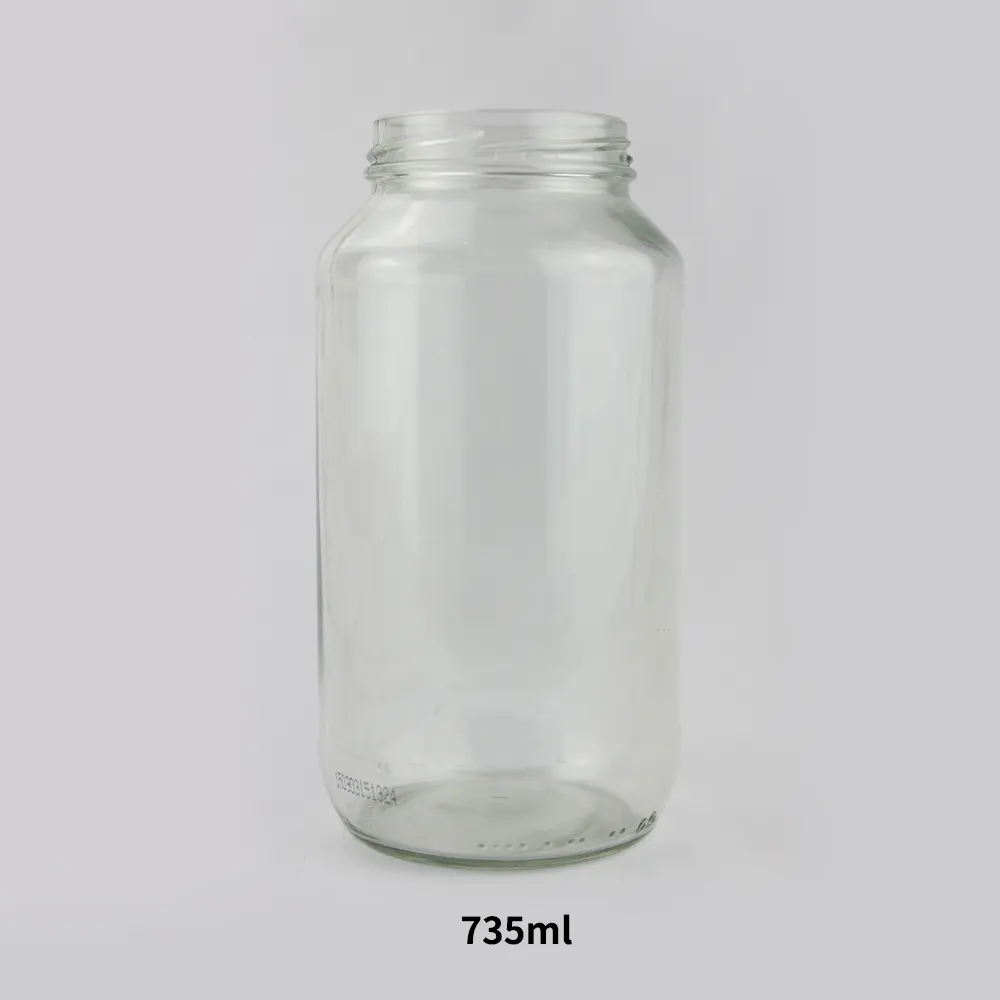
Jars for body butter are pressed or press-and-blown with walls of 3.5–5.0mm, about twice what a food jar carries, and a base of 12–18mm. The thick base keeps the jar steady on a wet bathroom shelf. It also accounts for much of the weight: an empty 200ml heavy-wall jar comes in at 320–420g, and buyers read that mass as quality in the same way they do with a heavy-base spirits bottle.
Three tolerances deserve a line each in the specification:
- Mouth inner diameter: ±0.4mm, so the cap fits consistently.
- Perpendicularity: within 1.5°, so the cap torques down evenly.
- Base push-up: shaped so the jar stands flat and does not rock.
Liners and cap shells that tolerate oil
A butter formula is anhydrous, typically 60–90% oils and butters with no water phase, and that is hard on liners. Pulpboard wicks the oil, delaminates and can grow mould. Induction foils without a coating lose their bond. The safe choices are a PE-foam liner, a tri-layer oil-resistant liner, or an induction heat seal rated for oil contact when the product ships through e-commerce and needs tamper evidence in transit.
For the shell, PP is the economical choice. An aluminium shell feels better in the hand and its threads hold up to being opened again and again with wet hands. Spa and amenity ranges sometimes prefer a wooden look, which is covered on the page about bamboo-lidded glass jars.
Cap and liner should be bought as a matched set with the jar. Each jar-and-cap pairing is torque-tested across a 10–18 in-lb application range, and on request seal integrity is checked at 40°C/75% RH. The wider cosmetic jar range, including face-cream formats and closure matching, and the cosmetic glass packaging collection cover decoration and compliance in more depth.
Why glass suits the formula better than plastic
Fragrance compounds move through polypropylene over months and the scent goes flat. Oils cause stress cracks in some copolyesters, and thin PET panels dimple inward when the formula expands in a warm warehouse. Soda-lime glass lets none of the formula's components through, holds its dimensions from a hot warehouse to a steamy bathroom, and can be recycled indefinitely.
PET is lighter and safer when dropped, and those are its only advantages here. Pricing for either route is quoted per project and depends on glass colour, decoration, the cap and liner set, quantity and freight terms; send the brief through the quote request page with your formula density or a sample.
Frequently asked questions
Which liner should I ask for with an oil-rich butter?
A pressure-sensitive PE foam liner under a polypropylene or aluminium-shelled cap gives a dependable reclosable seal on anhydrous formulas. Add an induction seal when the jar travels by parcel and needs to show tampering.
Can the jars be coloured or frosted?
Yes. Amber gives UV protection, and frosting is applied as a spray finish.
How do I keep glass jars from breaking in e-commerce shipping?
Start with a wall of 3.5mm+ and pack each jar in a moulded pulp or corrugated insert that holds it clear of the carton base. Limit pallet height to 1.1m. The packing specification we work to is designed around ISTA 3A drop sequences.