For food containers that will be moved between a refrigerator, a freezer and a hot oven, specify 3.3 borosilicate glass, not soda-lime. Its thermal expansion is roughly a third of soda-lime's, so a properly annealed container survives a sudden temperature difference of 120–160°C, against about 40–60°C for a well-annealed soda-lime jar. That margin is what lets a brand print oven-to-table and freezer-to-oven claims without inviting breakage complaints. Soda-lime remains adequate for shelf-stable sauces and pantry goods that never see a temperature swing.
Glass properties to state on the specification sheet
In 3.3 borosilicate, boron trioxide (B2O3) takes the place of much of the soda and lime in the batch, and silica rises above 80%. The resulting glass network grows far less when heated. Less expansion means less stress between the hot surface and the cold core of a wall during a temperature change, and that stress is what cracks a dish.
| Property | 3.3 borosilicate | Soda-lime container glass |
|---|---|---|
| Boron trioxide content | Typically 12–13% | Not a boron glass |
| Coefficient of thermal expansion (COE), 20°C to 300°C | About 3.3 × 10⁻⁶/K, which gives the grade its name | 8.5–9.5 × 10⁻⁶/K, commonly quoted as around 9.0 |
| Thermal shock resistance (largest sudden ΔT survived) | 120–160°C when properly annealed, at comparable wall thickness | About 40–60°C before fracture risk rises sharply |
| Softening point | Around 820°C | Roughly 700–730°C |
| Density | Near 2.23 g/cm³ | Near 2.5 g/cm³ |
COE and ΔT are the two figures that govern performance in the kitchen. The softening point matters for a different reason: borosilicate melts hotter, has a shorter working range and needs its own mould schedules, so the two glasses cannot casually share a line. Real borosilicate therefore comes from plants with dedicated borosilicate furnaces, and part of our job is matching a project to one of them. Our borosilicate glass overview covers the material in more depth.
How end users heat and cool these containers
Wall thickness, shape and lid design follow from how the container is used. Three patterns account for most demand.
Weekly meal preparation
This is the main use in Western markets. Food is cooked once, portioned, chilled or frozen, then reheated in a microwave or conventional oven over the following days, and every one of those cycles is a thermal shock. A freezer at −18°C and an oven at 180°C are almost 200°C apart, which exceeds what even borosilicate is rated for. Cautious brands therefore tell users to let the dish come to room temperature before it goes in the oven. Many users skip that step, and genuine 3.3 glass is the safety margin for them.
Bake and serve
Lasagne dishes, gratins, casserole roasters and pie plates travel from the oven to the dining table, so appearance counts as much as shock resistance. Buyers should ask for bright, clear glass with little green tint, smooth fire-polished rims, and handles formed as a solid part of the body instead of thin lugs that break off. Pressing suits these shapes. Blowing suits rounds and storage canisters.
Pantry and refill retail
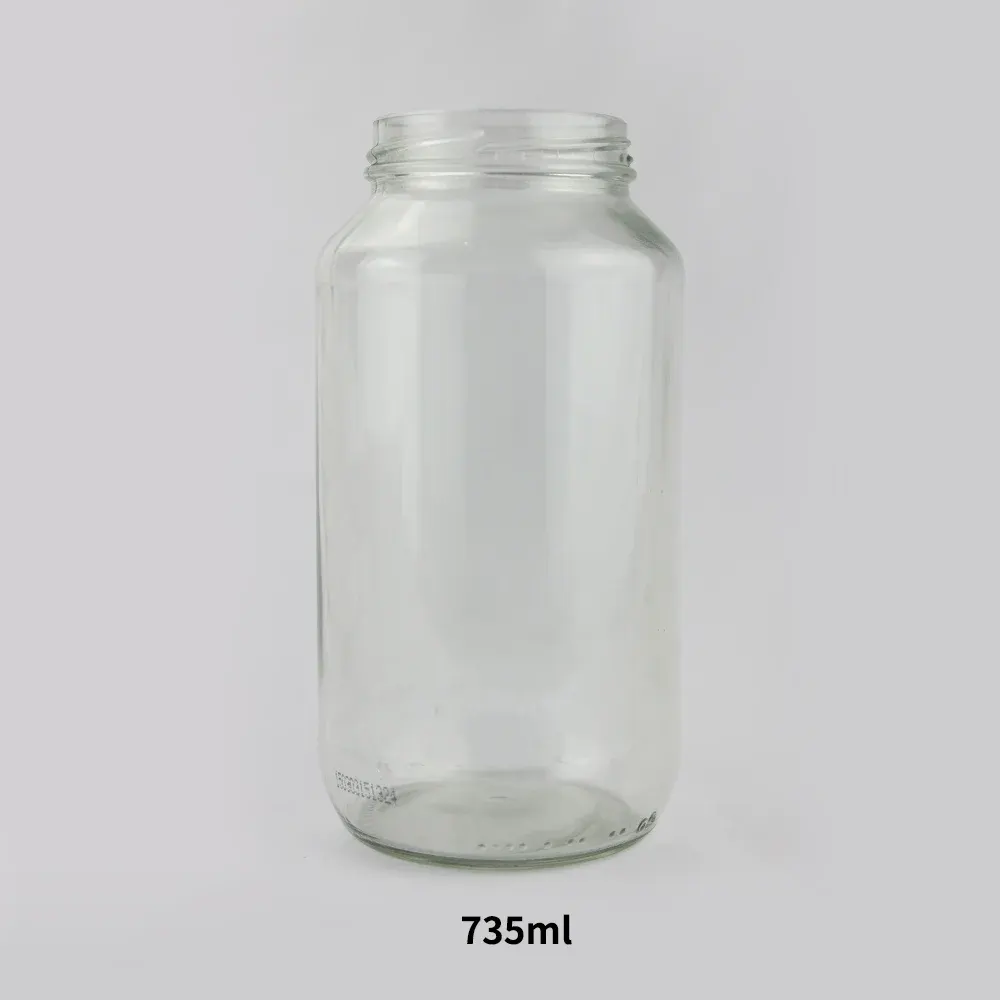
Tall canisters with clamp or screw lids hold grains, legumes and coffee on open shelves in zero-waste and refill shops, a channel that is growing quickly. Borosilicate's clarity and scratch resistance keep that display looking good for years. Brands in this channel often coordinate the canisters with the rest of their glass packaging for food and beverage, so jars, bottles and lids look like one family.
Container families and size ranges
A full borosilicate range normally draws on four families.
| Family | Capacity range | Usual closure | Point to check |
|---|---|---|---|
| Meal prep rounds and rectangles | 150ml to 1,040ml; 370ml, 640ml and 1,040ml are the standard commercial sizes | Snap-lock polypropylene (PP) lid with silicone gasket | Nesting height |
| Canisters | 400ml to 2,000ml | Bamboo, acacia or stainless lid with silicone seal | Lid fit across two suppliers |
| Bakeware (oval roasters, square bakers, pie dishes) | 1.0L to 3.0L | Sold open, or with an optional glass cover | Base flatness |
| Specialty (double-wall cups, graduated measuring jugs, microwave steamers) | By design | Vented lid on steamers | Tooling cost |
Rectangles outsell rounds in meal prep because they pack tightly into refrigerators and lunch bags, and retail sets usually contain three to five pieces. Ask how the line nests. A well-designed rectangular range stacks to about 60% of its assembled height, and that saving in freight volume lowers the landed cost of every set.
Canisters are bought on their outline, and the glass and the bamboo lid are made in different factories. Tolerances that do not match produce the familiar loose-lid complaint, so name the lid supplier early. A brand that already sells jars with lids can match gasket diameters between the two lines and carry fewer spare parts.
Bakeware walls run 4–6mm, thicker than storage ware, and annealing takes longer. Check that the base sits flat, because a dish that rocks on a glass-ceramic cooktop comes back as a return.
Specialty formats earn higher margins but cost more to tool, which suits brands that want to move beyond commodity sets. Where no open mould exists for a shape, we arrange mould development through our custom glass container service.
Lids, gaskets and vents
Leak resistance, microwave convenience and marketplace review scores depend on the lid as much as on the glass. The standard meal prep closure is a snap-lock lid with four hinges and a silicone gasket running the full perimeter. Specify food-grade silicone rated to 230°C or higher. If users will put lids through a hot dishwasher every day, ask for PP reinforced with glass fibre.
A vent, either a small silicone plug or a sliding valve, lets the user microwave food with the lid locked. In North American retail sets this was once an upgrade and is now expected.
The lid stays out of the oven, and the pack must say so plainly, because PP warps above roughly 110–120°C. Brands that want a covered dish for oven-to-table service add a glass lid or a glass cover with a silicone rim.
On the technical drawing, fix the gasket's cross-section diameter and its compression percentage. A groove that is 0.5mm off its drawn width is enough to make a sealed container leak across a production run. Our inspection procedure for glass packaging tests gasket compression set after 72 hours at 70°C, since a gasket that loses its spring is the fault that tends to surface about three months after launch.
Checking that the glass is genuine 3.3 borosilicate
A very low quote for "heat resistant glass containers" is a reason to ask questions. Before approving a pre-production sample, request the batch composition or a COE test report for the production line that will make the order.
Then test samples yourself. Heat them to 120–140°C and quench them in room-temperature water, for example at 20°C, and repeat. Soda-lime control pieces break within a few cycles, while real borosilicate keeps passing. Density gives a faster screen, using the two figures in the table above.
What to include in a borosilicate container RFQ
Quotes are only comparable when every supplier prices the same specification. State the following:
- Target capacity and brimful volume tolerance; ±3% is standard.
- Glass grade with a COE requirement of 3.3 × 10⁻⁶/K ±0.1.
- Thermal shock requirement, given as the ΔT you intend to test, such as 120°C.
- Wall thickness range and annealing standard.
- Clarity, with limits for seeds and blisters.
- Lid material, gasket material and the temperature rating of each.
- Decoration, if any.
- Case pack configuration and the nesting requirement.
Ask for a thermal shock report on the exact mould, since a generic certificate proves little. Run your own freeze-to-oven abuse test on pre-production samples before you pay the balance of the tooling invoice.
Our RFQ checklist for bottles and jars goes through the complete parameter list one line at a time. When the size list and annual volumes are settled, send them to us for a quotation.
Borosilicate glass container FAQ
Can a borosilicate container go directly from the freezer into the oven?
The glass tolerates large differentials, but taking a dish from −18°C straight into a fully preheated oven at 220°C puts any glass under stress. Good practice is a short rest at room temperature first, with that instruction printed on the packaging.
Are borosilicate containers safe in the microwave and dishwasher?
Yes. Neither microwave energy nor repeated dishwasher cycles affects the glass. The lid components set the limits, and in commercial kitchens the silicone gaskets should be checked annually for compression set.
What minimum order quantity applies to borosilicate food containers?
Minimums are quoted for each project, because they depend on the mould and on the line that runs it.
Can the containers carry a logo or colour?
Yes. Logos can be sandblasted or acid-etched, lids can take decal printing, silicone sleeves can colour-code a set, and tinted glass is available for specialty ranges. Most brands leave the body clear, since seeing the contents is one of the main reasons people buy glass storage.