Filed under bulk glass jars; the moulds we quote for this are pictured at the foot of the page.
Embossing puts the brand into the glass itself: the artwork is cut into the mould, so every jar comes out with the mark in relief and nothing can peel, fade or scratch away. Choose it for core SKUs, returnable formats and anything that lives in condensation or ice; keep labels for what changes from batch to batch. The trade-off is that the design carries no colour and cannot be altered without new tooling.
Embossing, labels and screen print compared
| Factor | Embossing (mould relief) | Paper/PS label | Screen print (ACL) |
|---|---|---|---|
| Durability | Permanent through wet, cold and repeated reuse | Lifts in condensation and scuffs | High, resists the dishwasher |
| Colour | None, only light and shadow | Full colour | 1–4 spot colors |
| Changing the design | Needs new tooling | Reprint whenever needed | Needs new screens |
| Anti-counterfeit value | High, since the mould itself is the proof | Low, labels are easy to copy | Medium |
| Best suited to | Core SKUs, returnables, top-tier lines | Seasonal runs, many SKUs, low volume | Coloured brand marks at volume |
Many brands use two of these together. A moulded crest or logo carries the identity permanently, and a small label handles flavour, vintage or batch. The label gets smaller and the brand mark never has to be reprinted.
Where embossing earns its tooling
Three situations justify the mould work. The first is refillable and returnable packaging such as milk, cold brew, candle and food-storage jars, where a label is both a repeat purchase and the part most likely to fail, while relief is paid for once. The second is brand protection: a distinctive shape combined with a moulded mark is much easier to defend than print, and customs can separate genuine goods from counterfeits more readily when the real jar carries marks in the glass. The third is perception. Shoppers associate relief with heritage and substance, which is why honey, preserve and candle brands specify it.
Private-label buyers do not need a proprietary jar to benefit. A stock shape with a custom embossed base ring is enough to set a listing apart from the same jar sold generically.
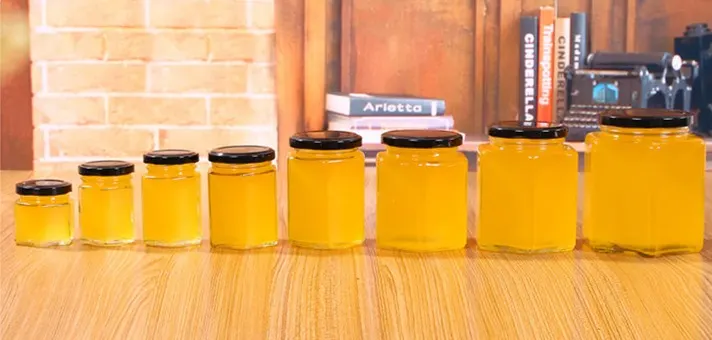
How the mark gets into the glass
The design is reverse-engraved into the blank-mould cavity, either by CNC milling or by chemical etching. Each jar pressed or blown in that cavity then carries the artwork raised (embossed) or recessed (debossed). Relief depth runs 0.3–1.0mm, which is deep enough to feel and to catch light on a shelf, yet shallow enough for the jar to release cleanly.
Glass is formed at around 1,100°C and annealed as a single piece, so the mark is part of the container rather than a layer on top of it. It comes through dishwashers, ice buckets, cold-chain condensation and decades of reuse unchanged.
Design rules for artwork that will mould cleanly
Relief has to obey the geometry of the mould. We check artwork against the mould drawing on these points before a modification is quoted:
- Draft angle. Relief walls need at least 3° so the jar leaves the mould without drag marks.
- Stroke width and depth. Hold lines at 0.8mm wide or more and keep relief inside 0.3–1.0mm. Finer detail does not fill reliably at production speed.
- Placement. Flat panels and gentle curves work best. Stay clear of the parting line and the heel radius. Shoulder embossing can be done, but it makes the mould more complex.
- Undercuts. Any feature the mould cannot pull straight away from is not possible.
- Capacity and origin text. These marks can be moulded in as well, which helps with export compliance.
Stock jars suited to embossing
These flint jars have the panel area and geometry that take relief well. All use lug twist-off finishes.
| Jar | Capacity | Weight | Finish |
|---|---|---|---|
| Hexagon jar, flint | 250ml | 200g | 58mm lug TO |
| Hexagon jar, flint | 500ml | 320g | 70mm lug TO |
| Round preserve jar, flint | 314ml | 230g | 63mm lug TO |
| Round storage jar, flint | 720ml | 400g | 82mm lug TO |
| Square shoulder jar, flint | 250ml | 240g | 63mm lug TO |
| Ribbed round jar, flint | 185ml | 160g | 53mm lug TO |
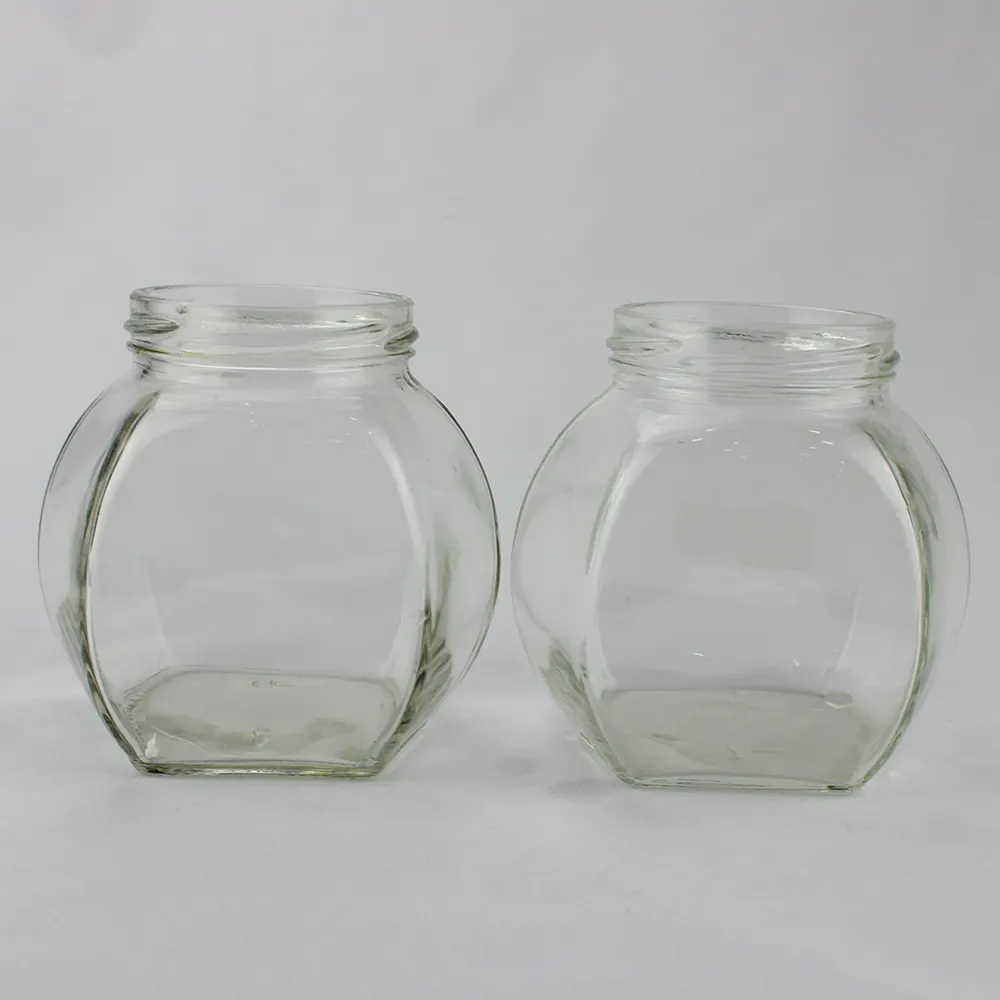
For smaller embossed sets, the same approach applies to glass spice jars bought wholesale. If the glass type is still open, our notes on flint glass as a material cover that choice.
What to send with an embossing enquiry
- Vector artwork with dimensions, marked as raised or recessed, with the relief depth you are aiming for.
- The placement zone: body panel, shoulder or base ring. It must stay off the parting line shown on the mould drawing.
- Expected lifetime volume for the design. This decides whether an existing mould is modified or a proprietary one is cut.
- Your closure choice. An embossed jar still needs a matched lug cap, so it helps to pick from the glass jar range with lids at the same time.
Before mass production, approve a physical sample taken from the modified mould. A drawing alone does not show how the relief reads in glass. Enquiries go through the quote request form.
Buyer FAQ
What is the minimum order for custom-embossed jars?
It is set per project. The figure depends on the mould and on the line that mould runs on.
What does the mould modification cost?
Cost is quoted per project and moves with the mould, the decoration, the quantity and the freight terms.
How long do embossed jars take?
Timing is confirmed per project once the mould, decoration and line schedule are settled.
Can a stock mould take my logo?
In most cases, yes, as long as the panel shape leaves room for the draft angle and relief depth the artwork needs. We compare the artwork with the mould drawing and confirm it is feasible first.
Does embossing weaken the jar?
Not when the design follows the rules above. Relief of 0.3–1.0mm with correct draft adds glass locally instead of taking it away, and the jar is still annealed as one piece. Embossed jars pass the same ISO 7459 thermal-shock and vertical-load tests as plain ones.