Wholesale glass salve jars are straight-sided, wide-mouth soda-lime jars, stocked in nine sizes from 5 ml to 200 ml; the 15 ml, 30 ml, 50 ml and 60 ml sizes carry most balm and butter lines. They take aluminum, anodized aluminum or bamboo lids. Pick the capacity from the chart below, choose amber or cobalt if the formula is light-sensitive, and treat the closure liner, not the glass, as the part that needs a compatibility test.
Sizes and dimensions
All figures are nominal and taken at ambient temperature. Mouth diameter is the inner opening that receives the closure, body diameter is the widest outside point, and height runs from the base to the top sealing plane.
| Capacity | Mouth (mm) | Body (mm) | Height (mm) | Usual cap |
|---|---|---|---|---|
| 5 ml | 33 | 35 | 25 | Aluminum screw cap |
| 10 ml | 38 | 40 | 30 | Aluminum screw cap |
| 15 ml (0.5 oz) | 45 | 48 | 35 | Aluminum or anodized aluminum |
| 30 ml (1 oz) | 53 | 55 | 45 | Aluminum or anodized aluminum |
| 50 ml (2 oz) | 58 | 60 | 50 | Aluminum or bamboo |
| 60 ml (2.5 oz) | 58 | 62 | 55 | Aluminum or bamboo |
| 100 ml (4 oz) | 63 | 65 | 65 | Aluminum or bamboo |
| 120 ml (4.5 oz) | 70 | 72 | 72 | Aluminum or bamboo |
| 200 ml (8 oz) | 70 | 78 | 92 | Bamboo or anodized aluminum |
The cap column gives the standard pairing; other lids can be swapped in as long as the neck finish is the same. Capacity typically varies by plus or minus five percent, depending on how the jar is formed. Dimensional reports, cap torque recommendations and stack-load test data can be requested, and the tooling drawing should be checked against your filling line before a production run.
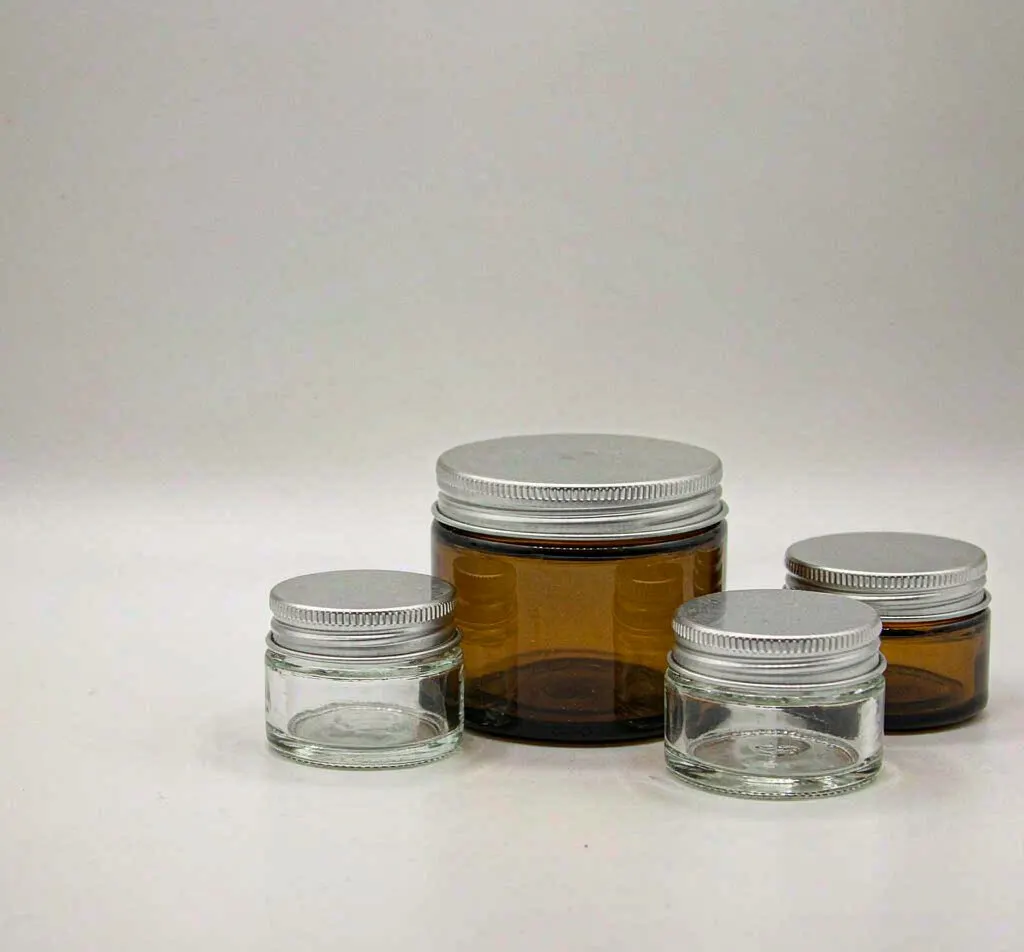
A volume outside the chart means a custom mould. Buyers who are still comparing formats often begin on the wider cosmetic glass packaging collection and narrow down to a jar from there.
Matching the jar to the product
A wide opening and straight walls are what make this jar suit thick, semi-solid fills. Ointment flows in more easily than it would through a narrow neck, and the user can reach the last of the product with a finger or spatula. Four product groups account for most orders.
Salves and balms
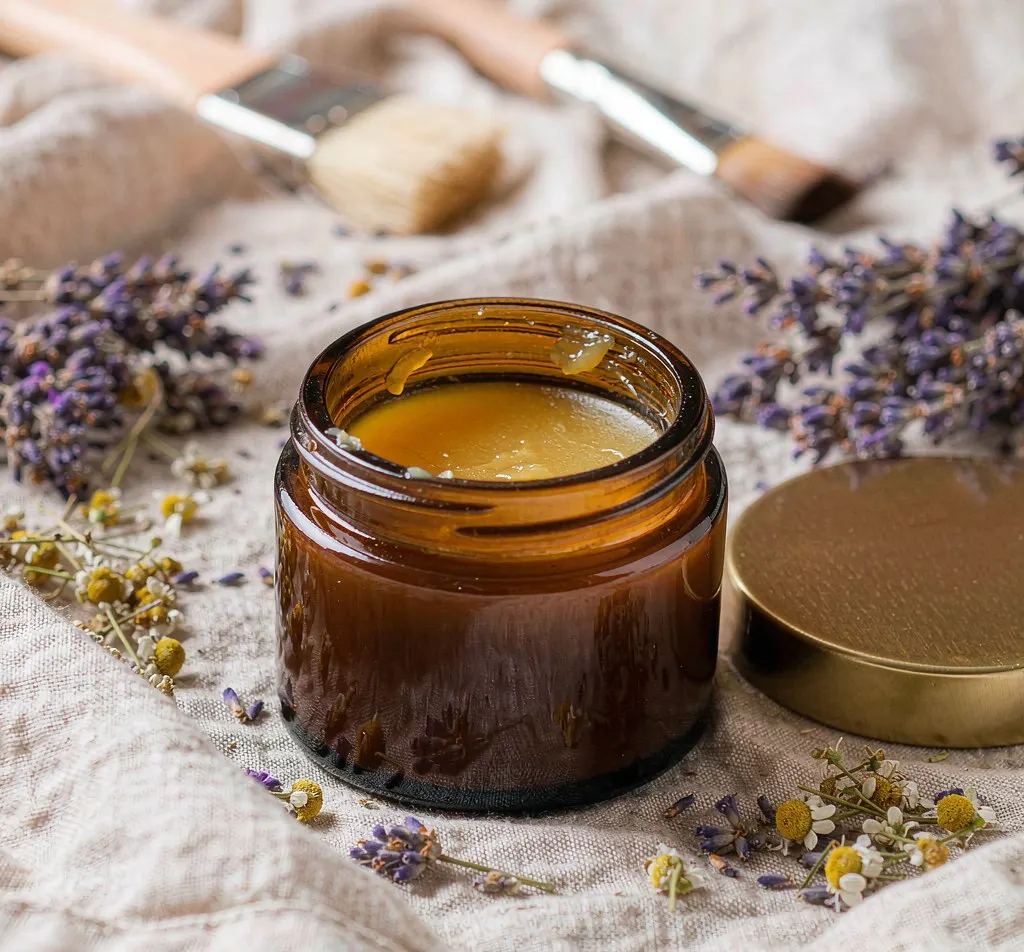
Anhydrous formulas such as beeswax ointments, shea or cocoa butter balms and herbal-infused balms need a container that does not react with the actives, does not warp under an essential-oil load and tolerates dozens of openings. Glass also removes the plasticizer migration risk that comes with some polymer containers, which is why it is the usual choice for botanical extracts and CBD-infused topicals. Soda-lime glass rarely causes trouble, but oil-heavy formulas and those containing citrus terpenes should still get a compatibility check and a closure that accepts a liner.
Lip balm and lip care
The 5 ml, 10 ml and 15 ml jars suit pot-format lip products, which look like a spa item next to the familiar plastic stick. Since the product touches mucous membranes, the lid has to close tightly enough to stop drying and oxidation, and the jar has to be simple to sanitize. Aluminum and anodized caps stand up to menthol, peppermint and flavour oils without corroding; our lip balm jar range is specified on that basis. Brands often add a larger jar from the same series for a lip scrub or overnight mask.
Solid perfume
A wax-and-oil fragrance base poured into a 5 ml or 10 ml jar gives a pocketable scent that cannot spill. Fragrance compounds are light-sensitive, so amber and cobalt bodies are worth having here: shielding the balm from UV helps the top, heart and base notes last. A friction-fit or lined aluminum cap with a frosted or coloured body is the combination we most often suggest.
Samples and travel sizes
Jars from 5 ml to 15 ml are used for samples, subscription-box inserts, travel sizes and gift-with-purchase offers, letting a customer try a new butter or balm before buying the full size. Carry-on liquid limits seldom apply to solids and semi-solids, one more reason these programmes use a jar and not a bottle.
Glass colour and light protection
| Body | Light protection | Reason to choose it |
|---|---|---|
| Clear | None stated | Shows the product |
| Amber | Filters the broadest band of visible and near-UV light | Default for light-sensitive balms and perfumes |
| Cobalt blue | Meaningful UV attenuation at the lower wavelengths | A distinctive look that still protects |
| Frosted (matte) | Mild diffusion only | Soft, easy-grip surface made by etching; photographs well for e-commerce |
Light speeds up the breakdown of fragile ingredients, among them certain vitamins, botanical extracts and fragrance top notes. Frosting is a finish, not a filter, and does not replace a coloured base. For a highly photosensitive formula, start with amber or cobalt; wall thickness and tint density can then be adjusted towards the protection level you need.
Lids and liners
Three lid families are standard, and all of them are matched to the jar's neck finish.
- Aluminum screw caps are light, recyclable and corrosion resistant. With a suitable liner they are our recommendation for oil-heavy or flavour-loaded products.
- Anodized aluminum caps come in custom colours and have a scratch-resistant surface that holds up in a humid bathroom.
- Bamboo lids are renewable and fit clean-beauty and zero-waste positioning. They can take an inner liner or a pressure-sensitive seal to protect the contents.
Glass gets along with waxes, oils, butters, fragrances and most plant extracts, so compatibility problems usually trace back to the liner. Options include standard polyethylene foam, a pressure-sensitive seal and a pulped-fibre liner, chosen against the oil load of the formula. With water-containing emulsions, confirm that lid and liner keep their seal for the whole intended shelf life.
Printing and decoration
Silk screen printing puts ceramic or organic ink directly onto the glass in one colour or several, and suits logos, ingredient callouts and batch codes. Hot stamping, also known as foil stamping, uses heat and pressure to bond a metallic or pigmented foil to the surface as a reflective logo or accent line; gold, silver and holographic foils are the common choices. Both hold up under normal retail and bathroom conditions.
Caps can be printed or embossed as well, so the lid carries the brand mark. None of this has to be ordered at once. Many brands begin with a coloured body and a contrasting cap, which stands out on a shelf without much decoration spend, and add print as they grow.
Material and compliance documents
The jars are soda-lime glass, the family used for food and cosmetic packaging worldwide. It is inert, non-porous and odourless, so under normal storage it adds no smell, taste or leachables to a balm or butter. Its chemical and thermal stability also suits anhydrous and low-water formulas that can stress some plastics.
For the clear and amber compositions we can supply material declarations for food-contact glass and, where relevant, certificates of compliance for your documentation file. Cosmetic packaging is regulated differently from food in many markets, so finished-product claims and labelling should be confirmed with your own regulatory consultant.
Ordering and sampling
For most brands the quickest and lowest-risk route is a proven stock mould with surface decoration added. A custom mould is the alternative when the volume or shape is not in the chart; once paid for, the tooling is held for your repeat orders.
Price, minimum quantity and timing are quoted per project. They move with the mould route, the decoration, the cap (bamboo and anodized lids are quoted separately and vary with finish complexity), the quantity and the freight mode, since sea and air differ widely in transit time and cost. Before any full run, do a fill-and-seal test using your actual formula.
Jars are often ordered alongside other formats. Cream and lotion lines draw on the wholesale cosmetic jar range, serums and oils on amber cosmetic bottles, and bath and body makers add bath salt jars to build a gift set. A useful brief names the container, closure, decoration, quantity and destination, as far as you know them.
Frequently asked questions
Which sizes are available wholesale?
Nine: 5, 10, 15, 30, 50, 60, 100, 120 and 200 ml. The small ones go to lip balm, solid perfume and samples, the large ones to body butter and massage balm.
Which caps fit these jars?
Aluminum screw caps, anodized aluminum caps in custom colours and natural bamboo lids. The choice follows the formula and the look of the brand.
Are amber and cobalt better for light-sensitive formulas?
Yes. Both block a meaningful share of UV and visible light, and frosted glass does not do the same job.
Can a logo be printed directly on the glass?
Yes, by silk screen in one or more colours, or by hot stamping with foil.
What is the minimum order for custom jars?
It is set per project and depends on whether the order uses a stock mould or new tooling, and on the decoration.
How long do production and shipping take?
Timing is confirmed per project once mould, decoration and freight mode are known.
Can I test samples before a bulk order?
Yes, and we strongly advise filling and sealing them with the real formula first.
Are the jars suitable for a CBD-infused topical balm?
As a container, yes: inert, non-porous glass works well with oil-based balms and butters. We make no medical or therapeutic claims about any formulation, and product claims and labelling should be cleared with a qualified regulatory consultant for each target market.