Part of our series on glass spice jars — read the overview first if the format is new to you.
For most wholesale grinder bottle programs the safe specification is a 100, 150 or 200 ml lead-free soda-lime jar with a PP grinder cap and an alumina ceramic burr. Ceramic is the core to choose whenever the fill contains salt: in humidity testing at 40 °C and 93% RH it shows no measurable mass loss at 1,000 hours, while 420-grade stainless pits at 240–300 hours. Stainless only earns its place in pepper-only or dry-herb fills, where its longer cycle life is the one advantage left.
Stock sizes, dimensions and closures
The open-tooling range comes in three body shapes: a straight-sided 100 ml cylinder, a 150 ml jar that tapers slightly to a finger-grip waist, and a wide-body 200 ml jar suited to coarse fills. Every body takes a 43 mm or 48 mm grinder closure, which lets a brand build a three-size family around a single cap tool.
| Model | Capacity (ml) | Mouth Ø (mm) | Height (mm) | Body Ø (mm) | Weight (g) | Closure |
|---|---|---|---|---|---|---|
| OG-GR100 | 100 | 43 | 98 | 52 | 118 | PP grinder cap, ceramic |
| OG-GR150 | 150 | 48 | 112 | 58 | 142 | PP grinder cap, ceramic |
| OG-GR200 | 200 | 48 | 128 | 62 | 168 | PP/SS grinder cap, ceramic |
| OG-GR150R | 150 | 48 | 115 | 58 | 150 | Refillable SS cap |
| OG-GR200B | 200 | 48 | 130 | 62 | 174 | Bamboo-top PP grinder |
Tolerances on these bodies are ±5 g on weight and ±1.0 mm on height. Mouth concentricity is kept within 0.3 mm so the cap seats square instead of cross-threading.
Two figures settle whether a cap from one source will run on a jar from another: the mouth diameter and the thread pitch, which on this range is 3.0 mm (12 TPI). In practice a competitor's cap rarely fits, so we advise buying jar and closure as one matched set, the way our wholesale spice jar range is specified.
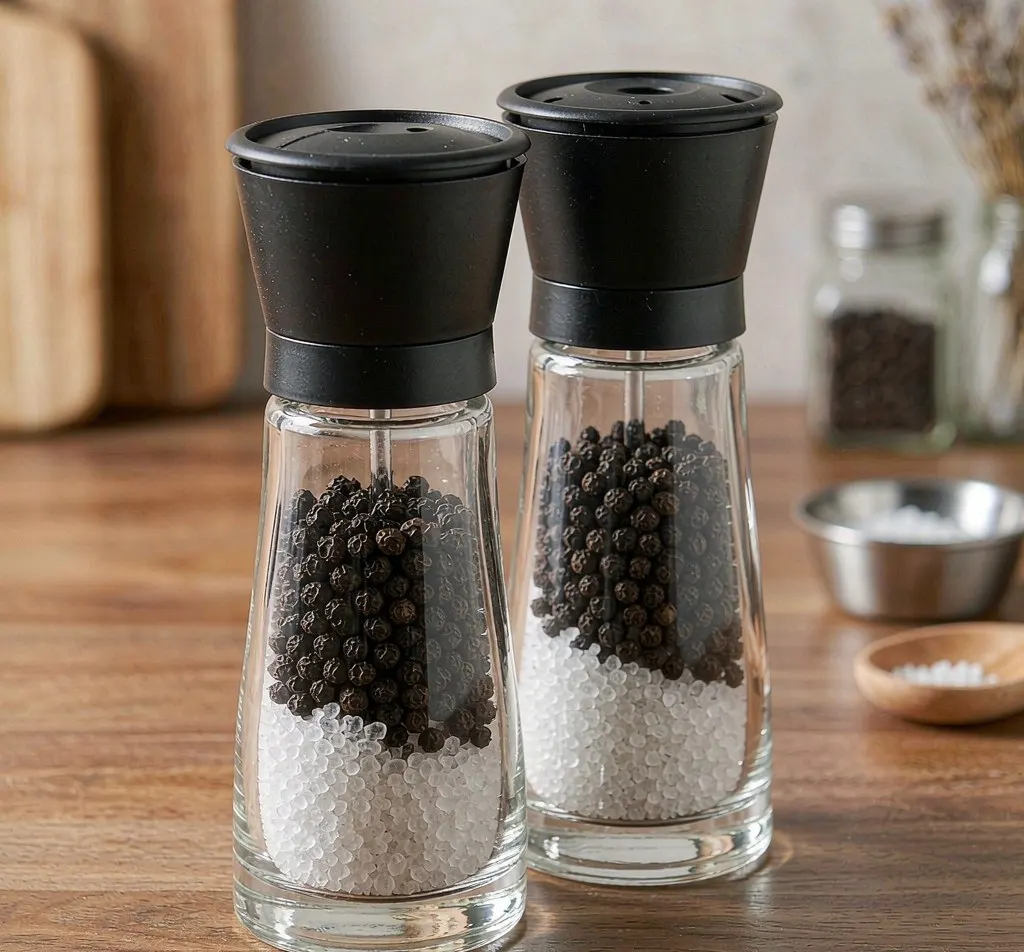
Ceramic burr or stainless burr
The burr is the only moving part in the pack, so it sets both how the grinder feels in the hand and how often it fails in the field. Ceramic cores are alumina (Al₂O₃) of 95–96% purity, sintered at 1,450–1,500 °C and finished to a burr tolerance of ±0.05 mm. Stainless cores are machined in 304 or 420 grade and hardened to 48–52 HRC.
| Property | Alumina ceramic | Stainless steel |
|---|---|---|
| Salt exposure, 40 °C and 93% RH | No measurable mass loss at 1,000 hours | 420 grade pits at 240–300 hours |
| Flake-size spread | ±0.15 mm over its life | Widens to ±0.30 mm by 5,000 cycles |
| Mean torque life | 14,200 cycles | 18,600 cycles |
| Lowest unit in a 30-piece sample | 11,800 cycles | 13,400 cycles, with more variance |
| Sensible use | Salt, salt blends, fine grinds | Pepper-only and dry-herb fills, coarse crack |
Sea salt and Himalayan pink salt bring trace chlorides and moisture into the mechanism, which is why corrosion decides the question for any salted SKU. With pepper alone the corrosion gap hardly matters.
Grind consistency is the second test. The wider drift of a worn steel edge is tolerable for cracked pepper but not for a fine espresso-style salt grind. Ask the supplier for the particle-size distribution (PSD) curve and check that the coefficient of variation (Cv) remains below 18% for the whole rated life.
How the cycle figures are produced
The torque-life test turns the core against a calibrated load cell at 12 revolutions per minute under a 2 N·m resistive load. Counting stops when burr torque passes the 0.9 N·m failure threshold. One cycle is a full clockwise turn that releases about 0.35 g of medium grind.
On that basis 14,200 cycles equals roughly 5 kg of spice, against the 150–400 g that a 100–200 ml bottle actually holds. Either burr outlasts the pack many times over. What limits real life is the thread between cap and glass, and the seal.
Coarseness adjustment that holds its setting
Coarseness is set by a threaded nut on top of the core rather than by a friction cam. The standard mechanism has five detented positions running from 0.5 mm (fine powder) to 2.4 mm (coarse crack), and the nut turns within a torque window of 0.15–0.55 N·m.
Low-cost caps often use a smooth adjuster with no detents. It creeps in transit, and the bottle reaches the shelf on a different setting from the one it was packed at. The mechanism we specify is locked by a molded retention ring rated for 1.2 N·m of resistance, and after a 1.2 m drop test on three axes the chosen grind stays within ±5%.
Tamper-evident single-use or refillable
The glass is the same in both formats, and so is the grinder core. What changes is the cap skirt and whether a refill collar is present.
- Single-use. A tamper-evident (TE) band is molded into the PP cap skirt. Its thin bridge breaks the first time the cap is opened and leaves a visible gap, which shows the shopper that the pack was sealed.
- Refillable. A reusable threaded collar replaces the TE band, with a wider 38 mm refill mouth under a secondary dust cap. The user unscrews the collar, tips in whole peppercorns or coarse salt, and screws the grinder back on.
The refillable build asks more of every part. The collar needs a double-start thread so it seats in 1.5 turns, the dust cap needs a living hinge rated for 200 open/close cycles, and the glass mouth needs a reinforced bead to take repeated torque.
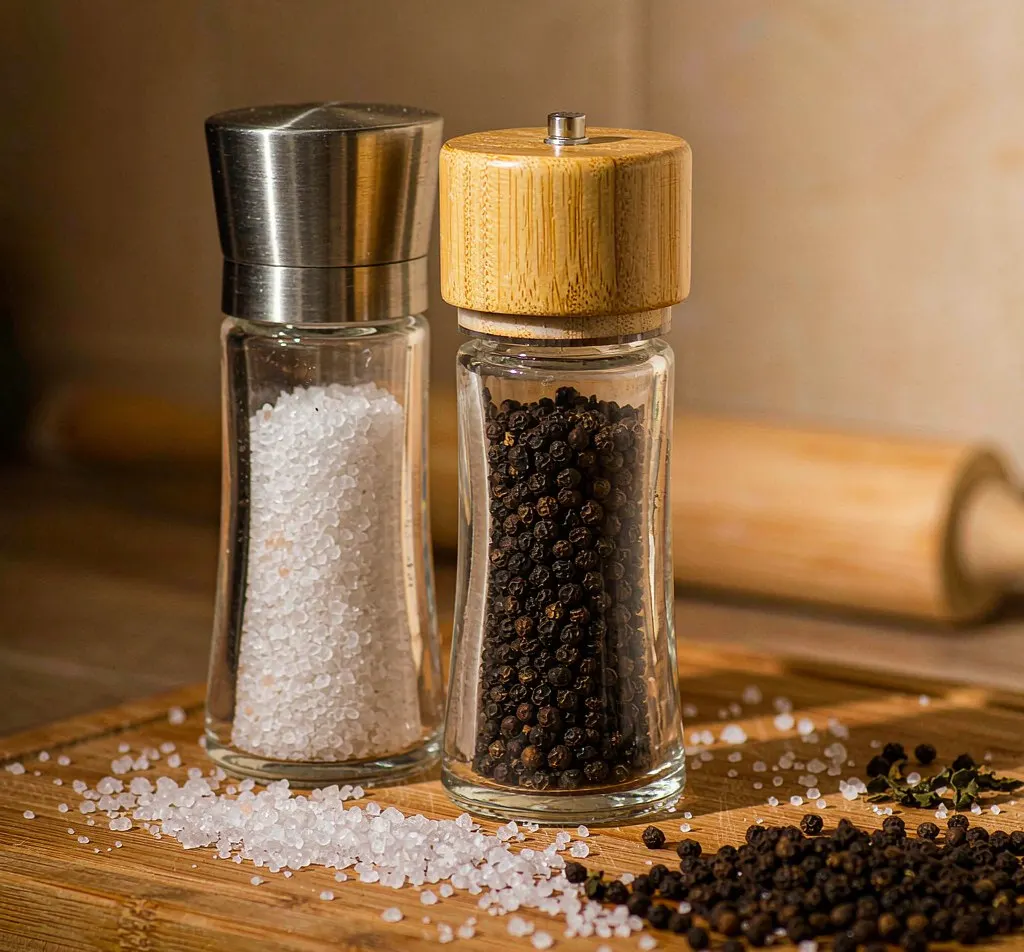
Whether that extra engineering pays back depends on shoppers actually refilling. Loyalty data from private-label programs puts the share who refill 2+ times at roughly 22–28% of buyers. A brand chasing trial and shelf presence is usually better served by the TE format, while a line positioned on sustainability can justify the refillable structure even at modest refill rates.
Because only the cap differs, a brand can start with the single-use version and move to refillable later by re-tooling the cap alone, keeping the glass mold. That is the path we suggest to most new seasoning brands.
Glass composition and food-contact reports
The body is lead-free soda-lime glass (SiO₂–Na₂O–CaO). Under the FDA 4% acetic acid extraction test the limit for extractable lead is 0.5 mg/L; typical readings are <0.1 mg/L, and cadmium stays below 0.1 mg/L. Iron oxide is held under 0.08% so the glass reads clear and not green. A warmer or amber tone is achieved with controlled CeO₂/Fe₂O₃ dosing at 0.02–0.05%, which remains food-contact compliant.
Clarity has a practical job here. Shoppers can see how much is left and judge the spice itself, whole or ground and evenly colored or not, which cuts down on returns of bottles wrongly thought empty.
Documentation is tied to the production lot:
- EU retail: LFGB testing of overall migration into 3% acetic acid, 10% ethanol and olive oil simulants at 40 °C for 10 days. Results sit under 6 mg/dm² against a limit of 10 mg/dm².
- US retail: FDA 21 CFR 175.300 / 177.1520 equivalence for the closure, plus a heavy-metals extractables report for the glass.
Both come from an ISO 17025 laboratory, stay valid for 12 months from the test date, and are repeated if the glass batch formula changes. Do not accept a compliance letter in their place. The certificate of analysis with each shipment should carry the report number and the lab's accreditation scope.
Decoration and closure color
The 100–200 ml grinder shelf is largely identical clear cylinders under black plastic tops, so decoration and cap color are where a brand separates itself.
| Method | What it gives | Limits |
|---|---|---|
| Screen printing | 1–4 Pantone-matched colors in UV-cured ink, straight onto the glass | Rated for 50+ dishwasher cycles without significant fade; registration ±0.4 mm |
| Ceramic decal | Finer detail in matte or gloss, fired on at 580–620 °C | Permanent and scratch-resistant; withstands commercial dishwashing |
| Pressure-sensitive label | PP film, practical for short runs or variable SKU data | Rated for −20 °C to 80 °C |
Cap color delivers the most visual change for the least tooling, and bamboo or stainless tops add a second texture for higher-tier lines. We suggest fixing one cap color and one printed element, a logo or a ribbon band, as the identity. That pairing can be picked out from 2 m away. Dielines, artwork specifications and two physical print proofs before production are handled through our custom spice jar service.
Failures to design out and checks to run on a supplier
Tender documents from supermarket own-brand teams and mid-size seasoning brands reviewed in 2025 repeat one complaint above all others: grinders that seize after the first refill, or bind before the pack reaches the shelf. The second recurring fault is odor and taste transfer from the closure. Caps molded from non-food-grade regrind have shown headspace VOC readings of 12–18 µg/L above threshold, enough for a trained QC nose to reject a lot even when the spice itself is compliant.
Six requests separate a supplier with engineering behind the product from one working off catalog photos:
- The grinder cycle-test report showing real mean and minimum counts, not a bare pass statement.
- The burr material certificate, with corrosion data if the fill contains salt.
- A numbered LFGB or FDA lab report for each lot.
- A thread-fit check on a sample. A cap that needs more than 0.5 N·m to overcome cross-thread resistance will jam on a filling line.
- A 50-cycle dishwasher test on the decoration before you commit.
- The supplier's QC sampling plan and its defect-rate data for the last three months.
The same approach to closures and food-contact glass runs through our food glass jar application pages, which helps when one program spans jars, bottles and caps.
Frequently asked questions
Which grinder core should a salt product use?
Ceramic. Alumina does not react with salt, whereas 420-grade stainless starts to pit within a few hundred hours of humid exposure. Keep stainless for pure dry-pepper fills, where it reaches a higher mean cycle count.
What sizes are available, and what is the minimum order?
Stock bodies are 100 ml, 150 ml and 200 ml, each taking a 43 or 48 mm grinder closure. Minimums are quoted per project, since they depend on whether you use open tooling or a custom mold, on the decoration and on the cap.
Does the grind setting move during shipping?
Not with a detented nut and a retention ring. Smooth friction-cam adjusters are the ones that drift in transit, which is why the detented design is our standard specification.
Are these bottles compliant with LFGB and FDA rules?
Yes. Each lot is supplied with a numbered report from an accredited laboratory covering the glass and the closure, and the reports are renewed yearly or whenever the glass formula changes.
Should a new brand launch disposable or refillable?
Launch with the tamper-evident disposable cap if the aim is trial and shelf presence. The glass body is shared, so the switch to a refillable cap can wait until the SKU has proved its sales rate.
What do lead time and payment terms look like?
Both are set per project. Lead time follows the mold, the decoration route and the production schedule, so we confirm it once those three are fixed.
How is grinder quality verified before shipment?
The shipment documents include the numbered compliance report and a summary of the cycle test. Qualified buyers can also ask for defect-rate data covering the previous three months.