One of our guides on bulk honey jars; start there for the overview.
Glass honey jars are sold in two ladders: 1.5 oz, 4 oz, 8 oz and 12 oz by volume in the United States (about 45 ml, 118 ml, 237 ml and 355 ml), and 250 g, 375 g and 500 g by net weight in Europe (about 190 ml, 280 ml and 370 ml nominal). Honey weighs roughly 1.42 grams per millilitre, so the volume name on a jar and the weight printed on its label never agree: a 4 oz jar carries close to 150 grams, or about 5.3 oz. Most of these packs use a wide mouth in the 63 mm class with a lined lug or twist-off cap whose job is to keep moisture out, not to hold a vacuum.
Honey jar size chart by capacity, net fill, mouth and cap
Treat each row as a planning position, not a stock item. The net fill figures assume a density of about 1.42 grams per millilitre, a fill line set with normal headspace over a warm fill, and a jar of typical wall thickness. Each of those assumptions shifts the result, so nothing here should go on a label until the real honey has been weighed in the real jar and the closure checked against that jar's finish drawing.
| Tier and nominal capacity | Reference net fill | Typical channel | Mouth and filling | Closure | Weak point |
|---|---|---|---|---|---|
| 1.5 oz portion, about 45 ml | Around 40 ml, roughly 55 to 60 g | Hotel breakfast trays, airline and room service, spa amenities, tasting boards | 38 to 43 mm class; small-bore nozzle or hand ladle, filled warm | Small button lug cap; film lids and portion sachets are common alternatives | The glass accounts for much of the unit cost, and the volume name and the weight figure sit close enough here to be mistaken for each other |
| 4 oz tasting and gift jar, about 118 ml | Around 106 ml, roughly 145 to 155 g | Hampers, gift boxes, wedding favours, subscription boxes, sample programmes | 43 to 53 mm class, enough for a small dipper; medium-bore nozzle, filled warm | Button lug or small twist-off; a wiped rim is the main defence against drips | Name and net weight are about a third apart, the widest relative gap of any tier |
| 8 oz household jar, about 237 ml | Around 215 ml, roughly 295 to 310 g | Supermarket own label, farm shops, speciality retail | 63 mm class wide mouth; large-bore nozzle, warm fill, ideally a positive-displacement filler | Lined twist-off or lug in the 63 mm class, with a wipe lip on the glass | The net weight is near 10.5 oz, so a listing that mixes units misleads |
| 12 oz family and value jar, about 355 ml | Around 325 ml, roughly 450 to 465 g | Grocery value ranges, discounters, cash and carry, larger gifts | 70 to 82 mm class, or a 63 mm class jar with a marked shoulder; the opening limits fill speed | Wide twist-off, 70 to 82 mm class; check removal torque and panel stiffness as the cap gets larger | Easily confused with the 12 oz by weight pack, which is actually a 250 ml jar |
| 250 g retail jar, about 190 ml nominal | Around 176 ml working fill | European own label, gift shops, deli counters, regional specialities | 63 mm class wide mouth; standard warm-fill nozzle | Lined twist-off, 63 mm class; the lid may need to carry the origin statement when the label face is tight | Light in weight but not in labelling duties, so mandatory text can crowd a decorated front panel |
| 375 g retail jar, about 280 ml nominal | Around 258 ml working fill | European standard household size, speciality and health food shops, delis | 63 to 70 mm class wide mouth; easy dipper access | Twist-off, 63 to 70 mm class, the band with the broadest choice of stock caps | Rarely troublesome, but often copied from a competitor without the fill being re-measured |
| 500 g family and catering jar, about 370 ml nominal | Around 355 ml working fill | Family packs, catering and foodservice, bulk gifting, market stalls | 82 mm class wide mouth, or a tall jar in the 63 mm class; spoon and scraper access counts most | Wide twist-off or lug, chosen for moisture barrier and a clean rim | True foodservice bulk starts above this, at one kilogram and up, and is seldom glass |
Volume names and net weight are different numbers
A jar is drawn and tooled by volume, in millilitres or fluid ounces. Honey is sold by mass, in grams or ounces. Honey is about one and a half times as dense as water, so the two figures drift apart faster than for nearly any other food packed in glass. A brief that gives only one of them is likely to be filled wrongly, which is why the unit convention should be fixed before the capacity.
The conversion has two steps. At room temperature honey runs between roughly 1.38 and 1.45 grams per millilitre, heavier as moisture falls, and 1.42 is a fair planning value. Jars are filled to a working line below the rim, which on a typical honey jar leaves about 90 to 92 percent of nominal volume for product. So a 118 ml jar takes about 106 ml, which weighs roughly 150 grams.
The 12 oz tier is where this causes the most trouble. A jar of 355 ml holds far more than 12 oz of honey by weight. The familiar retail pack labelled 12 oz, which is 340 grams, normally comes in a 250 ml jar. Two jars and two fills share one catalogue description, so ask which unit a listing means before comparing anything.
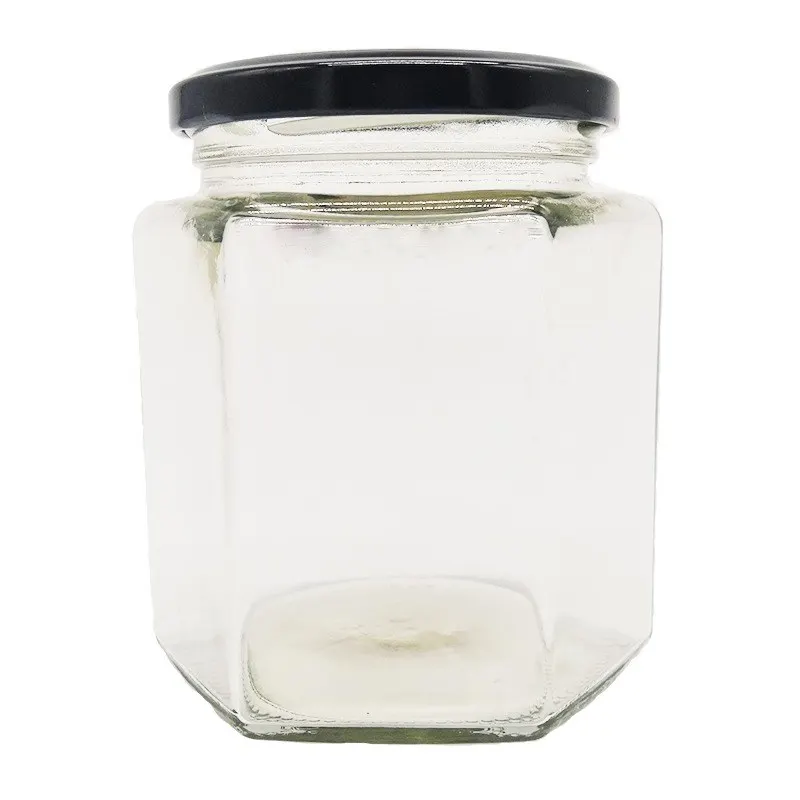
Choosing the tier by channel
The tiers are unevenly spaced because each grew out of a serving occasion. The smallest is a single serving, opened once and thrown away, and it is judged on how cleanly it opens and how cheaply it can be given out. The 4 oz jar is where a sample starts to become a product in its own right. The 8 oz jar is the standard household size in the United States and the usual choice for a first private-label run, and 12 oz takes the family and value position.
European ranges named by weight follow the same logic with three steps: a small household jar, the standard household jar, and a family or catering jar. Above 500 g, bulk packs for foodservice are more often plastic or metal, so glass ranges generally stop there.
Capacity, mouth and closure are three linked choices. Dropping from 8 oz to a 1.5 oz portion makes the same cap a larger share of the pack, squeezes the mandatory text off the label face, and shrinks the fill until a single gram alters the declared weight. Going from a 38 mm screw neck to a 63 mm wide mouth changes the nozzle, the capping head, the case count and the box cavity. Work out which of the three is still open and settle only that one.
Mouth diameter follows viscosity and crystallisation
Honey is among the most viscous foods packed in glass. Cold, it resists flow, traps air if pumped fast, and drains slowly from the nozzle, which is where stringing and dripping begin. Packers warm it until it flows freely without heat damage. A warm fill shrinks as it cools, so headspace has to be set for the cooled jar, not for what the operator sees at the filling head.
Crystallisation matters more to the person who buys the jar. Honey is a supersaturated sugar solution, and its glucose sets over time, quickest at kitchen-cupboard temperatures and under repeated temperature swings. Set honey is neither spoiled nor defective, but it is semi-solid and will not pour.
Wide mouth, 63 mm class and above
A wide opening lets the consumer reach set honey with a spoon or scraper. It also lets the packer use a larger nozzle and a shorter cycle, since on a thick product the opening, not the pump, restricts flow. And it makes the jar washable by hand, which is the basis for reuse.
Narrow neck, 38 or 43 mm class
A narrow neck pours a controlled stream, needs little glass, takes a simple screw cap, and suits a dipper or dispensing insert. The drawback should be written into the brief: once the honey sets, the consumer has to warm the jar to get anything out, and the pack should say so.
Dippers, spouts and the wipe lip
A dipper needs enough clearance to come out without smearing honey over the sealing land. On a narrow neck that usually means a drip-back insert, which is an extra part, an extra food-contact material to declare and something else to wash. A spout or gate insert directs the stream through a smaller opening but puts plastic into a pack that was otherwise one material. In either case the wipe lip around the opening does more for day-to-day use than the cap, because it keeps the rim clean.
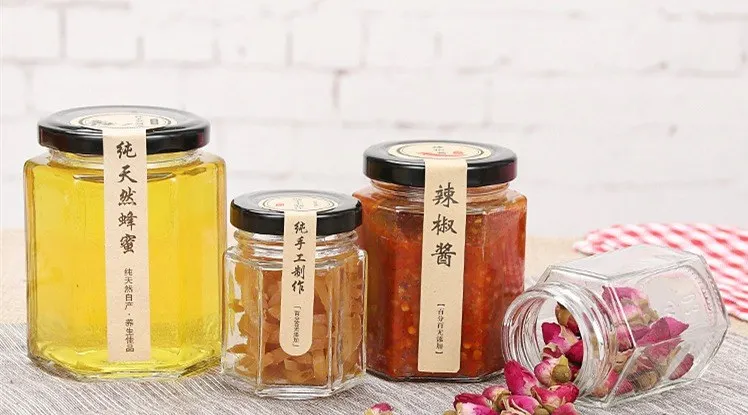
Closures and liners for a moisture-hungry product
Honey's water activity is too low for microbes to grow and it is naturally acidic, so the closure has no vacuum or pressure difference to hold. Its task is to stop humidity getting in. Honey is strongly hygroscopic: through a weak seal the surface layer absorbs water, its water activity rises, and osmophilic yeasts eventually take hold, which shows as fermentation and not as mould. The seal has to perform over twelve to twenty-four months, not just on filling day.
| Closure | Where it fits | Strengths | Watch for |
|---|---|---|---|
| Lug cap with button | Hex honey jars, mostly 63 mm class | Quickest to apply by hand or on a semi-automatic head; the button gives a seal check you can see and hear, useful when the failure is a slow moisture leak | Short interrupted threads are less forgiving than a continuous thread on torque |
| Twist-off, multi-lead continuous thread | Jars reopened many times | Accepts a broader capping torque range, resists backing off in transit, closes again on a sticky rim | The deep thread collects honey, so a wipe lip and rim cleaning before capping matter more |
| Plastic cap with flip-top or spout | Table use | Convenient dispensing | Adds a second material, changes recyclability, and is normally quoted apart from the glass |
A pierced or valved inner lid that lets a dipper drain back into the jar does cut mess on the rim and suits table service. It is still another food-contact component to list in a materials statement and another piece the consumer must clean before reusing the jar, so choose it on purpose.
The liner needs its own line in the specification. Honey sits at around pH 3.4 to 4.5 and holds moisture against the underside of the cap for the whole shelf life, so bare metal corrodes. The cap interior must be lacquered or carry a food-grade liner suited to an acidic, hygroscopic product, and that choice falls under food-contact rules such as EU 1935/2004. Verify the finished system with a capping torque check on the actual jar and liner, and a leak test that includes a transit or pressure-and-hold stage, not just a glance at the filling head.
Label rules that set the smallest size
The declared weight is the product of jar volume, fill line and density, so changing tier always changes the label. In practice the smallest jar in a range is often fixed by what the label must carry.
- United States. FDA 21 CFR 101 requires net quantity in both metric and US customary units, in a set position on the principal display panel, at a minimum type size that grows with panel area. Small-package provisions can drop or move parts of the nutrition declaration, but they come with conditions and thresholds.
- European Union. EU 1169/2011 requires honey's net quantity by weight, not volume, and sets a minimum x-height for mandatory text. Glass, liner and any insert come under EU 1935/2004.
- Origin. In the EU the country or countries of origin must appear on the pack, and a blend has to name them.
These references describe the rules, not any supplier's approvals. Certification belongs to a specific supplier, material and file, and the compliance route for a given product and market should be confirmed by whoever is responsible for it.
An origin statement fits easily on a 500 g jar. On a 1.5 oz portion it competes with net quantity, ingredient line, best-before date, lot code, responsible business and any nutrition panel. Packers deal with this in four ways: print on the lid top, which gives a larger disc than most buyers expect; add a neck wrap or folded booklet label, at the price of an extra handling step; move the text to an outer card, sleeve or gift box, which is how most small portions are sold; or go up a tier. Run the label-face calculation on the smallest jar in the range, not the flagship.
What moves the figure after a tier is chosen
- Selling unit. Fluid ounces in one market and grams in another means two artworks, two listings and one conversion rule driven by density.
- Moisture and floral source. Both change density, so monofloral honeys in identical glass can carry different gram statements.
- Fill temperature and filler type. Warm honey fills faster and more evenly but brings more heat into the headspace. A positive-displacement filler copes with viscosity better than gravity, with different cost and changeover.
- Glass colour and proportions. Clear, amber and coated glass hold the same volume but differ in shelf-life behaviour and visual weight.
- Case, pallet and freight. Glass plus honey is heavy, and a small change in jar height alters the case and the container load.
Sizing a gift set
A set looks deliberate when each jar is plainly a different product, and careless when two are close enough to pass for a picking error. The usual three-piece ladder is 1.5 oz, 4 oz and 8 oz, or 45 ml, 118 ml and 250 ml: the steps are obvious and total net weight stays sensible.
Keep all jars in one mouth class and one closure family so they run on a single capping head. Size the box cavity to the cap, which is nearly always the widest point of a filled jar; changing cap family after the box is tooled usually means a new box. Allow for freight, since honey is roughly 1.4 times the weight of water at equal volume and glass weight per gram of honey peaks at the smallest size. State every jar in the same unit on the pack, the listing and the size chart.
If the set includes very small portion units, fill accuracy and tare at that end are covered in our notes on portioning in mini mason jars. Where honey shares a box with a candle, that vessel is sized by wax mass and burn behaviour, as explained in the candle jar sourcing guide.
Reuse, recycling and light protection
Sustainability targets act on the mouth and closure more than on capacity. A reusable jar needs a mouth wide enough to wash by hand, a standard finish for which replacement caps exist, and no permanently fixed insert. That points to the 63 mm or 82 mm class with a lug or twist-off cap, and away from bonded drip-back inserts and narrow necks that trap honey in the shoulder. The same conditions make a jar returnable under deposit or refill schemes, and returnable ranges tend to settle on one or two capacities.
Recyclability depends on how many materials are in the pack. Glass with a metal cap and compatible liner is the simplest case. Spout inserts, silicone valves, shrink sleeves, induction foils and heavily bonded labels each need separating at home, and each addition makes that less likely.
Light and heat degrade honey, raising hydroxymethylfurfural and eroding freshness markers. Clear glass displays the product best and protects it least. Amber or shielded glass does the reverse, and a full-body label or sleeve on clear glass is the common middle route. Record the choice alongside the size, since switching to amber later changes how heavy the jar looks on shelf and may change case weight.
How honey jars differ from jam, sauce and mason jars
Size charts for neighbouring products share vocabulary with honey but not physics. Jam is filled hot into a wide-mouth jar, and its closure has to pull and hold a vacuum created by headspace as the product cools. Honey shares only the wide mouth: it is filled warm, protected by low water activity, denser and less variable, and at risk from moisture ingress. Reading a preserve chart across gives the right jar with the wrong closure reasoning.
Sauces pour at room temperature, are frequently hot filled, and are defined by acidity or salt, so they go into narrower necks shaped for pouring. Mason jars belong to a canning system built on two-piece lids and canning dimensions for home processing. Honey can be sold in a mason-shaped vessel, but those dimensions are not what a honey filling line needs.
For shapes, wall thickness and the wider format range, see our glass jar collection. Once the capacity tier is fixed, the honey jar format guide covers the vessel itself.
What to send with a sizing enquiry
We can answer a capacity question precisely when six points are fixed:
- Honey type and typical moisture content, which set planning density.
- Channel and serving occasion for each unit in the range.
- Fill method and temperature, since warm and cool fills leave different headspace and need different equipment.
- The serving implement the pack must accept, or a mouth preference.
- Closure family and finish, or the cap you already have tooling for, with its lid diameter.
- Destination market, which decides the unit convention, mandatory statement and origin declaration.
From that we set out a recommended capacity band with reference net fill, a mouth class and fill route, a closure and finish direction, the liner requirement, a check that the smallest label face can carry the mandatory text at the market's minimum type size, and a list of what a fill trial still has to measure. When the closure is already fixed we start from the finish and work back to capacity. When the honey is still being blended we start from density and treat capacity as provisional.
Commercial terms are not part of the sizing answer. They are quoted per project against a specific drawing and run, and depend on tooling, decoration and quantity.
Frequently asked questions
Which size suits a hotel, airline or tasting portion?
The 1.5 oz jar. It is chosen for clean opening and low give-away cost more than for the amount of honey inside, and many operators use a film lid or sachet in place of a cap.
Why does a 4 oz jar carry a heavier net weight than its name?
The name is a volume and the label states a mass. Density links them, and it changes with moisture and floral source, so confirm the declared weight by weighing a measured fill of your own honey in the jar you will use.
Does honey need a vacuum seal like jam?
No. Jam relies on the vacuum formed during cooling to hold the lid down and show the seal is intact. Honey needs a moisture and leak barrier instead.
Which cap stops honey running down the outside?
None by itself, because drips begin at the rim. A wipe lip on the glass and a clean rim before capping do more than the cap family; a pierced inner lid helps where a dipper is used.
Can crystallised honey go in a narrow-neck jar?
It can be filled that way, but the consumer will not be able to spoon it out. Choose a narrow neck only when pour control or lower glass weight outweighs that, and tell buyers to warm the jar.