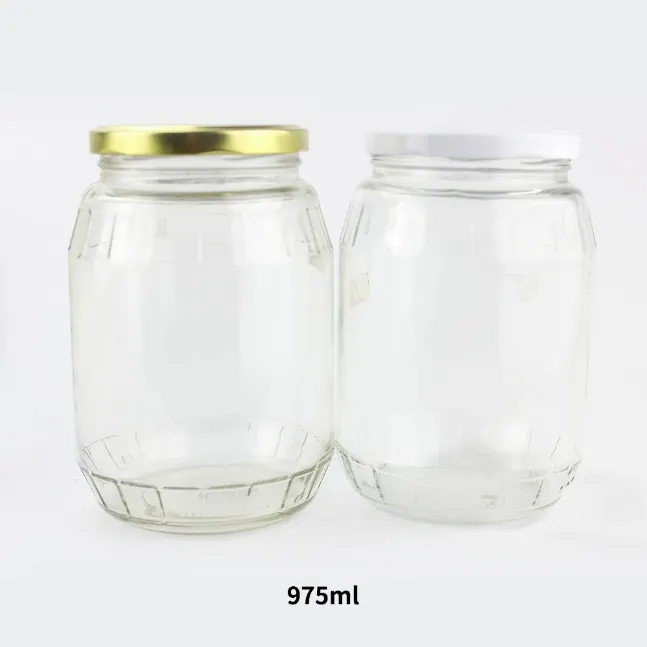
Part of our wide mouth jars wholesale range; the stock moulds are pictured at the end of this guide.
For peanut butter and other nut butters, specify a straight-sided glass jar with a wide continuous-thread (CT) finish: 82 mm is the mainstream choice, 70 mm the minimum for smooth butters. Pair it with an induction foil seal and an oil-resistant reclose liner, because nut oil will work through a weak closure over a 12–18 month shelf life. Most ranges are built on 12 oz and 16 oz jars that share a finish, with 8 oz and 26 oz added later.
Mouth width and jar shape
Peanut butter leaves the filler at 30–45 °C as a soft paste. Through a finish narrower than 63 mm it leaves voids and air pockets and smears the threads, and product on the threads means a contaminated seal. The finish is chosen by product style and line speed:
| Finish | Use it for |
|---|---|
| 70 mm CT | Smooth butters on slower lines, up to about 150 jars per minute |
| 82 mm CT | Most nut butters, including chunky. It takes large piston nozzles, wipes clean, and lets a spoon reach the bottom corners |
| 89–100 mm | Club sizes and natural-style butters that separate and need stirring; a wider mouth means less mess when the jar is first opened |
Choose straight sides over a shouldered jar. A piston nozzle can enter without striking a shoulder, and the consumer can scrape the wall clean, which natural brands often mention on the label. The common starting formats are the 8 oz straight-sided jar and the 16 oz size.
Glass tolerances for piston filling
Nut butter is hard on packaging. Ground nut particles are mildly abrasive, 15–25% of the product is oil, and at about 1.2 g/ml it is dense. Chunky grades carry particles up to 3–4 mm and run on piston fillers with cut-off valves. In each cycle the jar takes a nozzle diving in and rising, a bottom-up fill, and a knock as it transfers to the capper infeed. Four figures on the drawing cover those loads:
- Mouth inner diameter ±0.4 mm, so the nozzle clears the finish at speed.
- Heel radius ≥6 mm with a base push-up, to survive dead-plate transfers at 200+ jars per minute.
- Wall thickness 2.6–3.2 mm on 12–16 oz jars. Thinner walls have too little thermal mass and can check during fill-and-cool cycles.
- Finish flatness 0.15 mm, because a foil seal bonds only as well as the land beneath it.
Warm filling followed by cooling pulls a modest vacuum and puts a thermal differential of 35–45 °C on the glass. The jars we specify for this category are annealed and tested to a ΔT of 42 °C under ASTM C149, with polarimeter records kept per shift. We ask the same of jam jars, which are also filled warm.
Closures that keep nut oil in
Treat the jar, cap and liner as one system and validate them together, with a documented torque window. A co-packer then runs a single recipe instead of troubleshooting parts from three suppliers. The system has three layers.
Induction foil seal
The foil membrane is the main barrier. Bonded properly, it stops oil migration until the jar is opened and provides the tamper evidence retailers increasingly ask for. It needs an induction-compatible cap, a clean flat land, and a membrane with an oil-resistant adhesive layer rated for oily products.
Reclose liner
Once the foil is peeled off, the liner inside the cap does the sealing. Use a pulp-backed or PE foam liner with a PVDC-coated or PET facing, which resists staining and compression set. Plain pulpboard wicks oil and stains within weeks; it is the complaint we hear most from brands that have changed co-packer.
Cap torque
An 82 mm cap is typically applied at 12–20 in-lb. Induction sealing then has its own settings for dwell time and power, which have to be established on the line.
Sizes to plan a range around
| Capacity | Role in the range |
|---|---|
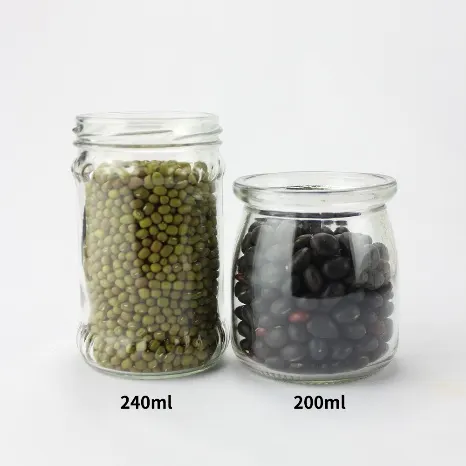
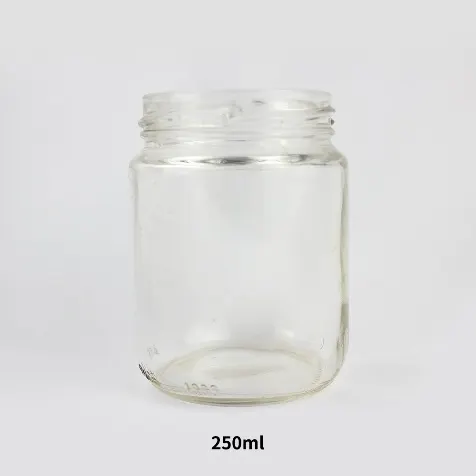
| 8 oz (≈250 ml) | Trial packs, organic lines, almond and cashew butters |
| 12 oz (≈350 ml) | The natural-brand standard; a lower shelf price than 16 oz without looking small |
| 16 oz (≈500 ml) | The volume size every range needs |
| 26–28 oz (≈780 ml) | Family and club packs, growing in private label |
A workable private-label launch is 12 oz and 16 oz on a shared 82 mm finish, followed by 8 oz for a higher-priced extension and 26 oz for club channels. A common finish across three sizes means a single cap specification, a single induction recipe and a single set of change parts. Our food-grade jar range and honey jars follow the same logic, and their 12 and 16 oz wide-mouth jars also suit spreads.
Check body diameter as well as finish. If the diameter varies by 12 mm across the range, the capper's chuck or belt spacing still needs change parts. It costs far less to find that out at the RFQ stage, before tooling, than during commissioning.
Label panel and cap decoration
A true cylinder accepts wrap-around paper or BOPP labels at line speed without the flagging that shouldered jars cause. A 16 oz jar typically offers 70–80 mm of straight wall, enough for a front-and-back or full-wrap design. State the label panel diameter with a tolerance; ±0.5 mm keeps a high-speed wrap labeler centered.
Decide early whether the cap will be printed. The top of an 82 mm cap is inexpensive branding space that many private-label programs leave blank.
Freight, documents and recycled content
Filled glass is heavy: a 16 oz jar with product weighs over 900 g, so freight is a large part of landed cost. Bulk-palletized 16 oz straight-sided jars load at roughly 1,600–1,900 per pallet and about 38,000–42,000 per 40HQ container.
Expect a Certificate of Analysis with each lot covering annealing, thermal shock and dimensions at AQL 1.0, along with migration testing to EU 10/2011 and FDA 21 CFR and support for BRCGS/SQF audits. Our quality inspection page explains how these checks are run, and the RFQ checklist lists what to send for a quote.
Glass supports two honest sustainability claims: it can be recycled indefinitely, and it contains cullet (recycled glass). Flint food jars run 30–50% post-consumer cullet depending on the furnace campaign. If your label carries a recycled-content claim, ask for the percentage per lot instead of relying on a brochure figure.
Lightweighting below the 2.6 mm wall guideline is possible but seldom worth doing, since buyers of a higher-priced nut butter expect some heft in the jar. Brands that supply in-store nut-butter grinders at natural-food chains order the same 82 mm jars in 26 oz and 1 kg formats with minimal decoration, because there the jar is for carrying home and storage.
FAQ
Why do nut butter brands choose glass over plastic?
Plastic leads the mass market on cost. Glass is used by organic and natural-positioned brands because it signals purity, runs cleanly through induction sealing and does not scalp roasted-nut flavor.
Can the jars handle warm filling?
Yes. Thermal-shock testing to a 42 °C differential covers standard fills at 30–45 °C and the vacuum that forms on cooling.
What is the minimum order for wholesale nut butter jars?
Minimums are quoted per project. They depend on the mold and the production line it runs on, as well as on decoration and quantity.