One of our guides on candle jars in bulk; start there for the overview.
A standard 7-day prayer candle jar is a tall soda-lime glass cylinder about 60 to 66mm across and 200 to 205mm high, holding 440 to 500ml brimful, which works out to a wax fill of roughly 12 to 14 oz. For wholesale buyers the points that matter are a 2.8 to 3.2mm body wall, a 5 to 7mm base and proper annealing, because the candle burns unattended for up to 168 hours. Decoration is the third decision: fired ceramic print or decal is what keeps a saint's image intact through the whole burn.
Reference sizes and tolerances
The devotional format is usually described as the D6 x H20cm family, or the 8-inch class. Jars are machine made in flint (clear) soda-lime glass by press-and-blow or blow-and-blow, with the wall spread evenly from base to shoulder. These are the reference sizes we source most often.
| Model | Capacity (ml) | Capacity (oz) | Diameter (mm) | Height (mm) | Glass weight (g) | Carton qty (pcs) |
|---|---|---|---|---|---|---|
| PC-380 | 380 | 12.8 | 58 | 190 | 300 | 48 |
| PC-440 | 440 | 14.9 | 60 | 200 | 320 | 48 |
| PC-470 | 470 | 15.9 | 63 | 203 | 340 | 48 |
| PC-500 | 500 | 16.9 | 66 | 205 | 360 | 36 |
Capacities in the table are brimful. In the PC-440 and PC-470, a working fill of 12 to 14 oz of paraffin or a paraffin-soy blend leaves enough headspace to hold the flame clear of the rim late in the burn. Diameter is controlled to +/- 0.8mm so the jars feed through automatic fillers and shrink-sleeve applicators without jamming. A custom height anywhere from 180mm to 210mm needs its own tooling.
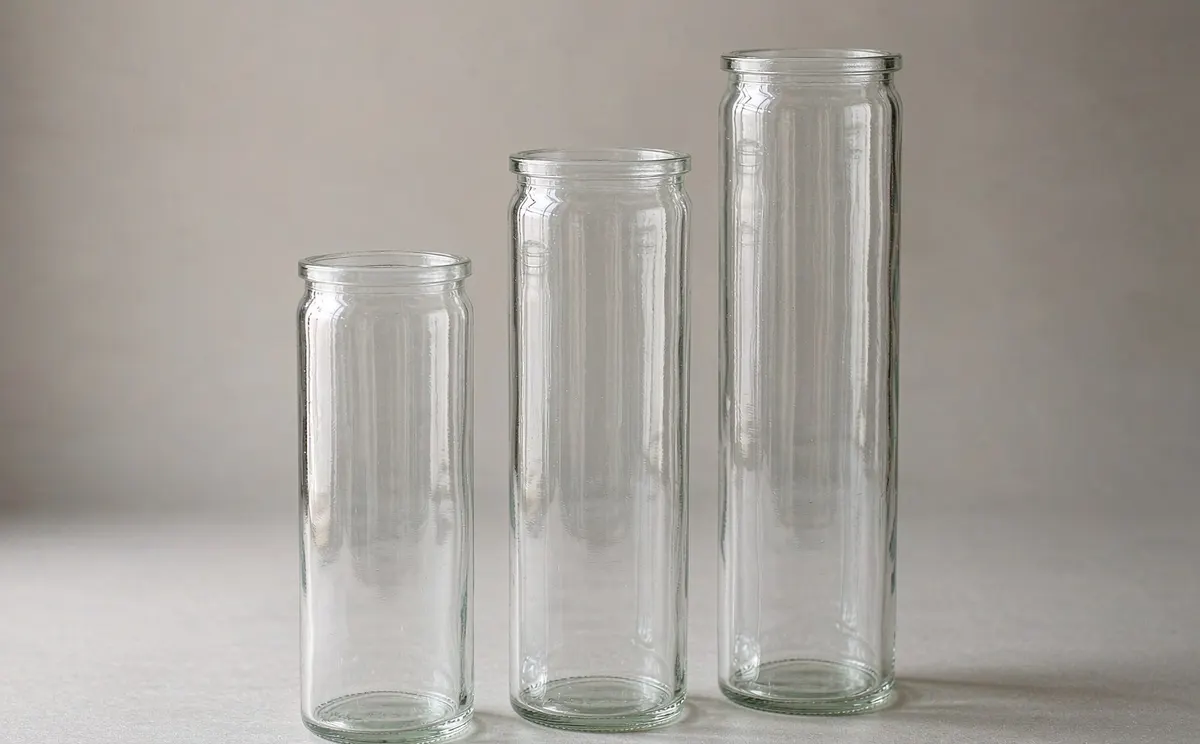
Why the jar is tall and narrow
Compared with the tumblers in a general candle jar range, a devotional jar gives up diameter to gain height. Three practical reasons sit behind that shape.
- A steadier flame. About 200mm of glass above the wax pool acts as a chimney, drawing hot air straight up. The flame stands upright, the pool melts evenly, and tunneling, where only the centre of the wax melts, becomes much less likely. In a short, wide jar a draft from an open church door or air conditioning can push the flame onto the wall and overheat one spot.
- Rack fit. Altar racks in churches and grottos have fixed slots, usually on 70 to 75mm centers. A jar of 60-66mm puts the most wax, 440-500ml, into that footprint; a squat jar of equal volume would not go in.
- Room for imagery. The straight wall offers around 180mm of printable height, enough for a full-length saint, a prayer set in two columns, or an English-Spanish novena layout. Shoppers in religious retail recognise this format at once, and devotional candles sold in short jars tend to do poorly there.
Glass requirements for a week of continuous burning
A prayer candle is lit and left for five to seven days, often among dozens of others, with nobody trimming the wick. The container is under heat stress for 120 to 168 hours, so three properties need to be written into the order.
Wall and base thickness
The PC series is specified at a nominal 2.8 to 3.2mm in the body and 5 to 7mm in the base, checked by ultrasonic gauging on production samples. The heavy base lowers the centre of gravity, so a nearly empty jar is hard to knock over on a rack. It also adds thermal mass for the final hours, when the flame is closest to the bottom.
Thermal shock and annealing
Candle glass should withstand a temperature differential of at least 42°C without breaking, a benchmark in line with the ASTM C149 test method for glass containers. Annealing has to bring residual stress low enough to prevent delayed cracking. That is the failure in which a jar gets through filling and the first three days, then splits on day five as the wax level falls and heat concentrates on bare glass. Annealing quality cannot be seen, so ask for the annealing report with the pre-shipment inspection papers.
Clarity under heat
Glass made from a poor batch recipe can turn cloudy after long exposure to flame heat, and a sharp printed image looks milky by day four. The cause is alkali migrating out of under-formulated glass. It is not soot and will not wipe off. A stabilized soda-lime composition stays clear to the end of the burn.
Full-burn testing
We recommend a full-burn test before a first order and can arrange one. Jars are filled with your wax and wick, burned without interruption for 180 hours, and then examined for wall temperature profile, base stress and image condition. Send the melt point of your wax blend and the wick size early, so a mismatch shows up before you commit to a container.
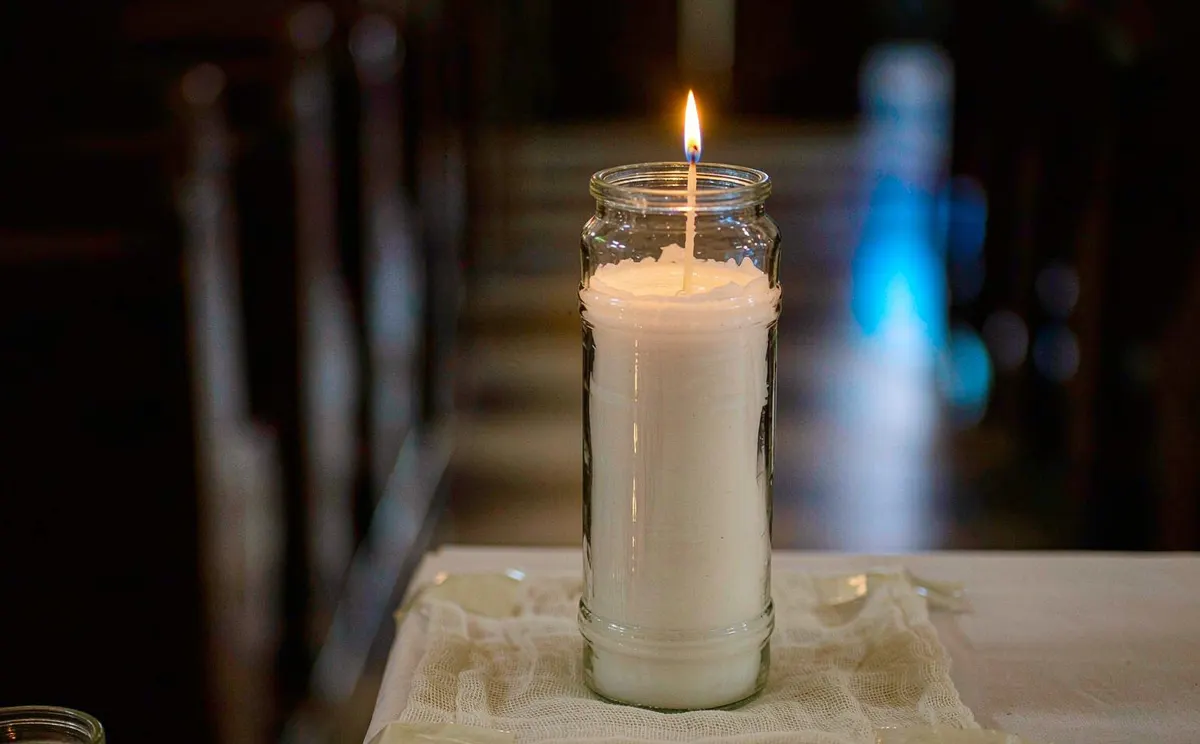
Decoration methods for religious imagery
Imagery sells this product: Our Lady of Guadalupe, the Sacred Heart, Saint Jude, Saint Michael, crosses, doves and prayer texts. The method chosen sets the print cost and decides how the picture looks after seven days of heat.
| Method | How it is made | Best for | Limits |
|---|---|---|---|
| Silk screen, fired ceramic ink | Printed straight onto the glass and fired at approximately 600°C, which fuses the pigment into the surface | Line art and text in one to four colors; full-wrap layouts with registration of +/- 0.5mm | Spot colors cannot reproduce gradients or skin tones |
| High-temperature decal | Ceramic pigments screen-printed as a transfer, applied by hand or machine, fired at 560 to 620°C | CMYK portraits of saints, memorial candles carrying a photograph | Higher unit cost than direct print |
| Frosting | Acid etching or machine frosting; can be masked to leave a clear printed window | White memorial candles, cathedral-style lines | Diffuses the glow, so images need a clear window |
| Color coating | Sprayed ruby red, cobalt blue or amber | Sanctuary lamp styles | Organic coatings near the flame can discolor under sustained heat; choose fired ceramic colors for a 7-day burn |
Fired silk screen is our usual recommendation. It resists scratching and dishwashing, and candle heat does not change it, so the image at the end of the burn matches the image at lighting. The ceramic inks are free of lead and cadmium, which supports California Proposition 65 expectations and the heavy-metal limits in EU and North American packaging rules.
Image rights for licensed religious artwork in the destination market rest with the buyer. Where it helps, we can point to public-domain sources of iconography.
What each buying channel tends to specify
- Church supply distributors stock altar candles, sanctuary lamps and votives for parishes and cathedrals. They want dimensional consistency because racks are standardized, plain or white glass, and dependable carton counts. Many buy empty glass and have it filled locally.
- Religious candle brands sell private-label novena and saint candles through bookstores, gift shops and online. Print quality and packaging that survives parcel delivery come first. Running eight to fifteen designs on one common jar is normal.
- Memorial and vigil candle makers produce cemetery, yahrzeit and roadside candles that often burn outdoors or in mausoleums. Heavy bases and restrained decoration such as frosting, a simple cross or dates suit them, and 190mm jars and 3-day formats sit beside the classic size.
- Hispanic market and botanica distributors form the largest devotional channel in North America by volume. They buy saint candles by the case with Spanish prayer text and traditional imagery such as Guadalupe and San Judas Tadeo, in bright multi-color decals. Importers commonly load 10 to 20 SKUs into one 40HQ, and some add altar accessories from our wholesale candle holder range.
- E-commerce sellers and wholesale clubs order around All Saints' Day, Dia de los Muertos and Christmas. First runs are small, often one or two pallets per SKU. They ask for Amazon-compliant carton labels and drop-test documents, and frequently begin with a plain clear jar labelled in-house before moving to printed glass and, if volume supports the tooling, a mould height of their own.
Export packing for tall printed glass
Tall jars chip at the rim and scuff in transit if packed loosely, and a scuff across a printed face makes the unit a reject. The packing specification we work to is as follows.
- Jars stand rim-up in 5-ply double-wall corrugated cartons of 36 or 48 pieces, according to model.
- A corrugated divider separates every jar, so glass never touches glass, and cells are cut to the jar diameter to keep sideways movement under 2mm.
- Printed jars get a tissue or PE foam interleaf in each cell. Fired ceramic ink is hard, but on a long, humid sea voyage it can still micro-abrade against neighbouring print.
- Cartons are column-stacked on fumigation-free export pallets of plywood or heat-treated wood, with corner boards and stretch wrap; strapping is optional.
- Each new carton configuration is drop tested to an ISTA 1A equivalent, and desiccant packs go into shipments bound for tropical ports.
A 40HQ takes approximately 58,000 to 62,000 pieces of the PC-470. The spread comes from decoration, since printed jars travel in slightly larger cartons. For mixed loads we draw up the pallet plan beforehand and label cartons by SKU for the receiving warehouse. Importers who also carry personal-care lines sometimes top up a container from our cosmetic glass bottle collection.
Order terms and compliance documents
Minimum quantity, production time and sampling are quoted for each project. They turn on whether an existing mould is used, the decoration method and number of colors, the order size and the freight terms.
The document set can include material declarations confirming lead- and cadmium-free glass and inks, migration test reports where a market requires them, and annealing quality reports. We also coordinate third-party pre-shipment inspection by SGS, BV or an agency the buyer names, at the buyer's cost.
Frequently asked questions
Can a glass prayer candle really be left burning for seven days?
It can when three conditions hold together: the wall and base thicknesses given above, annealing that removes residual stress, and a wax and wick pairing that never lets the flame touch the glass. A 180-hour test burn with your production wax confirms all three.
Should I choose decal or silk screen for a saint image?
Use a fired ceramic decal for a full-color photographic portrait and direct silk screen for line art or text in a few colors, which is the more economical route. Neither fades or peels during the burn.
Can several saint designs ship in one container?
Yes, this is routine for botanica and religious retail importers. Every design still has to reach its own decoration minimum, and cartons and pallets are planned per SKU so the warehouse can sort them.
When should I order for the Q4 season?
Production time is quoted per project once mould, decoration and schedule are known, so raise the enquiry well ahead of the autumn peak.