Part of our spirits bottles wholesale range; the stock moulds are pictured at the end of this guide.
A square spirits bottle is a harder piece of glass to make than a round one, and the drawing has to allow for that. Corners need a radius of 1 to 3 millimeters instead of a true right angle, walls usually run 2.5 to 4.0 millimeters, and the bottle needs longer in the annealing lehr. Get those three points right and you gain flat panels that carry labels, print and embossing without distortion, plus cartons that pack with no wasted space.
What the square shape gives a spirits brand
Most whiskey, vodka, gin and tequila on a store shelf sits in cylinders. A square body interrupts that row, and its straight lines read as precise and modern, which is why the format is common among higher-priced labels.
The practical gain is the flat panel. A curved wall bends printed graphics toward the edges; a flat face shows them as drawn. The same face gives room for embossing and other decoration.
Square bodies also sit tight against each other in a case, so cartons and pallets carry less empty space than they do with round bottles. That lowers freight per bottle and the emissions that go with it.
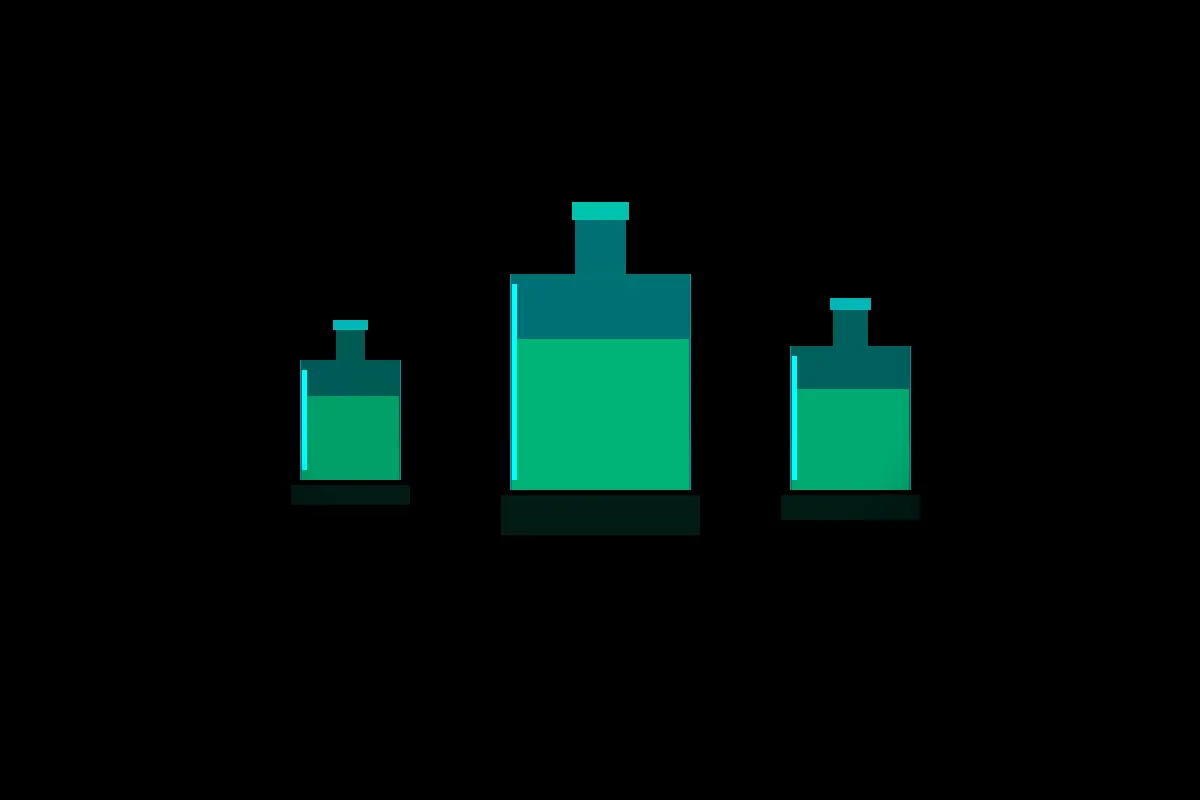
Dimensions to settle on the drawing
Four parts of the bottle decide whether a square design can be produced cleanly. We check each of them on the drawing before a project goes to a plant.
| Feature | Typical range | Why it matters |
|---|---|---|
| Corner radius | 1 to 3 millimeters | A true 90-degree corner concentrates stress and will not fill or release from the mould. A small radius still looks crisp. |
| Wall thickness | 2.5 to 4.0 millimeters | Flat panels are weaker than curved walls, so they need somewhat more glass than a round bottle of the same capacity. |
| Base weight | 15 to 30 percent of total bottle weight | A weighted or stepped base adds stability and visual mass; buyers read a heavy base as a sign of quality. |
| Bottle weight, 750ml whiskey | 450 to 700 grams | Weight is one of the main inputs to the unit cost. |
| Bottle weight, 500ml vodka | 300 to 450 grams | As above. |
Corners
The aim is an edge that looks sharp while it is in fact slightly rounded. The radius lets molten glass flow into the corner of the mould and come out without tearing, and it removes the stress point that would otherwise crack in handling. Corner definition is among the first things an experienced buyer looks at on a sample.
Walls and lightweighting
Thickness is not even around a square body. The thinnest glass sits in the middle of each panel, with more at the corners and in the base where reinforcement is needed.
Some designs use a reinforced base so that the panels can be thinner without weakening the bottle. Done well, this can bring the weight down by 20 to 30 percent against a conventional square bottle while it still feels solid in the hand.
Base and neck
Beyond weight, the base can carry a recessed pattern or an embossed logo that only shows when the bottle is held to the light. At the other end, the closure is round and the body is not, so the neck has to manage the change. Extended necks and collar rings are the usual way to bridge a square shoulder to a screw cap, a cork or a dropper top, and the closure should be sized so it looks in proportion to the body.
Glass colour
Clear flint is the most common choice for square bottles, especially for vodka and gin, where the brand wants the liquid's clarity on show. Amber suits spirits that benefit from protection against UV light. Deep greens, blues and custom tints are used when colour itself is the shelf signal. For standard capacities by spirit, see our notes on whiskey bottle sizes and vodka bottle sizes.
Decoration on flat panels
Flat faces accept more kinds of decoration than a curve does, and they accept them more cleanly.
- Silk-screen printing puts logos, patterns and fine artwork straight onto the glass.
- Frosting and sandblasting create a contrast in touch and appearance between treated and untreated areas.
- Embossing raises a logo, a founding year or a pattern on one or more faces. Because a flat panel makes good contact with the mould, the raised detail comes out sharper than on a curved wall. Deep-relief embossing goes further and throws visible shadows under bar or shelf lighting.
How square bottles are formed, and where defects come from
Not every glass plant runs square shapes well, because each production stage is less forgiving than it is for a cylinder.
Mould. The mould is machined in halves on computer-controlled milling equipment. For a square bottle the faces of those halves must line up exactly; if they do not, wall thickness differs from one side to the next and the fault is visible on the finished bottle.
Forming. A heated gob of glass, typically between 300 and 800 grams depending on bottle size, drops into the mould. Square bottles are commonly made by press-and-blow: a metal plunger presses the gob into a preform, then compressed air blows it to final shape. Working in two stages gives better control over where the glass ends up, which matters more here than on a round body.
Annealing. The bottle then passes through the lehr, the oven that cools it slowly to release internal stress. Thick corners and bases cool at a different rate from thin panels, so a square bottle needs longer in the lehr than a round one of similar size. Under-annealed bottles can crack without warning or break on the filling line. Good plants log the lehr temperature profile in real time.
Two newer tools help smaller brands. Designing the bottle in 3D lets a distillery see the shape before any mould is cut, and machine-vision inspection on the line catches very small defects as bottles pass.
Choosing a plant and running the project
Start by confirming that the plant has actually made square or geometric bottles. Ask for photos of earlier projects and, where possible, physical samples, and judge three things on them: corner definition, wall uniformity and surface finish. Our supplier comparison guide and the overview of glass bottle manufacturers cover the wider selection criteria, and the page on quality certificates explains which documents to ask for.
State your expected volume at the outset. A square bottle normally needs its own mould set, and for smaller runs many suppliers will suggest an existing stock mould with custom labelling instead of a new private mould.
Expect two or three rounds of sample revision before approval. A sound project plan names the milestones in order: mould fabrication, first article samples, a pilot run, then full production. Our guide to planning a glass bottle schedule explains how those stages fit together.
What drives the cost
Pricing is quoted per project. The main drivers are:
- Mould complexity. Several embossed elements, textured surfaces or unusual proportions mean a more elaborate mould and a longer cycle time.
- Bottle weight. Glass is priced largely by weight, so the ranges in the table above matter.
- Order quantity. Larger runs spread set-up cost over more bottles.
- Decoration and closures. Frosting, silk-screen printing and special closures each add a step.
When you compare quotes, make sure they describe the same bottle. A lower figure may reflect thinner walls, looser corner geometry or lower-grade raw materials, so ask for the full technical specification with every offer. The separate guide to what shapes glass bottle pricing goes through each factor.
Lighter weight and recycled content
Sustainability work on square bottles follows three lines: lightweighting, a higher share of recycled cullet (crushed waste glass returned to the melt) and more energy-efficient furnaces. Many suppliers now offer square options built on these without giving up the look a spirits brand wants.