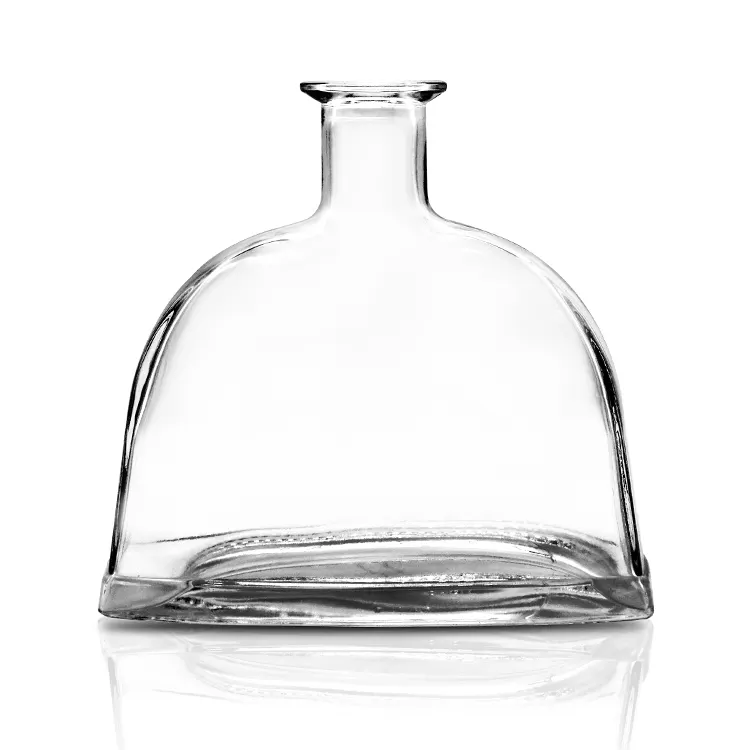
Filed under rum and spirits bottles; the moulds we quote for this are pictured at the foot of the page.
A calabash neck rum bottle is always a custom-mould project: the gourd-shaped bulge at the neck or shoulder has to be designed into a bespoke mould, then proven on first samples before a production run. It forms on ordinary IS (individual section) machines, so the risk is not the equipment but glass distribution through the bulge. Budget your attention for three things: wall thickness at the widest point, the capacity you choose, and whether the shape runs on your filling line.
What the calabash shape is and why rum brands choose it
The name comes from the dried calabash gourd that Caribbean communities used for centuries to carry liquids. In glass it becomes a rounded swelling in the neck or shoulder, above an otherwise conventional body.
Brands pick it for three reasons. It signals heritage and craft before anyone reads the label, which suits aged expressions. It breaks up a shelf dominated by straight cylinders. And it works in the hand and on a back bar: the bulb gives a natural pouring grip, and lit from behind the curve throws a highlight that a flat shoulder does not.
If a standard shape will do the job, our guide to rum bottle sizes covers the stock 75cl and litre formats and the market rules behind them.
Capacity, weight and finish to specify
The profile scales comfortably across 500ml, 700ml, 75cl/750ml and 1L. Under 375ml the bulge becomes cramped and glass distribution gets worse; over 1L the swelling starts to interfere with grip and case packing. Most projects settle on 700ml for the EU or 75cl/750ml for the Americas and travel retail.
| Route | Capacity | Glass weight | Neck finish |
|---|---|---|---|
| Stock heritage round with a near-calabash shoulder | 700ml / 75cl | 520-600g | Cork or bar-top |
| Custom calabash neck, standard glass | 700ml / 750ml | 550-650g | Set by the design |
| Custom calabash neck, super-flint | 700ml / 750ml | 650-800g | Bar-top |
| Calabash with embossing, frosting or spray | Set by the design | Set by the design | Set by the design |
The neck finish (the top section that takes the closure) stays a standard cork mouth, bar-top or screw type, so the unusual silhouette does not restrict your choice of stopper or cap.
Where the forming risk sits
Nothing about the bulge is machined. It is blown or pressed into shape inside the mould, by the same blow-and-blow or press-and-blow process used for any container. Molten glass, though, takes the easiest path. A swelling tends to stretch thin at its maximum diameter and pile up heavy where the shoulder turns.
Thin spots matter twice. They are the places that fail vertical-load and impact testing, and they show as visible waves in the finished glass.
Two controls deal with this:
- Parison design. The parison is the pre-shape made in the blank mould. It is profiled so that additional glass already sits where the final blow will stretch the bulge, and so the gob drops into the mould cleanly.
- Thickness verification. First articles are mapped with an ultrasonic gauge at 24 points around the bulge. A minimum wall is written into the specification, typically 2.2-2.8mm on a 700ml rum bottle, and the mould is not released for production until samples meet it.
These are mould-design questions rather than limits of the machine, and they apply equally at 700ml and at 75cl/750ml.
How a custom project runs
Development is gated: each stage is signed off before the next begins.
- Brief and references. You send sketches, competitor bottles and the brand story; we turn them into design constraints.
- 3D design. A CAD model fixes brimful and nominal capacity, the weight target and the finish. You get renderings and dimension drawings.
- Engineering review. Forming simulation and predicted wall thickness are checked, along with pallet and case fit.
- Sampling. Physical first articles arrive with ultrasonic thickness reports, for your line trial, closure fit and photography.
Buyers on a first bespoke bottle can use our spirit bottle range and supplier criteria to judge a plant, and the wholesale glass bottle pages for the wider buying process. When the brief is ready, send it through the quote form with your target capacity and annual volume.
Decoration that suits the shape
The silhouette carries the message, so decoration works best when it is restrained. Four treatments suit it:
- super-flint glass with a deep punt and a plain bar-top;
- amber or smoke glass for the warmth of an aged rum;
- a brand mark embossed into the bulge, which is formed in the mould together with the bottle;
- matte frosting for a craft edition.
Screen printing and hot-stamping follow the usual route described on our frosted and coloured bottle page.
Checking the bottle against your filling line
Filler grippers, star wheels and case partitions are built around cylinders. A bulged neck can sit differently in each of them, so the fit has to be checked before production rather than discovered on the line. We send dimension drawings early and line-trial samples ahead of the run, which lets your co-packer confirm handling before the shipment leaves.
Frequently asked questions
Can a calabash neck be made on standard glass machines?
Yes, provided the moulds are engineered for it. The work lies in even glass distribution through the bulge and a parison that loads cleanly, not in special machinery.
What is the minimum order for a custom calabash bottle?
Minimums are quoted per project. They depend on the mould and on the production line the bottle is assigned to.
How long does development take?
Timing is confirmed project by project once the mould, the decoration and the line schedule are settled.
Does the neck shape change the closure?
No. The finish remains standard, so closures are unaffected. Only handling changes, which is why the line-fit check matters.