One of our guides on glass honey jars; start there for the overview.
A custom honey jar is defined by four choices: the shape of the glass, whether the logo is embossed into it, the closure, and the label or print that goes on top. Embossing is usually the most valuable of the four, because a design raised 0.5 mm to 1.2 mm out of the glass outlasts any label. Size the jar by honey weight, not volume: honey has a specific gravity of 1.4, so a 12 oz jar needs only about 250 ml of capacity.
Choosing the jar shape and size
Custom honey packaging mostly draws on a few shape families, and each one places the brand differently on the shelf.
- Queenline. A round jar with a gentle taper, a wide base and a shoulder that is either ribbed or smooth. It is the volume standard.
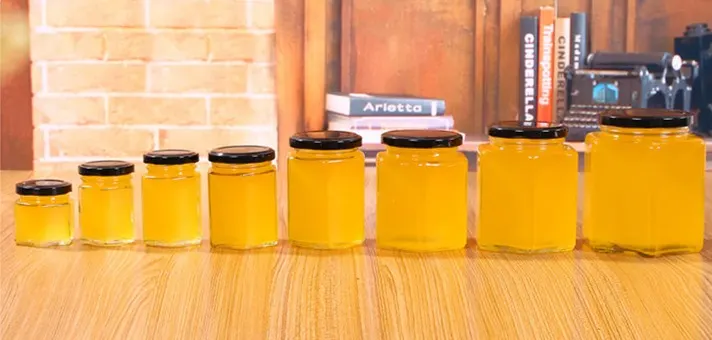
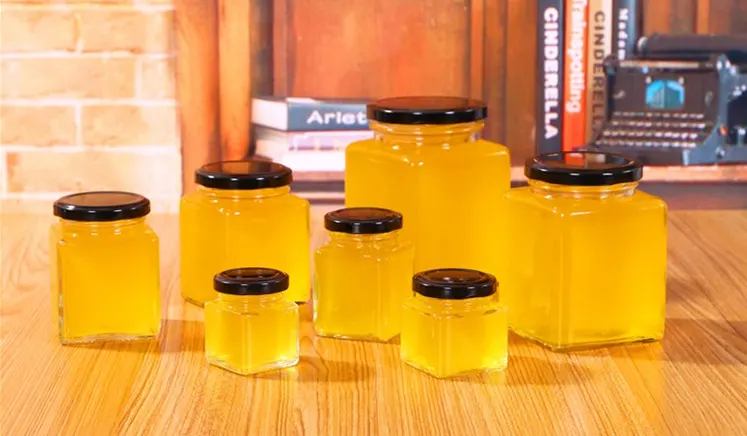
- Hexagonal. A faceted body that echoes honeycomb, typically closed with a lug lid.
- Hive and skep styles. Round moulds shaped like a beehive, aimed at gift buyers and the upper end of farmers-market trade.
- Proprietary profile. A mould cut for one brand, which no competitor can order.
The usual capacities are 8 oz (227 g), 12 oz (340 g), 16 oz (454 g) and 24 oz (680 g) of honey. Hexagonal ranges can run from 4 oz to 24 oz.
A proprietary mould goes through three stages: a 3D print to judge how the jar feels in the hand, a single-cavity sample mould for filling trials, and then the full production mould set. Our page on developing custom glass jars covers those steps in detail.
Two points get particular attention when we check a honey jar drawing. The punt, the indent in the base, should be shallow and wide so the jar stands steady on an uneven market table. The glass at the heel must not run thin, since that is where most breakage complaints begin.
If you only need standard jars by the pallet, the stock honey jar range is the better starting point. Many brands also sample a stock 120 ml wide-mouth honey jar before they commit to a mould of their own.
Embossing the logo into the glass
A label can soak off in a market cooler or smear under sticky hands. An embossed logo, brand name or bee motif cannot, because it is cut into the mould cavity and comes out as part of the jar. The work is done once in the tooling; nothing is applied jar by jar afterward.
Where the design can go
- Shoulder ring: stays visible when jars are stacked on a shelf.
- Heel band: quieter, noticed when the jar is picked up.
- Base: a maker's mark for people who look closely.
Debossing sinks the design into the surface instead of raising it. It suits small text such as a founding year or a net-weight statement.
Artwork limits
Keep line strokes wider than 0.8 mm. Fine serifs under 1 mm tend to fill in and lose their edge. Text on the shoulder bends with the shoulder radius, so supply vector artwork early; a proof of the design on the mould surface comes back for approval before any steel is cut. The embossed glass jar program shows related techniques.
Lids, dippers and other closures
Closures divide into those built for retail filling lines and those built for gifting.
| Closure | Typical use | What to know |
|---|---|---|
| Lug twist-off cap (48TW, 53TW, 58TW, 63TW or 70TW, matched to the jar mouth) | Standard retail honey | The plastisol compound holds a hot-fill vacuum when honey is packed at 55 to 60 degrees Celsius to slow crystallization |
| Deep CT cap in gold or black tinplate | Creamed and whipped honey | Chosen where holding a vacuum matters less |
| Turned wooden lid in beech or acacia | Gift jars | Finished with a food-safe lacquer; pairs with a wooden dipper |
| Cork stopper or swing-stopper hybrid | Mead and honey-syrup crossover products | A specialty option |
Dipper length depends on the mouth. A 63 mm mouth takes the standard 15 cm dipper, and an 82 mm wide-mouth gift jar has room for a 20 cm one. Dippers can be packed loose in poly-lined cartons for brands that assemble sets by hand, sanitized and wrapped one by one for co-packers working under food-safety audits, or tied to the jar neck with raffia or elastic.
Labels and printing quoted with the jar
Buying jars, lids and labels from separate suppliers creates coordination work that brands tend to underestimate. We quote the jar, closure, dipper and label as one package, and the labels are cut to the panel dimensions of your mould. They can also be applied at the plant before the jars are packed.
- Die-cut paper with a matte or gloss laminate
- BOPP film where moisture resistance matters
- Textured estate papers for a farmstead look
Silk-screen printing straight onto the glass is the alternative to a label. One to three spot colors are fired at 560 to 620 degrees Celsius, after which the print is effectively permanent and stands up to dishwashers and ice buckets.
An apiary with several varietals, such as wildflower, orange blossom and buckwheat, does not need a mould for each. One jar can carry three or four label variants, which keeps the glass stock in a single item while the shelf still shows a range.
Documents to expect with each lot
Three papers should accompany every lot: a statement that the flint glass composition is FDA-compliant, a heavy-metal leach test against California Proposition 65 limits, and a dimensional report on the lug finish. The last one lets your capper heads be set correctly from the first day of filling.
Tooling cost, minimum quantity and schedule are worked out per project. A brief that names the container, closure, decoration, quantity and destination is enough to start, even if some of it is undecided.
FAQ
What is the minimum order for a custom honey jar?
It varies by project. The mould and the production line it is assigned to determine it, so it is stated in the quotation.
Can a logo be recessed instead of raised?
Yes. Both are cut into the mould, with relief of up to 1.2 mm.
Do the wooden lids and dippers come with the jars?
They can be supplied in the same order, in any of the three packing styles described above.
How much honey does each jar size hold?
Sizes are named by honey weight, so an 8 oz jar holds 227 g of honey. The glass capacity in millilitres is smaller than the weight suggests because honey is dense.
How long does a project take from artwork to delivery?
The schedule is quoted per project after the mould, decoration and line slot are confirmed.