For a wholesale cookie jar programme, fix the capacity and the mouth diameter first, then pick the lid by the shelf life you intend to claim. Most cookie brands work between 250 ml (8 oz) and 2000 ml (64 oz), with mouths of 70 mm to 120 mm, and a clamp lid with a gasket keeps the cookie surface under 45% relative humidity for 28–42 days. Decoration, glass colour and paperwork follow from those three choices.
Capacity and mouth diameter
The range starts at a 30 ml (1 oz) favour jar and ends at a 2000 ml (64 oz) family storage jar. Anything smaller than 250 ml is read by shoppers as a sampler, and jars larger than 2000 ml take up so much carton space in a 40 ft HQ container that the freight outweighs what the glass saves.
A sensible starting line-up is three sizes: 500 ml (16 oz) for everyday packs, 1000 ml (32 oz) for sharing and 1500 ml (48 oz) for gifting. That set handles nearly all cookie portioning while keeping moulds and label stock to a minimum.
| Capacity | Mouth diameter (mm) | Usual lid |
|---|---|---|
| 250 ml / 8 oz | 70 | Bamboo with silicone ring |
| 500 ml / 16 oz | 82 | Tinplate screw lid, gold or black |
| 750 ml / 25 oz | 90 | Clamp lid with EVA gasket |
| 1000 ml / 32 oz | 100 | Tinplate screw lid with foam liner |
| 1500 ml / 48 oz | 110 | Clamp lid with EVA gasket |
| 2000 ml / 64 oz | 120 | Wooden lid with food-grade silicone |
Treat these pairings as a reference, because the neck is a separate mould part. One 500 ml body can carry a screw finish, a clamp finish or a cork-style finish, so a gift version with a wooden lid can be added later without requalifying the glass.
What separates a cookie jar from the pantry jars in a general storage jar range is the opening: 70 mm to 120 mm rather than 58 mm to 86 mm. The extra width lets a sandwich cookie or a stack go in without catching on the neck. The 82 mm and 100 mm finishes are the same ones used on mason-style canning jars, which helps buyers who want one lid supply for both lines.
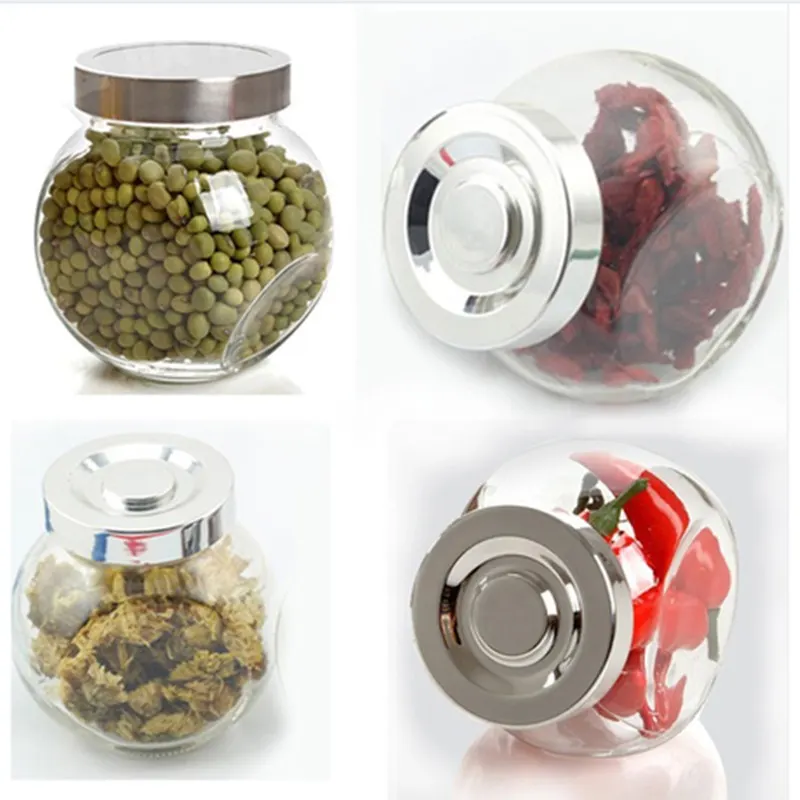
Dimensions to write into the drawing
- Mouth at the sealing land. A jar sold as 82 mm that actually measures 79.4 mm will be rejected by an automatic capper. Ask for ±0.5 mm on this dimension.
- Wall and base. A 500 ml jar typically has a 2.2 mm sidewall and a 3.0 mm base. At 2000 ml this rises to 2.8 mm and 4.0 mm so the jar passes a 1.2 m drop onto vinyl flooring.
- Proportion. Above 1000 ml, hold the height-to-diameter ratio below 1.9:1 so the jar stays upright under shelf vibration.
These figures decide whether a co-packer runs at 60 units per minute or keeps stopping to clear jams.
Lid options and how long each keeps cookies crisp
Humidity is what ruins a cookie. Left open at 22 °C and 55% relative humidity, plain shortbread goes soft in about 9 days. How far a closed jar extends that depends on the closure and on the fat content of the recipe.
| Closure | How it seals | Humidity hold | Line fit |
|---|---|---|---|
| Clamp lid | EVA or silicone gasket squeezed to 12–18% deflection by a zinc-alloy or 304-stainless hinge | <45% RH for 28–42 days | Applied by hand; semi-auto capping at 25–35 units per minute |
| Tinplate screw lid | 400 CT thread with a 1.2 mm EPE foam liner or PLA-coated paper liner | Close to the clamp lid in everyday use | Automatic capping at 60 units per minute |
| Wood or bamboo lid | 2.5 mm silicone ring in a 3.0 mm groove, compressed 0.5 mm | <50% RH for 21–28 days | Pressed on by hand |
Clamp lid
This is the tightest passive seal of the three. Laboratory helium leakage stays below 1×10⁻³ mbar·L/s, equivalent to less than 0.5% oxygen ingress per month for a 1000 ml jar at 25 °C. In accelerated testing the mechanism lasts 8,000 open-close cycles before gasket compression drops under the sealing threshold, which is roughly eight years for a jar opened twice a week.
Tinplate screw lid
Co-packers prefer this one because it runs on standard cappers. The lid is 0.23 mm electrolytic tinplate with clear or gold lacquer, and the PLA-coated paper liner supports a plastic-free claim. On 82 mm and 100 mm finishes the cap is torqued to 10–14 in-lb, where the tamper band breaks cleanly and the seal holds 30 kPa of internal pressure for 60 seconds with no weep. If you need one leak-test method across every lid in an assortment, see how we document it for airtight-lid glass jars.
Wood or bamboo lid
The wood does no sealing in a pressure sense; the ring does. We specify LFGB-grade, platinum-cured silicone with no peroxide residue, Shore A 45–55 with a durometer tolerance of ±3. The lid is beech or bamboo dried in a kiln to 8–10% moisture so it does not warp, then finished in a hardwax oil suitable for food contact. This is enough for most gift cookies, though not for long-hold bakery lines.
Induction liner for long shelf life
A cookie with a 6-month shelf life needs more than a lid. Put a PET/foil induction liner under a screw cap so oxygen and aroma cannot move until the first opening, and treat any wooden lid as a decorative second cap. We can arrange an induction trial on your own cookie with headspace oxygen reported after 30 days, which gives the claim something to stand on.
Glass composition and food-contact limits
Cookie jars are soda-lime glass, free of lead and cadmium, with roughly 73% SiO2, 14% Na2O and 9% CaO plus small amounts of alumina and magnesium oxide that improve resistance to thermal shock. Under USP classification this is Type III glass, appropriate for dry and low-moisture foods. Lead crystal and leaded enamel have no place in the food-contact zone.
Ask for results per production lot. The reference is FDA CPG 7117.06 / 7117.07, tested by ASTM C738 extraction in 4% acetic acid for 24 hours at 22 °C. The release limit we work to is extractable lead ≤ 0.5 ppm and extractable cadmium ≤ 0.5 ppm, in line with the FDA action level and the EU approach to glass in food contact. A California Prop 65 statement can be issued for West-Coast retailers.
Fired enamels, screen inks and decals have their own limits: lead under 0.06% (60 ppm) and cadmium under 0.1% (100 ppm) in the dry film, measured after firing at 600–650 °C. Decoration stays off the mouth roll and off the inside wall above the fill line. Templates for the FDA, LFGB and Prop 65 paperwork are gathered in our wide-mouth food jar section.
Soda-lime glass copes with a temperature difference of about 60 °C. A jar taken from a 4 °C cold store should not go straight onto a 90 °C dishwasher rack. Lids give out first: tinplate lacquer starts to dull after 50–80 dishwasher cycles, and wooden lids are hand-wash only.
Decoration methods and glass colours
The choice between the four methods comes down to run length, how much abrasion the jar will see and whether an exact Pantone match is required.
| Method | Best for | Limits to know |
|---|---|---|
| Embossing | A logo, wordmark or measuring scale on the base, shoulder or sidewall that must last the life of the jar | Depth of 0.3–0.6 mm on a 2.2 mm wall; deeper marks cloud a thin sidewall |
| Silk-screen | 1–4 colors in UV-cured or fired ceramic ink | Registration ±0.4 mm; detail finer than 0.3 mm should move to a decal or label |
| Fired decal | Photographic art, gradients, fine-line illustration | Waterslide or heat-release, fired at 580–620 °C, 120–175 line screen |
| Pressure-sensitive label | Promotions that change often | About 180 mm by 90 mm on a 500 ml jar, 240 mm by 110 mm on a 1000 ml jar |
Embossing is formed in the mould, so washing, stacking and store handling cannot remove it. A decal sits flush and resists chipping. Label artwork made for glass candy jars transfers easily, since candy and cookie jars use the same decoration fixtures.
Whichever route you take, approval runs in the same order: digital proof, a physical strike-off on the chosen glass, then signed colour approval before the run. Glass comes clear, amber, frosted or painted, with batch-to-batch colour held at delta-E ≤ 1.5. Lacquered tinplate lids are matched against an approved printed chip; gloss gold and black drift a little under warehouse UV, so a matte or cured finish is the safer choice.
Amber deserves a note for butter-rich recipes. It transmits only 10–30% of light in the 400–500 nm band, which slows fat oxidation. The colour is a mineral colourant in the melt, not a coating, so it neither wears nor leaches, and it is offered in a light honey tone and a deep whiskey tone.
What to verify before placing an order
Ten checks separate a dependable jar supplier from a risky one. They apply to any quotation you receive, ours included.
- Material certificate. A lead-free soda-lime formulation sheet and an ASTM C738 report for each lot showing lead and cadmium at ≤ 0.5 ppm. A single generic certificate is not enough.
- Mould ownership. Ownership or an exclusive licence for any embossed or custom-neck jar. With a shared mould, a competitor can buy the identical jar.
- First-article dimensions. A measurement report covering mouth diameter, thread pitch and base flatness before bulk production.
- Seal data. The leak-test method and the measured helium or pressure-decay figure.
- Decoration compliance. Ink lead and cadmium content, and confirmation that nothing is printed in the food-contact zone.
- Drop and thermal shock. The pass rate at 1.2 m and the ΔT rating for your size.
- Capacity. Volume at the fill line, measured with water.
- Traceability. Glass and ink lot samples retained for 24 months, so a shipment can be re-tested if a rule changes.
- Communication. Prompt, technical answers at the sample stage. A supplier that goes quiet over a strike-off will go quiet over a container.
- Logistics terms. An FOB quotation naming the port, the Incoterm and the exclusions, so destination charges do not come as a surprise.
The cost of one rejected shipment, counted in rework, air freight and a missed retail window, is far larger than any per-jar saving from a supplier that passes only some of these.
Frequently asked questions
What is the minimum order for a custom embossed cookie jar?
It is quoted per project. The mould and the production line it runs on set the figure, and decoration adds its own threshold.
Clamp or tinplate screw lid for the longest freshness?
The clamp lid is the stronger passive seal. The screw lid comes close in daily use and suits automated filling, so the decision usually rests on how the jar will be capped.
Are amber cookie jars compliant for the US and EU?
Yes. Amber is the same soda-lime glass with a mineral colourant, subject to the same extraction limits as clear. It also blocks 70–90% of 400–500 nm light.
Can the glass and the lid match a Pantone reference?
Amber, frosted and painted glass are held within delta-E ≤ 1.5 across batches. Lids are approved against a lacquer chip at strike-off.
What lead time and Incoterms apply to a 40 ft HQ shipment to the US?
Both are confirmed per project after the mould, decoration and line schedule are settled. Ask for the quotation to state the port and the Incoterm explicitly.
Wooden lid or clamp lid for a gift jar?
Choose wood or bamboo for a presentation jar that is opened now and then. Choose the clamp when freshness is the selling point: it holds for roughly 10–15 days longer.
How much more does a decorated jar cost than a plain one?
Pricing is set per project and depends on the mould, the decoration method and number of colours, the quantity and the freight terms.