Bulk sake glass comes in three Japanese standard volumes: the 300 ml ichigobin, the 720 ml yongobin and the 1.8 L issho-bin. For most export programmes the workable starting point is a stock 720 ml bottle with a 28 mm ROPP screw finish, in amber or deep green if the sake is an aromatic ginjo and in flint only when the liquid is robust or the bottle sits inside a carton. The stock moulds exist in exactly these sizes, so the real decisions are neck finish, glass colour, closure and decoration.
The three standard sizes and their dimensions
Each volume belongs to a way of drinking, and the glass geometry follows from it. One go is 180 ml, so the yongobin is the "four-go bottle"; one sho is 1.8 L, which gives the issho-bin its name. A custom mould can depart from these volumes, but stock tooling does not.
| Format | Height | Body diameter | Empty weight | Usual neck finish | Where it sells |
|---|---|---|---|---|---|
| 300 ml ichigobin | 185–210 mm | 58–64 mm | 220–300 g | 28 mm ROPP or 18.5 mm T-stopper | Izakaya pours, hotel minibars, airline and gift editions |
| 720 ml yongobin | 295–320 mm | 78–86 mm | 420–560 g | 24–30 mm neck, most often 28 mm ROPP | Retail; the highest-volume size in the category |
| 1.8 L issho-bin | 360–400 mm | 105–120 mm | 900–1,250 g | 30 mm ROPP or 31.5 mm cork | Restaurants and households, poured over several days |
The 720 ml weight range reflects a choice of sidewall: a lightweight 2.6 mm wall at the bottom of the range, a heavy 3.4 mm wall at the top. Its broad, gently sloping shoulder does practical work. It gives a rotary labeller running 6,000–9,000 bottles per hour a stable surface, and it keeps the centre of mass low so a filled bottle does not tip on a chilled shelf.
The issho-bin weighs more than 2.7 kg when full, so its base is reinforced with a punt 12–18 mm deep and a base thickness of 4.0–5.5 mm. That stops the base warping in the annealing lehr and lets pallets stack to 1.8–2.2 m. Its wider neck suits a bottle that is opened and poured many times; a narrow one would slow service.
For a first export run through hospitality accounts, the 300 ml size is a sensible pilot, because it tests decoration and closure with less capital at risk. Below it, sampling and travel-retail sizes of 50–200 ml are covered by miniature liquor bottles, which sit well beside a 300 ml flagship.
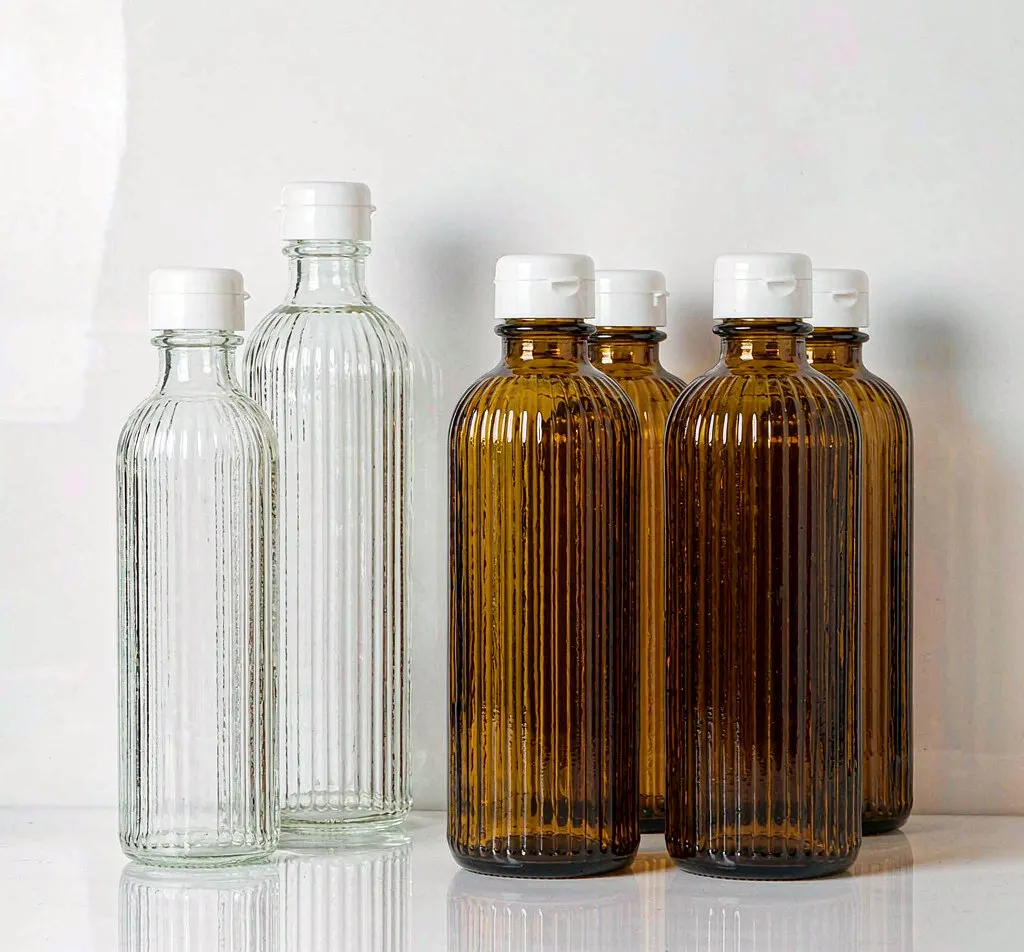
Neck width and shoulder angle
The ratio of neck to shoulder matters more than any other dimension. A neck under 26 mm limits oxygen exchange and holds aroma, but unfiltered nigori, with its rice sediment, is hard to fill through it. A neck of 28–31 mm fills and pours easily while raising total package oxygen and exposing more of the shoulder to light.
The compromise we normally specify for filtered sake is a 28 mm neck with a 22-degree shoulder. For nigori the neck opens to 31.5 mm and the shoulder steepens to 28 degrees, so that sediment does not bridge at the transfer point during filling.
Four questions to settle before approving a shape
Sake is not a Western-style spirit. Most junmai and honjozo sit at 13–16% ABV and some genshu reach 20–22%, yet the esters that give a ginjo its banana, melon and apple notes are more fragile than the aromas of nearly any grape wine. Ultraviolet light destroys them within days and oxygen strips them. A catalogue bottle designed around vodka or whiskey brings a neck, wall profile and base that ignore all of this. We ask every new project to answer four questions first:
- Fill temperature. Does the headspace need to allow for 4–6% thermal expansion?
- Carbonation. A sparkling sake needs a pressure-rated neck and a closure rated to at least 6 bar.
- Oxygen. What is the highest acceptable total package oxygen (TPO) at the filler? For a high-grade ginjo the design target is under 0.5 ppm.
- Light. Which UV band must the glass block across an expected retail life of 90–180 days?
When these go unanswered, the result tends to be skunked flavour and a short shelf life that the brewery cannot trace. The same discipline applies to the other spirit formats we specify, including custom vodka bottles, wholesale tequila glass and custom whiskey bottles, although the answers differ for each liquid.
Choosing between flint, amber and green glass
Colour is decided by one physical fact. The compounds behind ginjo aroma, chiefly ethyl caproate and isoamyl acetate, start to break down under light of wavelengths below roughly 500 nm, and the band between 350 and 450 nm does the most harm. In clear glass under fluorescent shop lighting, a delicate ginjo can lose its nose in 7–14 days.
| Glass | Light behaviour | What the shopper sees | Use it for |
|---|---|---|---|
| Flint (high-clarity clear) | 90–92% visible-light transmission; blocks essentially nothing below 400 nm | The liquid itself, from near-water clear to pale straw | Robust junmai, honjozo and some aged koshu in a controlled channel, or any grade packed in a carton |
| Amber | Transmits less than 5% of light below 450 nm | Nothing of the liquid | Daiginjo and ginjo with a fragile nose and unknown retail conditions |
| Deep emerald green | Blocks typically 60–80% below 450 nm, depending on cobalt and chromium dosing | A light-coloured liquid, dimly | Mid-tier sake that has to survive open shelving |
Flint reaches that transmission with a soda-lime composition in which iron oxide is kept below 0.02%, so the glass does not push a pale junmai towards green. Because it offers no UV defence, it needs an opaque secondary pack, a carton or a dark shelf.
Amber gives a ginjo 6–12 months of protected shelf life under ordinary store lighting. The price is visual: craft and value brands accept a hidden liquid, while a junmai sold on its colour cannot.
Green is the pragmatic middle, and many consumers read it as traditional because of its association with European beer and wine. One warning: pale or "dead leaf" green protects almost nothing and should not be used for any aromatic grade.
Closures and the neck finish each one needs
Sake closures fail in the field more often than any other part of the pack, because the brief pulls two ways. The seal has to keep oxygen out for months, yet it should open easily in a casual dining setting. Three families cover the category.
| Closure | Typical finish | Oxygen transmission | Best fit |
|---|---|---|---|
| ROPP aluminium screw cap with EPE or coextruded PET/foil liner | 28 mm or 30 mm | Below 0.02 cc/day at 23 °C | Filtered sake in 720 ml and 1.8 L; around 90% of export sake |
| Natural cork | 18.5 mm or 19 mm straight cork | 0.5–2.0 cc/day | Limited daiginjo drunk within 3–6 months of bottling |
| Micro-agglomerated cork with silicone-top disc | As natural cork | Roughly 0.1–0.3 cc/day | The cork look with better consistency |
| T-stopper, often with a ceramic or wood top | 18.5–21 mm | Perhaps 0.5–1.0 cc/day | 300 ml gift formats opened within weeks |
ROPP screw caps
A roll-on pilfer-proof cap is formed onto the glass thread at the bottling line, so fit does not vary between lots the way cork expansion does. That matters to importers using a contract bottler. The seal supports a 12-month shelf life and stays tight in cold-chain storage down to 2 °C, where some plastic-threaded closures relax. The condition is on the glass: the finish must hold ±0.3 mm on the T-radius, otherwise the tamper-evidence band tears unevenly.
Corks
Cork suits brands that want a wine-style opening, but a corked sake left longer than its short window will oxidise. The neck has to be reamed to an inner diameter of 18.5 +0.4/−0 mm, and the cork should seat 3–5 mm below the lip. If either is off, the cork pops when the cold chain contracts the bottle, or it sinks. Sake corks are also shorter, and the finish tolerance tighter, than those used for wine bottles and their corks, so a wine cork should not be assumed to fit.
T-stoppers
A T-stopper is a ground-glass or silicone-tipped plug held by friction and gravity. Its appeal is that it looks and feels handmade. It is not pressure-rated and must never go on sparkling sake, and where stock will sit in a warehouse above 25 °C we add a secondary shrink band.
We can also arrange matching liner materials and pre-torqued samples, so that the contract filler can validate its capping head ahead of a full run.
Tolerances to write into the specification
Consistency in sake glass is made at the hot end of the line and only confirmed by inspection afterwards. These are the points we check when matching a project to a plant, and the figures a buyer can ask to see.
- Composition. Fe₂O₃ under 0.02% for clear grades. Amber and green are coloured with controlled iron, sulfur and chromium to land within ±3 nm of the specified spectral band. Each furnace batch gets a spectro check and a gob-weight check to ±1.5 g, since an error there becomes uneven wall thickness later.
- Wall thickness. Some namazake is pasteurised at up to 62 °C and then held at 2 °C, a 60 °C swing that cracks uneven walls. Sidewalls run 2.6–3.4 mm by format with no more than ±0.25 mm variation around the circumference, measured by in-line laser gauging at 12 points per bottle. The base is the thickest part at 3.5–5.5 mm, to carry a 1.8 m pallet column.
- Punt and base. On an issho-bin the 12–18 mm punt is structural: it raises base rigidity by roughly 18–25% and stops the base bowing during the 90-minute lehr anneal. A 720 ml bottle takes a shallow 6–10 mm punt or a flat reinforced base, and a flat base is fine at 300 ml. The punt must be centred to ±1.0 mm, or the bottle rocks on the labelling turntable and the front label lands 1–3 mm out of register.
- Surface defects. Stones (unmelted sand grains), blisters (gas inclusions) and cord (a wavy distortion from uneven glass flow) spoil the look of clear sake glass. Controls to ask about are a forehearth gradient of ±2 °C, moulds finished to Ra 0.4 µm, and camera inspection at 6 stations for birdswing checks, lip tears and finish dimensions, rejecting any defect over 0.5 mm on the visible shoulder or body.
Before committing, ask for a dimensional report measured on a first-article sample of 30 bottles from the pilot run, not taken from the drawing. It should show height to ±0.5 mm, body diameter to ±0.4 mm, finish ID/OD to ±0.3 mm and weight to ±3 g.
Frosting, screen print and foil
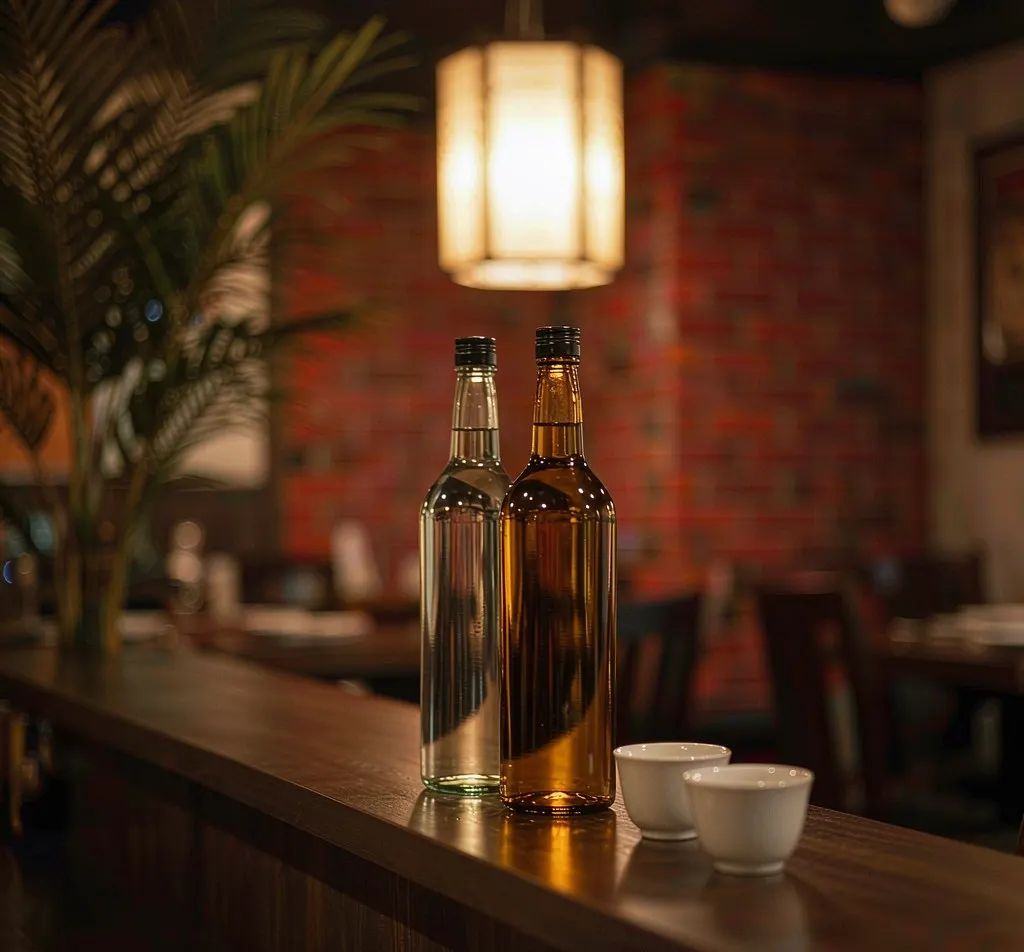
Frosting produces the matte, icy surface that North American gift buyers associate with sake. It can be done by hydrofluoric acid etching, but the more common food-contact route is a sprayed ceramic-frit satin coat fired at 580–620 °C. Frosting only the shoulder, or a single band, costs less than a full frost and is the usual choice on a 720 ml bottle, where the clear lower body shows the liquid. Be aware that a light full frost also hides minor cord, and some value brands specify it for that reason.
Screen printing carries the minimalist Japanese look: one kanji, a fine rule, a brand mark, printed straight onto the glass in 1–3 colours with UV-cured or thermally fired ink. A low-build ink of 8–12 µm keeps the surface feeling like smooth glass.
Foil stamping and hot-transfer add the gold and silver expected on daiginjo gift and festival editions. Foil does not last through repeated dishwasher cycles. Japanese households often reuse 720 ml bottles as water carafes, so foil belongs only on products unlikely to be reused that way.
Whatever the combination, approve one physical bottle carrying the full frost, print and foil stack, viewed under the actual retail lighting, before the production run is released. Brands with modest volumes usually do better with stock tooling plus custom decoration than with a custom mould; frost and print generally differentiate the bottle enough.
Pallet counts and container loads
Three things shape the commercial side of a sake bottle programme: order quantity, mould cost and pallet density. The first two are quoted per project and depend on the mould (a single-cavity blank-and-blow mould for a 720 ml bottle is the simplest case, a multi-cavity, dual-finish, embossed issho-bin mould the most involved), the decoration, the quantity and the freight terms. Pallet density can be planned in advance.
| Format | Units per pallet |
|---|---|
| 300 ml ichigobin | 1,800–2,400 |
| 720 ml yongobin | 1,120–1,440, in 7–9 layers with dividers |
| 1.8 L issho-bin | 480–620 |
The pallets are a 1,200 × 800 mm euro pallet or a 1,140 × 1,140 mm export pallet, stacked no higher than 1.85 m. A 20-foot container takes 10–11 pallets, roughly 18,000–22,000 units of mixed 720 ml and 300 ml. A 40-foot high-cube takes 22–24 pallets and 38,000–46,000 units.
Packing uses new corrugated dividers rated to a 350 kg-f compressive load, with each pallet shrink-wrapped in 120-gauge film and fitted with corner board. Export paperwork includes fumigated pallet certification, MSDS where applicable and the glass-specific packing declaration most carriers ask for.
Because sake and shochu largely share the 720 ml and 1.8 L tooling, mixed loads of the two are economical. Buyers filling a container with other glass can also look at the wide-mouth food jar range for non-alcohol lines that travel alongside.
Frequently asked questions
How does a yongobin differ from an issho-bin?
The yongobin is the 720 ml retail bottle for filtered sake: about 300 mm tall, a 28 mm neck, close to 480 g empty. The issho-bin is the 1.8 L sharing and foodservice bottle, roughly 380 mm tall with a 30–31.5 mm neck. The larger bottle needs a deeper punt and a thicker base to stack safely, which makes its tooling and unit cost higher.
Will the same bottles work for shochu and other Asian spirits?
Yes. Shochu, soju and many infusions use the same Japanese 720 ml and 1.8 L shapes. Only closure and colour change. Shochu at 25–35% ABV wants the same oxygen barrier but is less sensitive to light, so amber is rarely needed, and a citrus shochu often goes into flint to show its colour.
Which colour protects a delicate ginjo best?
Amber, which blocks more than 95% of the 350–450 nm band. If the brand insists on showing the liquid, use flint with a printed carton or a dark shelf.
Cork or screw cap for a top-grade sake?
For export and cold chain, the 28 mm ROPP cap: its oxygen transmission is a small fraction of a natural cork's, and it holds across 2–62 °C. Choose cork only when the uncorking is part of the brand story and the distribution window is short.
What are the MOQ and mould cost for a custom sake bottle?
Both are quoted per project. They depend on whether you use stock tooling or a new mould, the number of cavities, embossing, decoration and the quantity ordered.
Can these bottles take sparkling or nigori sake?
Yes, with changes to the specification. Sparkling sake needs a pressure-rated neck and closure; nigori needs the wider neck and steeper shoulder described above.
How long do production and shipping take?
Timing is confirmed per project once the mould, decoration and shipping route are fixed.